

On this page
A reading of 120/80 mmHg, the typical systolic and diastolic values quoted in OpenStax College Physics, describes the pressure at one height: your heart. Move the measuring point up or down and the number changes. The change comes from the Class 11 fluids rule p = p₀ + ρgh.
Why is blood pressure higher in your feet than your head?
The blood in your arteries is one connected column of fluid. Each layer has to hold up the weight of the blood above it, so pressure grows with depth below the heart and shrinks with height above it.
Whole blood has a density of about 1,060 kg/m³, according to values collected in The Physics Factbook.
One millimetre of mercury (1 mmHg) is about 133 Pa, the conversion used in OpenStax College Physics.
Put those together and ρg = 1,060 × 9.8 ≈ 10,400 Pa per metre. That is about 78 mmHg per metre, or 0.78 mmHg for every centimetre of height. The same OpenStax chapter works the case of a person whose feet are 1.4 m below the heart, using a density of 1,050 kg/m³, and finds about 108 mmHg of extra pressure in the feet, for a static column of blood.
Worked example: head, heart and feet in a standing teenager
Take a person 1.70 m tall. As rough assumptions, put the heart 1.25 m above the soles and the top of the brain 0.40 m above the heart. Use the Physics Factbook blood density of 1,060 kg/m³.
Pressure change per metre: Δp = ρgΔh = 1,060 × 9.8 × 1 ≈ 10,390 Pa, and 10,390 ÷ 133.3 ≈ 77.9 mmHg.
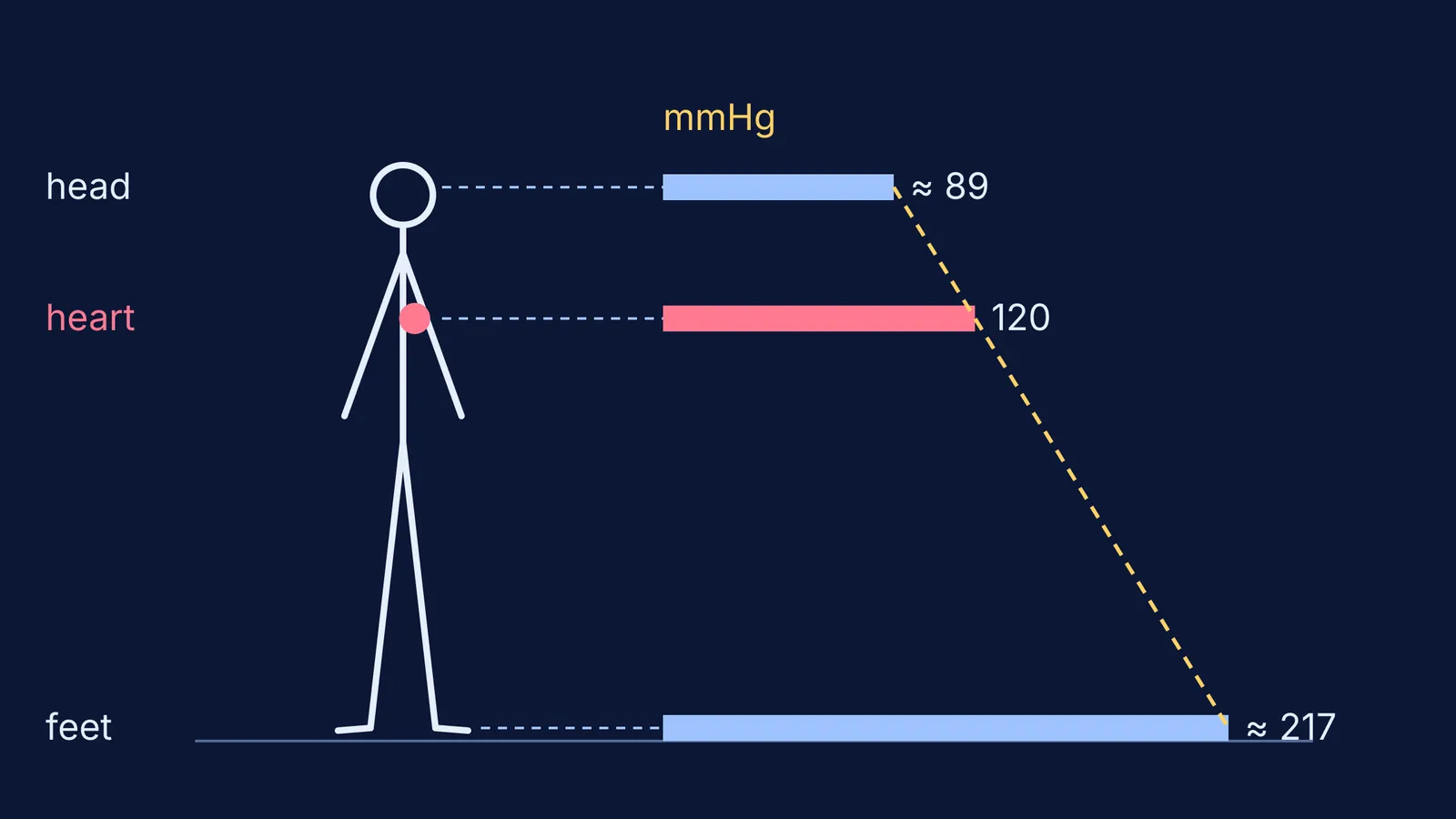
Feet, 1.25 m below the heart: 1.25 × 77.9 ≈ +97 mmHg. A systolic of 120 at the heart becomes about 217 at the feet; a diastolic of 80 becomes about 177.
Head, 0.40 m above the heart: 0.40 × 77.9 ≈ −31 mmHg. Systolic 120 drops to about 89; diastolic 80 drops to about 49.
Compare: the systolic pressure at the feet is about 2.4 times the pressure at the head, from gravity alone.
Now lie down. Head, heart and feet sit at almost the same height, so the ρgh terms nearly vanish and the three pressures come close together.
This is a simplified model: it treats the blood as a still column and ignores the pressure lost to flow, which OpenStax notes takes pressure from about 120 mmHg as blood leaves the heart to almost 0 in the small veins.
Why is blood pressure measured at heart level?
Because the heart is the reference point everyone agrees on. The American Heart Association's recommendations for blood pressure measurement (Pickering and colleagues, 2005) say the middle of the cuff should be at the level of the right atrium, the midpoint of the breastbone. If the upper arm is below that level, readings come out too high; above it, too low. The statement says the difference may be about 2 mmHg for every inch above or below heart level.
Try it on a common mistake. Suppose your arm hangs by your side while sitting and the cuff ends up 13 cm below your heart. That adds roughly 13 × 0.78 ≈ 10 mmHg to the reading, with nothing about your health having changed.
If your family uses a home cuff, the same physics gives a checklist:
Rest your arm on a table so it is supported.
Line up the middle of the cuff with the middle of your chest.
Do not let the arm hang down or hold it up in the air.
Use the same position every time so readings can be compared.
What a reading means for your health is a question for a doctor, not for a physics formula.
How do you solve blood pressure questions in physics exams?
These questions turn up in Class 11 fluids and in NEET and JEE practice. Use three steps:
Choose the heart as the reference level and write Δh with a sign: positive below, negative above.
Compute ρgΔh in pascals, with Δh in metres and the blood density given in the question.
Divide by about 133 to convert to mmHg, then add to the heart value.
The usual slips: water's density instead of blood's, Δh left in centimetres, and the wrong sign for the head. For more practice, try these hydrostatic pressure and depth problems, see how a giraffe's heart pumps blood up a long neck, and revise what the two numbers mean in systolic and diastolic blood pressure.
If you get stuck on a step, the Fermi Problem Library has worked problems with a step-by-step solver that explains the reasoning rather than printing an answer. If the gap is the idea itself, the Fermi Concept Library gives each concept in physics and biology its own lesson.
Next time someone straps a cuff on your arm, check its height first. You now know what each centimetre is worth.


