

On this page
Watch a snake for a while and you will notice that it stares without ever blinking. A snake has no movable eyelids, so blinking is impossible. Here is what covers its eyes instead, why they turn milky blue before a moult, and how this helps you tell a snake from a lizard without legs.
Why do snakes not blink their eyes?
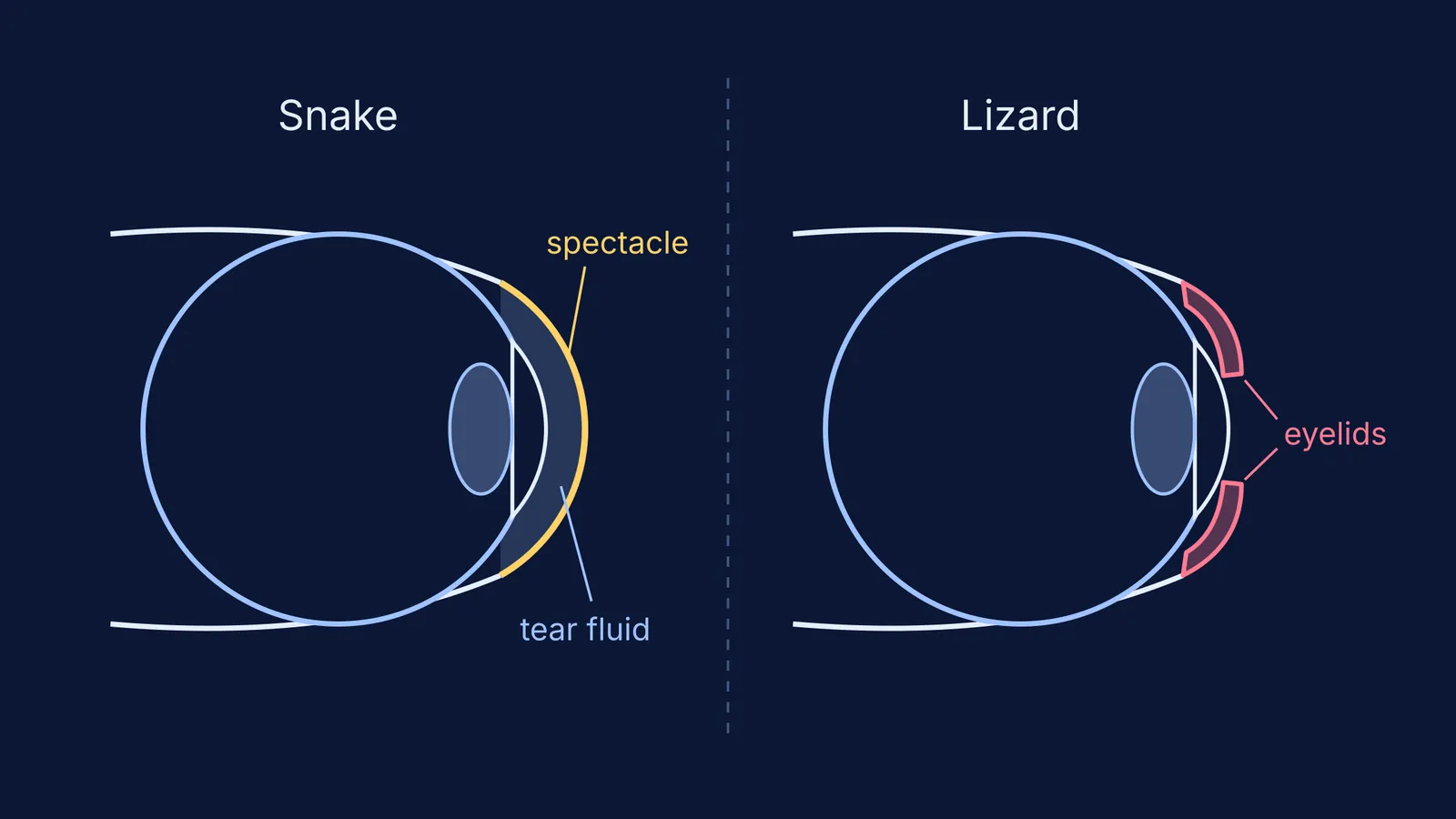
In almost all snakes, each eye sits behind a transparent, fixed scale called the spectacle, also known as the brille. A 2023 review in the journal Animals by Tom Hellebuyck and Ferran Solanes Vilanova explains that the spectacle forms when the tissues that would have become the eyelids fuse over the pupil in the embryo. The fused lids become transparent and lose all their glands and muscles, so nothing is left that can close the eye. (Blind snakes have a clear eye scale instead.)
Because this clear window is fixed, a snake cannot close its eyes, even to sleep.
Three facts from the same review make the spectacle easier to picture:
In snakes, the spectacle is 74 to 244 micrometres thick, depending on the species and its habitat.
Beneath it lies the subspectacular space, filled with a fluid that works like our tear film and lets the eyeball rotate freely.
That fluid drains through a duct that opens into the mouth.
Does the snake's eye scale have blood vessels?
Yes. In a 2013 study in the Journal of Experimental Biology, Kevin van Doorn and Jacob Sivak watched blood flow in the spectacles of coachwhip snakes. At rest, the vessels constricted and dilated in a regular cycle. When the snake was threatened, they stayed constricted for longer, up to several minutes, reducing blood flow across the eye and so limiting the blur the vessels would otherwise cause. During shedding, the vessels stayed dilated, with strong, continuous flow.
Why do a snake's eyes go cloudy before it sheds?
A snake grows a new outer skin under the old one, then sheds the old layer in one piece. This is ecdysis, covered in our explainer on why snakes and insects shed their skin. The spectacle is part of the skin, so it is shed and replaced too.
During this renewal phase, the Hellebuyck review notes, the skin looks dull or bluish, and the effect is strongest in the spectacle, where old and new skin layers build up and turn it opaque. Shortly before the shed, the eyes clear again as the layer between old and new skin breaks down. Then the old skin peels away, eye caps included.
An eye cap that stays stuck after shedding, called a retained spectacle, is a commonly seen problem in snakes. The review notes that peeling it back forcibly can damage the eye beneath.
How can you tell a snake from a legless lizard?
Several lizards have lost their legs, including glass lizards and Australia's pygopods. The Wisconsin Herpetological Association lists these differences:
Eyelids: most legless lizards have a visible eyelid over each eye; snakes have a spectacle.
Ear openings: most legless lizards have one on each side of the head; snakes have none. Read how snakes hear without outer ears to see how they manage.
Tail length: a snake's tail is usually a third of its total length or less; a legless lizard's is often half or more.
Tail dropping: legless lizards can drop their tails to escape, which snakes are not known to do.
Tongue: snakes have longer, more forked tongues; legless lizards have shorter, thicker ones.
There is one trap. Most geckos, including the legless pygopods, also have spectacles instead of movable eyelids, according to the 2023 review. So no eyelids alone does not prove you are looking at a snake. Australia has about 45 legless lizard species, and naturalist Peter Rowland told ABC News that lizards have external ear openings that venomous snakes lack, and a fleshy tongue they can use to lick their face and clear their eyes. Always check the ears too.
Never handle a wild animal to check any of this. Look from a safe distance, or use a photo.
How do you write this up in a biology answer?
Use this four-step frame for exam questions on reptiles:
Name the structure: the spectacle, or brille.
Give its origin: the tissues that form the eyelids fused over the eye in the embryo and became transparent.
Give its function: it protects the eye and holds a tear-like fluid; because it cannot move, the snake cannot blink.
Give the contrast: most legless lizards have eyelids and ear openings, snakes have neither, and most geckos, including pygopods, are the exception on eyelids.
Our post on why humans blink so often explains the job a blink does, which a snake's spectacle does permanently.
If eye structure and adaptation are weak spots, the Fermi Concept Library covers every concept in biology, each with its own lesson and its place in the map, so you can see how eye structure links to the ideas around it.


