

On this page
Look at a cobra or a rat snake from the side and you will find no ear hole, no flap and no eardrum. Yet snakes are not deaf. They hear mostly through bone, a neat lesson in how sound travels.
Do snakes have ears at all?
Yes, on the inside. Snakes lack both an outer ear and an eardrum-type middle ear, according to a 2012 study in the Journal of Experimental Biology. What they keep is an inner ear with a working cochlea, as the Technical University of Munich described it in 2008.
The middle ear is reduced to a single bone, the columella. With no eardrum to attach to, the columella connects to the quadrate bone of the jaw (overview of the columella)). In mammals the same ancestral bone became the stapes; our post on the malleus, incus and stapes shows the human version.
How do snakes hear through their jaw?
When a snake rests its head on the ground, an incoming vibration sets both sides of the lower jaw moving, and a chain of bones attached to the jaw carries that motion into the inner ear, as the 2008 study's announcement explains.
Two details from that report matter:
The left and right halves of the lower jaw are joined only by flexible ligaments, so each half moves on its own. This is the same looseness that lets a snake stretch its mouth wide around prey.
Surface waves in sand travel at about 50 metres per second, and the waves can be as small as a few thousandths of a millimetre.
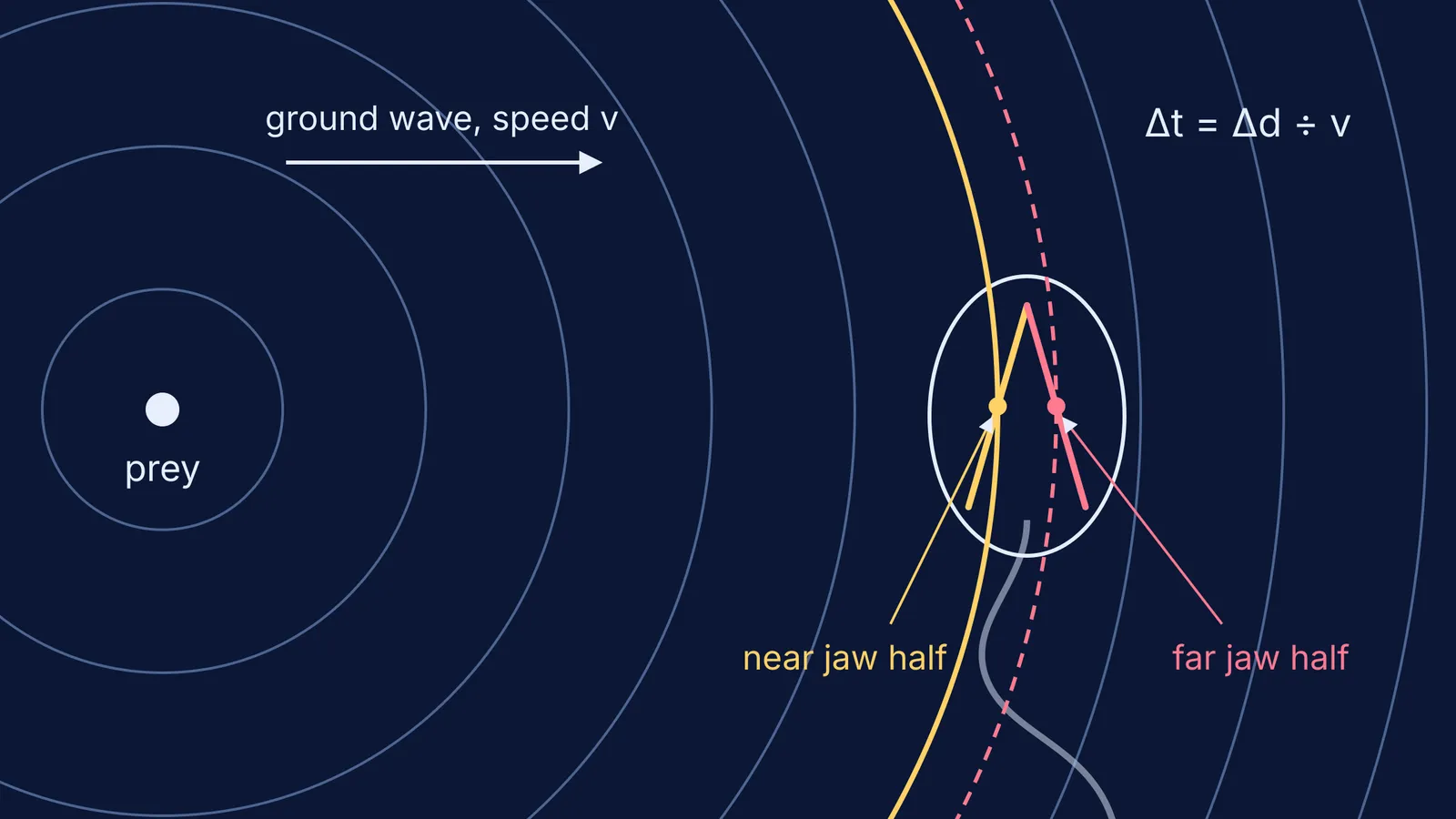
Paul Friedel, Bruce Young and Leo van Hemmen modelled the jaw halves as bodies floating on sand and calculated that the snake ear is sensitive enough to locate prey from the difference in arrival time at the two sides (Physical Review Letters, 2008). These sand waves are slower than sound in air, because loose sand is soft; for how a material sets the speed of sound, see our explainer on the speed of sound in solids, liquids and gases.
Can snakes hear airborne sound, like talking or music?
A little, and mostly low notes. Christian Bech Christensen and colleagues measured brainstem responses in 11 royal pythons and found the greatest sensitivity at 80 to 160 Hz, for both vibration and airborne sound (Journal of Experimental Biology, 2012). Threshold-level airborne sound generally shook the pythons' heads at least as much as threshold-level vibration did, so the team concluded that the snakes' response to airborne sound can be explained by sound-induced head vibration.
An earlier study by Peter Hartline found the snake auditory system responding over roughly 150 to 600 Hz and suggested the lung helps pick up sound (Journal of Experimental Biology, 1971).
Behaviour is mixed too. In 304 trials with 19 snakes from five genera, Christina Zdenek and colleagues played sounds in three bands between 0 and 450 Hz; responses depended strongly on the kind of snake, and death adders, taipans and brown snakes were more likely to move away (PLOS ONE, 2023). Only the lowest band, 0 to 150 Hz, made the floor vibrate measurably.
Worked example: how can a snake tell which side a mouse is on?
Try the physics yourself.
Wave speed in sand: v is about 50 m/s (TUM report, 2008).
Suppose the near and far jaw halves sit 1 cm apart along the direction the wave travels. This is an assumed figure for the exercise, not a measurement, so Δd = 0.01 m.
Delay between the two sides: Δt = Δd ÷ v = 0.01 ÷ 50 = 0.0002 s, or 0.2 milliseconds.
Wavelength of a 100 Hz vibration, inside the pythons' most sensitive range of 80 to 160 Hz: λ = v ÷ f = 50 ÷ 100 = 0.5 m.
The wavelength is 50 times the jaw spacing, so both jaw halves move almost in step. The snake must compare tiny timing differences between them, the same trick your two ears use for low sounds in air. The diagram at the top shows this: circular wavefronts from the prey reach the near jaw half before the far one. For the human version, read how two ears find the direction of a sound.
Spreading waves are easier to grasp when you watch them move. The Fermi Simulation Lab has interactive simulations for ideas that are easier to see than to read.
What should you remember for your sound chapter?
Sound is a mechanical wave; it travels through solids and the ground as well as through air.
An outer and middle ear match airborne pressure waves to the fluid of the inner ear. Snakes lost both, so they hear air poorly.
The cochlea turns vibration into nerve signals in snakes and humans alike.
v = fλ works for ground waves just as it does in air.
Direction comes from comparing arrival times at two receivers.
If one link in that chain still feels shaky, the Fermi Concept Library gives every concept in physics and biology its own lesson.


