

On this page
When a mosquito buzzes near your face, you instinctively swat at the correct side without even opening your eyes. But how do we know which direction a sound comes from?
Your ears are positioned on opposite sides of your head for a crucial evolutionary reason: stereo hearing. When a sound wave travels through the air, it must cover a slightly different distance to reach each ear. The human brain acts as an extraordinarily precise computer, calculating the origin of the sound based on two primary cues. In 1907, the physicist Lord Rayleigh formalised this biological mechanism as the Duplex Theory of sound localisation (Wikipedia). Rayleigh famously used tuning forks and singing flames to prove that humans switch between different acoustic cues depending on the pitch of the note.
What is the Interaural Time Difference (ITD)?
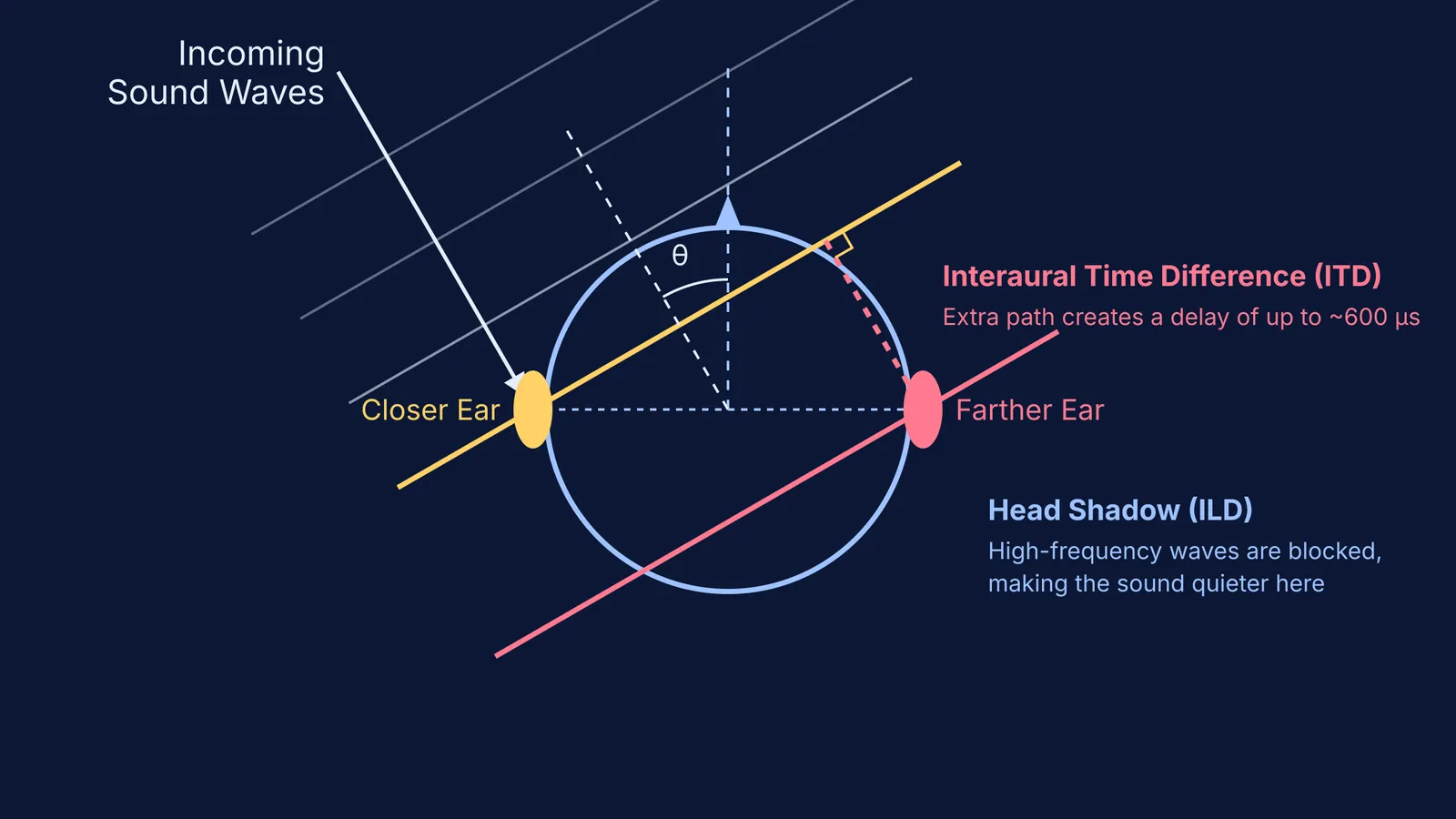
Because the speed of sound is relatively slow—roughly 343 metres per second in air (Wikipedia)—a sound originating from your left will arrive at your left ear slightly before it reaches your right. This arrival delay is called the Interaural Time Difference.
For an average adult head width of 21.5 cm, the maximum possible delay (when a sound is directly to one side) is about 626 microseconds (Wikipedia). Although this fraction of a millisecond seems vanishingly small, the human auditory system is so sensitive that it can discern timing differences down to 10 microseconds (Wikipedia). This precise timing analysis is the brain's primary tool for locating low-frequency sounds (below 2,000 Hz) (PMC).
Why do high and low pitches behave differently?
Timing alone is not enough to build a complete acoustic map. Sound waves behave differently depending on their frequency and wavelength. For low-frequency sounds, the wavelength is much larger than the human head. These long waves easily bend, or diffract, around the head, meaning the volume remains nearly identical in both ears. In these cases, the brain relies almost entirely on the arrival delay.
However, if you listen to a high-pitched whistle, the physics changes entirely. High-frequency sounds have short wavelengths that are smaller than the width of your head. Because they cannot efficiently bend around the obstacle, they bounce off, creating an "acoustic shadow" on the far side of your skull. This shadow makes the sound significantly quieter in the farther ear. This drop in volume is called the Interaural Level Difference (ILD) (PMC).
According to modern binaural signal processing models, ILD becomes a significant cue for high-frequency sounds (above 1,000 Hz) (PMC). The brain measures the intensity contrast between the left and right auditory nerves. This split in how frequencies are handled is why Displacement and pressure waves in sound interact with solid obstacles differently depending on their pitch.
How does the brain process both signals?
The nervous system routes these timing and loudness signals straight to the brainstem. In a region called the superior olivary complex, specialised neurons act as "coincidence detectors". They are wired in such a way that they only fire when they receive perfectly timed electrical impulses from both the left and right ears. By comparing which specific neurons are firing the fastest, the brain instantly maps the sound's location in three-dimensional space.
This biological circuitry is incredibly robust, but exploring these wave mechanics interactively can deepen your intuition; you can model wave interference and diffraction directly in the Fermi Simulation Lab.
Furthermore, replacing damaged biological detectors with electronic arrays was the core challenge for medical pioneers like Graeme Clark and the multichannel cochlear implant.
How can you test your sound localisation?
You can test your brain's reliance on these two binaural cues with a simple practical exercise. This is an excellent experiment for students preparing for physics or biology exams, as it demonstrates wave mechanics and neurobiology in real time:
Have a friend sit in a chair with their eyes closed.
Snap your fingers directly to their left or right. They will instantly point to the correct side, relying on the 626-microsecond Interaural Time Difference (Wikipedia).
Now, snap your fingers directly in front of their nose, and then directly behind the back of their head.
Watch them guess randomly. Because the sound reaches both ears at the exact same time and with the same loudness, the brain's primary ITD and ILD cues fail.
To fix this, allow the person to tilt or rotate their head slightly while you snap. The moment their ears move out of perfect symmetry, the brain recalculates the new time delays and instantly locates the sound.


