On this page
Sound waves arrive at your eardrum as weak vibrations in the air. By the time those vibrations reach the fluid-filled inner ear, their pressure has been multiplied by more than 20 times. This mechanical transformation is the work of the ear ossicles, a chain of tiny bones that could easily fit on the face of a coin.
What are the ear ossicles?
The ear ossicles—the malleus, incus, and stapes—are the three smallest bones in the human body (George et al., 2024). They are housed in the air-filled cavity of the middle ear.
These bones are named after the Latin words for their shapes: the hammer (malleus), the anvil (incus), and the stirrup (stapes). They form a continuous mechanical chain that connects the outer ear to the inner ear.
What is the order of the ossicles?
The ossicles are arranged in a specific sequence to pass vibrations inward:
Malleus: The first bone in the chain. Its long handle is firmly embedded in the tympanic membrane (eardrum), meaning any movement of the eardrum directly moves the malleus.
Incus: The middle bone acts as a bridge. Its heavier body articulates with the head of the malleus in a specialized joint, and its long downward process connects to the stapes.
Stapes: The final and smallest bone, shaped exactly like a rider's stirrup. Its flat base, called the footplate, fits precisely into the oval window. This window acts as the physical gateway to the fluid-filled cochlea.
What is the function of the ear ossicles?
The primary function of the ear ossicles is impedance matching. Sound waves travel easily through the low-impedance air of your ear canal, but the inner ear is filled with a watery fluid, which has a much higher impedance.
If sound waves hit the oval window directly from the air, about 99.9% of the acoustic energy would simply reflect backwards (George et al., 2024). The ossicles solve this by acting as a mechanical transformer, ensuring vibrations are efficiently passed from the air to the cochlear fluid. This physiological adaptation is as crucial for human survival as the mechanism of inspiration and expiration is for breathing.
How do the ossicles amplify sound?
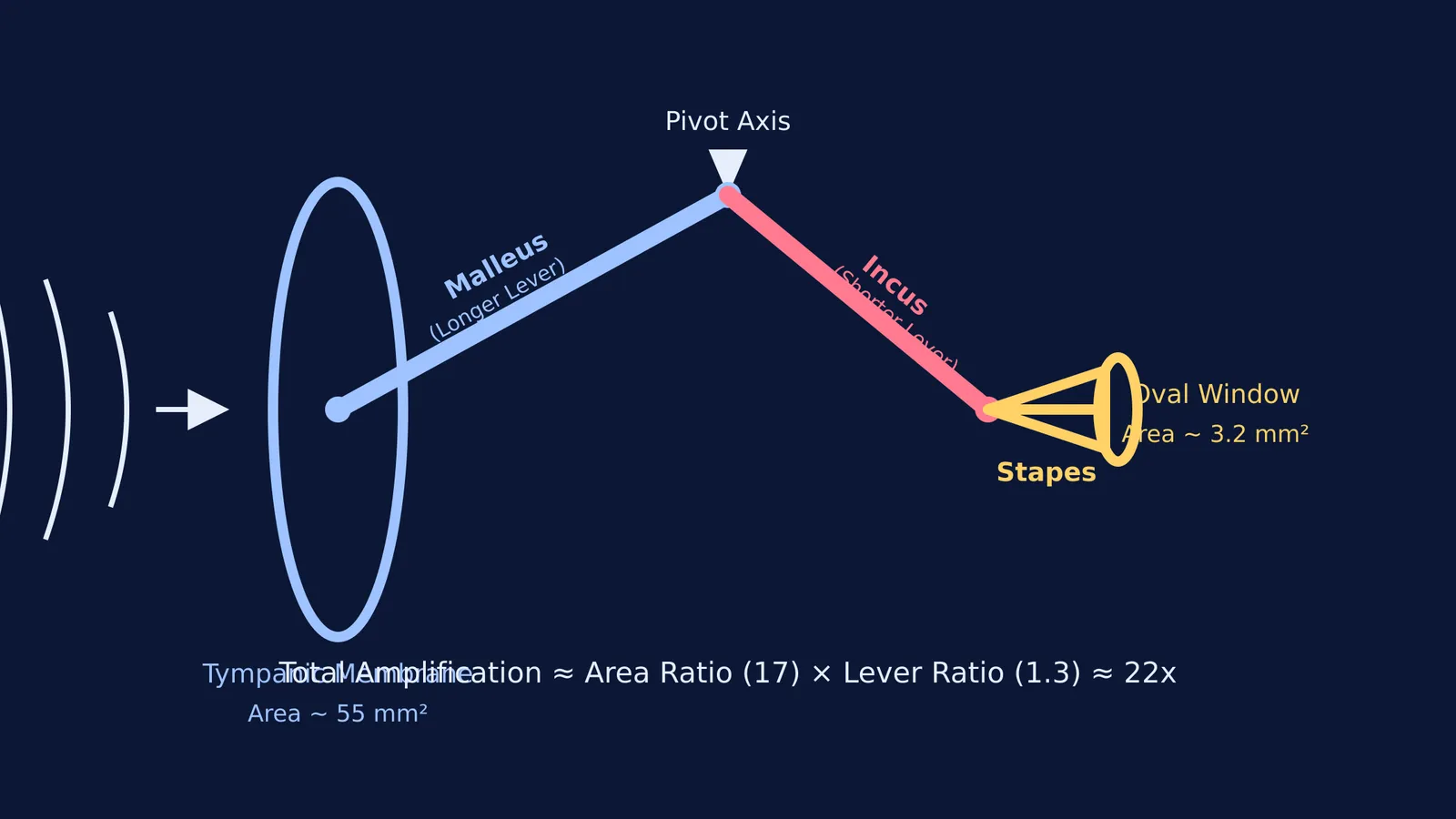
To overcome the resistance of the cochlear fluid, the middle ear must amplify the sound pressure. It achieves a 22-fold increase in pressure through two mechanical advantages (George et al., 2024):
The area ratio (hydraulic effect): The tympanic membrane has an effective vibrating area of about 55 mm², while the stapes footplate has an area of only 3.2 mm² (George et al., 2024). Concentrating the force from a large area onto a small area increases the pressure by roughly 17 times.
The lever action: The handle of the malleus is slightly longer than the long process of the incus. Together, they form a lever system that multiplies the force of the vibrations by about 1.3 times (George et al., 2024).
Multiplying these two factors (17 × 1.3) gives a total pressure amplification of approximately 22 times at the oval window.
What protects the inner ear from loud noises?
While the primary function of the ossicles is to amplify quiet sounds, they also have a protective role. The ossicular chain is attached to two tiny muscles: the tensor tympani and the stapedius.
When your ear is exposed to very loud, continuous noises, these muscles reflexively contract. The tensor tympani pulls the malleus inward, while the stapedius pulls the stapes outward. This stiffens the entire chain of bones, dampening the vibrations before they reach the delicate hair cells of the cochlea. This automatic response is known as the acoustic reflex.
How to test your understanding
If you are preparing for exams, linking anatomy to physics helps the facts stick. This is how the Fermi Concept Library works. When you bring a biology topic, Fermi's AI tutor works out what you already know and builds a plan for the session, teaching you the connections between the structure of the stapes and the equations of pressure. Instead of just memorising terms, you learn why the ear is built the way it is.
Just as you might practice assertion-reason traps on DNA and gene expression, testing yourself on the mechanism of the ossicles ensures you are ready for applied questions. Before moving on, cover your notes and use this checklist:
Can you list the correct order of the bones from the eardrum to the inner ear?
Can you name which bone directly contacts the tympanic membrane, and which contacts the oval window?
Can you explain the two mechanisms that amplify sound pressure, and state the total amplification factor?