

On this page
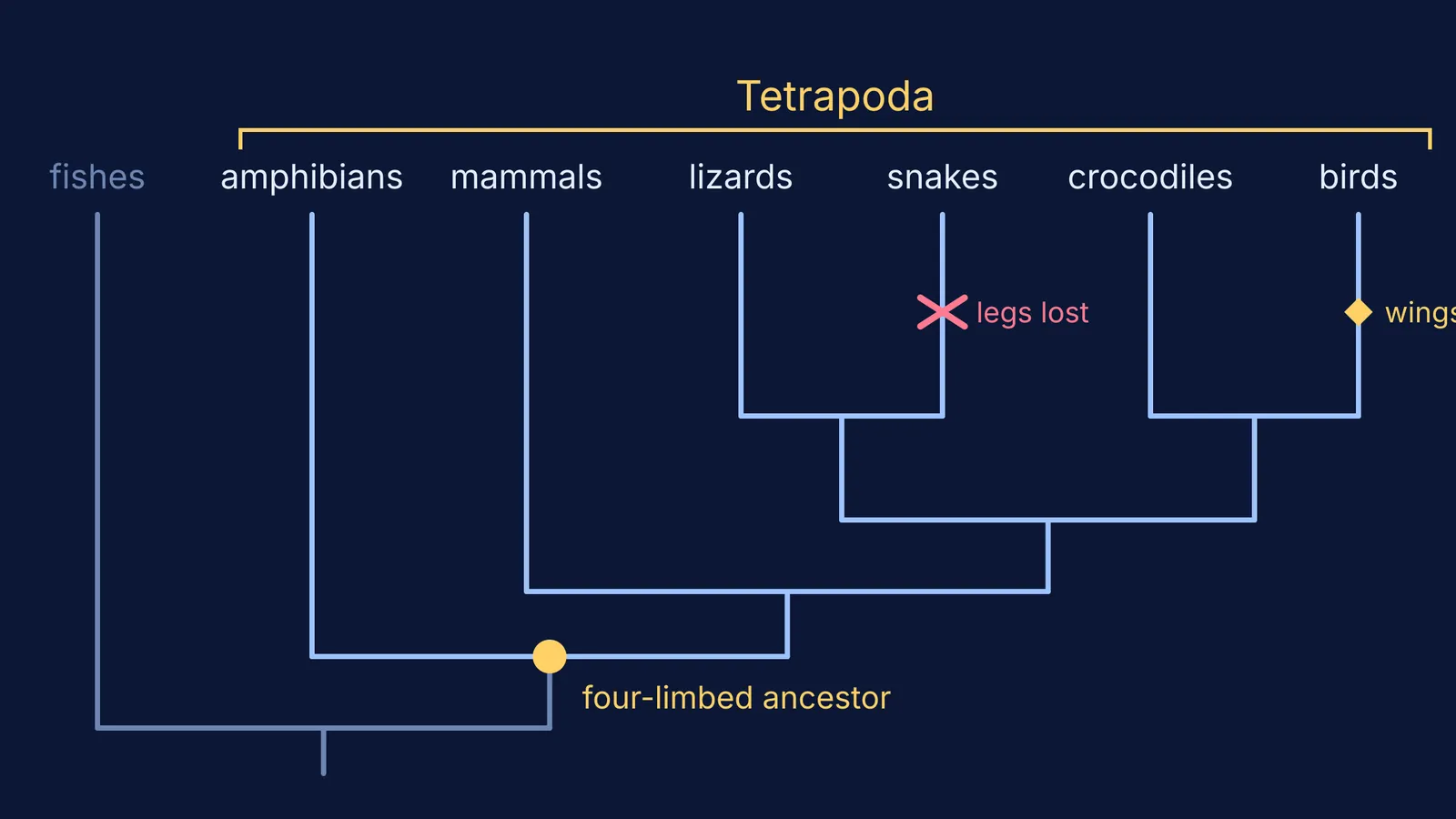
A cobra has no legs. A peacock stands on two. Yet your NCERT Class 11 chapter puts both under Tetrapoda, a name that means "four feet". The way out of this apparent contradiction is one idea: biologists classify animals by their ancestors, not by the legs they have today.
What does tetrapod actually mean?
In the NCERT Class 11 Biology chapter on the Animal Kingdom, jawed vertebrates (Gnathostomata) are split into two superclasses: Pisces, which "bear fins", and Tetrapoda, which "bear limbs". The same chapter says Amphibia, Reptilia, Aves and Mammalia "have two pairs of limbs and are thus grouped under Tetrapoda".
That is a handy textbook summary, but specialists define the group differently. On the Tree of Life Web Project page on terrestrial vertebrates, Michel Laurin gives the formal definition from Gauthier and colleagues (1989): Tetrapoda is the clade made up of the last common ancestor of amphibians and amniotes, and all its descendants.
Nothing in that definition counts legs. Descend from that four-limbed ancestor and you are a tetrapod, whatever your body later does with its limbs.
Why are snakes called tetrapods if they have no legs?
Because snakes are reptiles, and reptiles descend from four-limbed ancestors. NCERT itself notes that in reptiles "limbs, when present, are two pairs" and that "limbs are absent in snakes" (NCERT Animal Kingdom). The legs were lost; the ancestry was not.
Three lines of evidence show the loss happened:
Fossils with legs. In 2006, Sebastián Apesteguía and Hussam Zaher described a Cretaceous snake from Patagonia with a sacrum, a pelvic girdle and "robust, functional legs" (Nature, 2006). Their analysis placed it as the most primitive snake then known.
Embryos that start legs. Martin Cohn and Cheryll Tickle found that python embryos begin hindlimb buds, but the signalling that normally grows a leg is not switched on; pythons keep only severely reduced hindlimbs (Nature, 1999).
A broken genetic switch. A 2016 study led by Evgeny Kvon at Lawrence Berkeley National Laboratory looked at a limb enhancer of the Sonic hedgehog gene. Mice given the snake version of this DNA developed severely reduced limbs, and restoring a single binding site lost in snakes gave the snake enhancer full function again (Cell, 2016).
So a snake is a tetrapod that switched off its legs. The same logic explains limbless amphibians like *Ichthyophis*, covered in our post on why Ichthyophis is a limbless amphibian, not a snake.
Why are birds tetrapods when they walk on two legs?
Birds still have four limbs. Two just look different. NCERT puts it plainly: in Aves, "the forelimbs are modified into wings", while the hind limbs are adapted for walking, swimming or clasping branches (NCERT Animal Kingdom).
A wing is a forelimb doing a new job, the same way a whale's flipper is a forelimb used for swimming. Our post on why a whale is a mammal, not a fish uses the same kind of reasoning.
How do you check whether any animal is a tetrapod?
Use this three-step test, in order:
Find its class. Is it an amphibian, reptile, bird or mammal? If yes, it is a tetrapod. Stop.
If it has no legs, ask "lost or never had?" Snakes and *Ichthyophis* lost them; fishes never had limbs and use fins.
If the limbs look odd, ask "modified from what?" Wings, flippers and the tiny hindlimbs of pythons are all modified or reduced limbs.
Never count legs first. Our post on vestigial organs in humans covers other leftovers that point to ancestry.
Three trap MCQs to test yourself
1. Which of these is NOT a member of Tetrapoda?
(a) *Naja* (b) *Ichthyophis* (c) *Exocoetus* (d) *Struthio*
Answer: (c). *Exocoetus* is the flying fish, a bony fish with fins. The trap is that *Naja* (cobra) and *Ichthyophis* have no legs, and *Struthio* (ostrich) cannot fly, so they feel like odd ones out. All three are tetrapods.
2. Assertion: Snakes are placed in Tetrapoda. Reason: Every member of Tetrapoda has two pairs of functional limbs.
(a) Both true, Reason explains Assertion (b) Both true, Reason does not explain (c) Assertion true, Reason false (d) Both false
Answer: (c). The Assertion is true because snakes descend from four-limbed ancestors. The Reason is false: snakes have no limbs.
3. The wing of a bird is best described as:
(a) a new structure not found in other tetrapods (b) a modified forelimb (c) a modified fin (d) a vestigial limb
Answer: (b). Option (d) traps students who mix up "changed" with "useless"; option (c) traps those who think of flight as swimming through air.
If classification keeps tripping you up, the Fermi Concept Library has a lesson for each biology concept and shows its place in the map, which can help you see how groups fit together. For mixed practice, the Fermi Problem Library has worked problems with a step-by-step solver that explains the reasoning rather than printing an answer.


