On this page
In 1871 Charles Darwin used a short list of body parts to argue that humans share ancestors with other animals. In The Descent of Man he described rudimentary organs as parts that are either useless or "of such slight service to their present possessors" that they could not have developed under the conditions that now exist. His examples included the four you still see in biology textbooks: the appendix, wisdom teeth, the tailbone and the muscles that move the ear.
Modern research shows several of these parts still do something. That does not weaken the argument.
What does vestigial actually mean?
A vestigial structure is one that is reduced, or does much less, than the matching structure in related species. It does not have to be useless. The evidence comes from the mismatch: a part built for one job in our relatives, kept in a smaller form in us.
Is the appendix a vestigial organ?
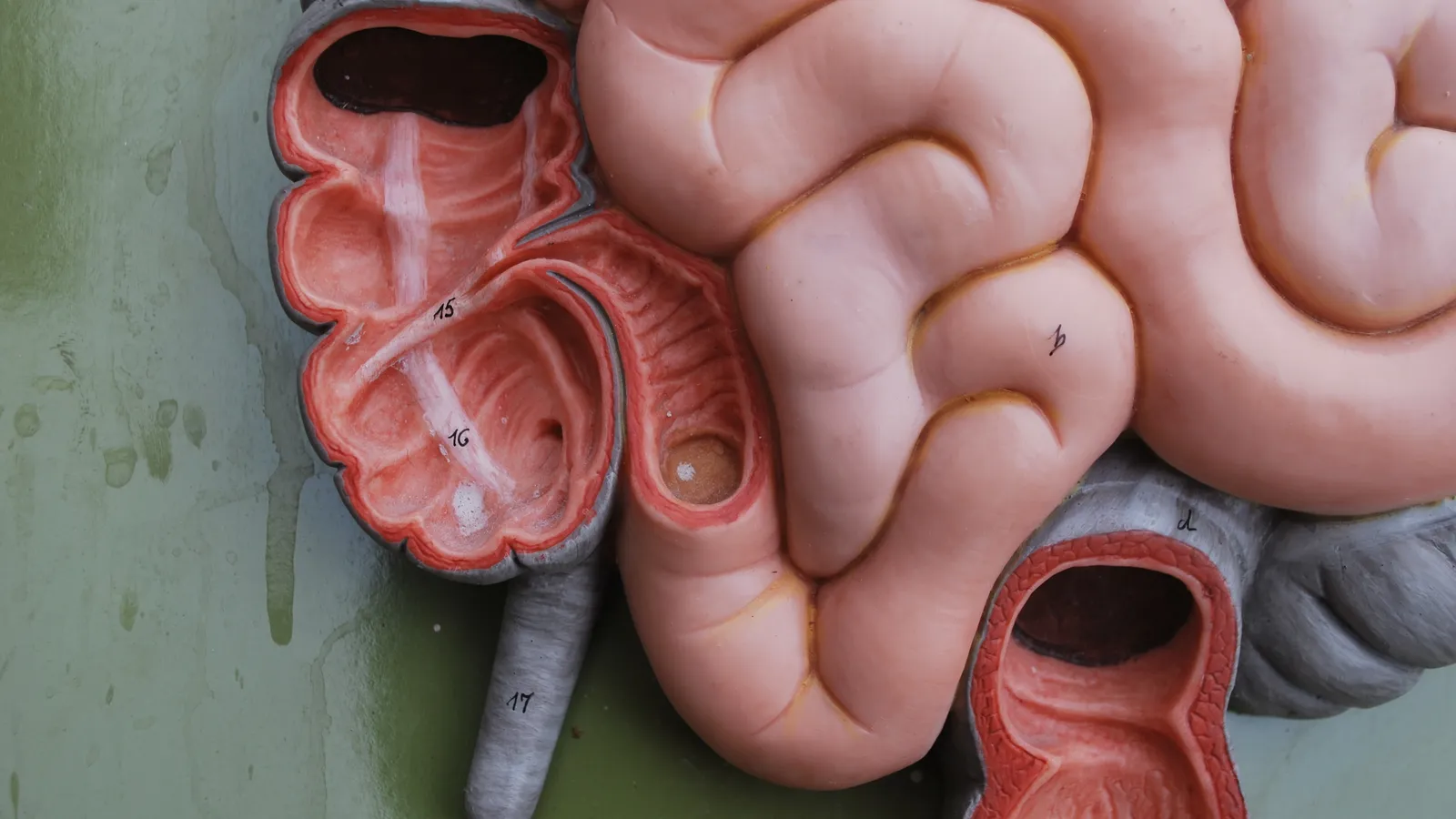
The appendix is a small finger-shaped pouch off the caecum, the start of the large intestine. Darwin treated it as a rudiment and noted that it is sometimes the cause of death, in the same 1871 chapter.
A 2009 comparative study in the Journal of Evolutionary Biology found that the appendix evolved independently at least twice in mammals and has been maintained for 80 million years or longer. The authors link this to the idea that it acts as a "safe-house for symbiotic gut microbes" during gut infections.
Why are wisdom teeth and the tailbone called vestigial?
Wisdom teeth are the third molars, the last teeth to erupt. Darwin observed that they are rather smaller than the other molars and more liable to decay, and wrote that they appeared to be "tending to become rudimentary" (Descent of Man, chapter 1).
Many people never develop them at all. A meta-analysis of 92 studies covering 63,314 people put the worldwide rate of missing at least one wisdom tooth at 22.63%, with individual estimates ranging from 5.32% to 56% (Carter and Worthington, Journal of Dental Research, 2015).
The coccyx is a few small fused vertebrae at the bottom of the spine. A 2024 study of 108 human embryos in eLife describes an embryonic tail that develops and then regresses during weeks 4 to 7 after conception.
Also in 2024, researchers writing in Nature identified an inserted stretch of DNA (an Alu element) in the TBXT gene as a probable contributor to tail loss in humans and apes. Mice engineered to make the same altered form of the gene's product had shortened or missing tails.
Can humans still move their ear muscles?
Most people cannot move their ears much, but the muscles are still there. A 2020 study in eLife recorded electrical activity in these muscles and found it was larger at the ear on the side of the sound a person was paying attention to. The authors suggest the ear-orienting system may have persisted as a "neural fossil" for about 25 million years. A 2025 follow-up with 20 participants in Frontiers in Neuroscience found the superior auricular muscle was significantly more active in the hardest listening condition. The muscles still respond to where and how hard you are listening, even though they barely move the ear.
How are vestigial organs evidence of evolution?
The argument runs in three steps:
The structure is reduced in humans compared with a clearly working version in related animals (a tail, a large caecum, movable ears).
Its form matches that working version: same position, same tissue, same developmental origin, as the embryonic tail shows.
Descent with modification explains this match. It accounts for why a body would carry a scaled-down copy of a part that works fully in other animals.
How do you write an exam answer on vestigial organs?
Here is a worked example for a typical 3-mark question: "What are vestigial organs? Explain how they support evolution, with two human examples."
Definition (1 mark): Vestigial organs are structures that are reduced in size or function compared with the corresponding organ in related species.
Examples (1 mark): The coccyx is the remnant of a tail; the auricular muscles, which move the ears in many mammals, barely move the human ear.
Evidence link (1 mark): Their presence in reduced form shows that humans share common ancestors with animals in which these organs are fully working.
Before you submit, check:
Did you say "reduced", not "useless"?
Did you name the working version in another animal for each example?
Did you end with common ancestry, which is the actual evidence?
If homologous, analogous and vestigial organs still blur together, the Fermi Concept Library covers every concept in biology, each with its own lesson and its place in the map. For practice questions, the Fermi Problem Library has worked problems with a step-by-step solver that explains the reasoning rather than printing an answer.