

On this page
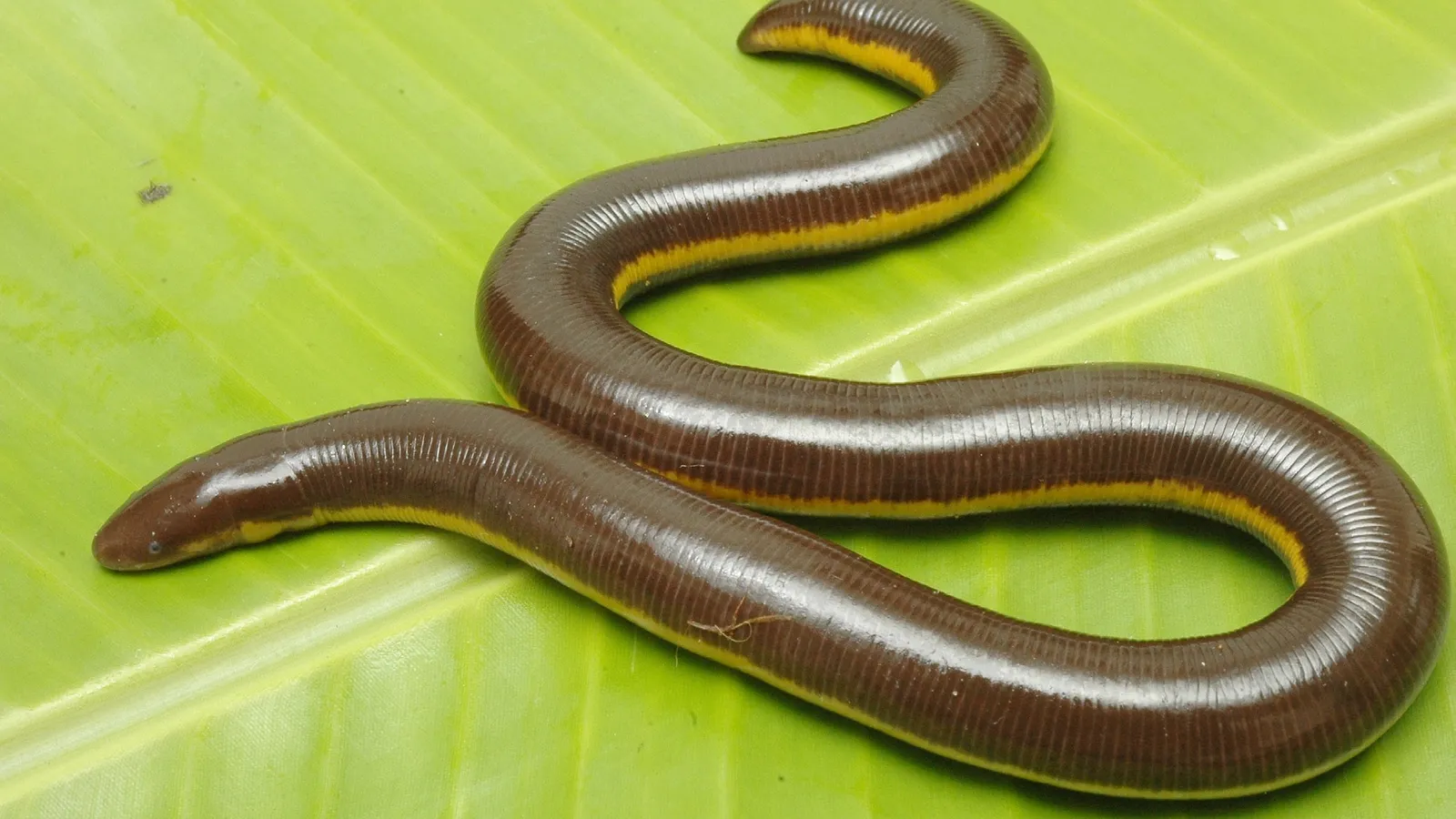
In the Western Ghats you may spot something shiny, dark and legless that most people would call a snake. The NCERT Class 11 chapter Animal Kingdom puts it somewhere else: *Ichthyophis* sits in Class Amphibia with frogs, toads and salamanders, under the label "Limbless amphibia" (NCERT Biology Class 11, Chapter 4). Researchers in Kerala say caecilians like it are among the least-studied vertebrates, partly because people mistake them for snakes (Arun et al., 2020).
Why is Ichthyophis an amphibian and not a snake?
An animal's class depends on its skin, how it breathes and its life cycle, not on whether it has legs. NCERT gives these amphibian features: moist skin without scales; breathing through gills, lungs and the skin; a three-chambered heart; cold blood; egg-laying, with indirect development (NCERT, Class Amphibia). Reptiles, by contrast, have "dry and cornified skin, epidermal scales or scutes". Snakes and lizards shed those scales as a skin cast, and reptile development is direct.
Animals in both groups have lost their legs. NCERT places amphibians and reptiles together under Tetrapoda, the vertebrates that have limbs, and still notes that limbs are absent in snakes. So missing legs say nothing about class; look at skin and life story.
What makes its skin amphibian skin?
A 2020 study of *Ichthyophis beddomei* from the Western Ghats of Kerala found two types of skin glands, mucous and granular, and numerous gland openings on the skin surface (Arun et al., 2020). The authors explain that the mucus keeps the skin moist, which helps the animal breathe through it. A snake's skin is the opposite: dry, cornified and covered in scales.
To see how much skin breathing matters to amphibians, read how a frog breathes through its skin, lungs and mouth lining.
How does Ichthyophis grow up?
The life cycle is the strongest evidence. A detailed study of how *Ichthyophis kohtaoensis* develops found that the female lays her clutch in a burrow on land and cares for it, and that the larvae live in water and have features the land-living adults do not (Dünker, Wake and Olson, 2000). The researchers divided development, from the end of neurulation to metamorphosis, into 20 stages. The stages are marked by lateral line organs, three pairs of external gills, and a tail fin that grows and then shrinks away.
Field work in Thailand found that females laid their eggs on land close to ponds, brooks and rivers. Mothers guarding older clutches were in poorer body condition than mothers with younger clutches, a sign of how much energy their care costs (Kupfer, Nabhitabhata and Himstedt, 2004).
That is the amphibian double life without legs: a water-living larva, a land-living adult, and a metamorphosis in between. A young snake is a small snake from the start, with no larval stage and no metamorphosis. Frogs follow the same plan as *Ichthyophis*; our explainer on how amphibians live a dual life walks through it.
Is Ichthyophis a worm?
No. Its ringed body can make it look like a giant earthworm, but an earthworm belongs to the phylum Annelida, which NCERT describes as having body segmentation like rings; as non-chordates, annelids have no notochord (NCERT, Tables 4.1 and 4.2). *Ichthyophis* is a chordate: NCERT places Amphibia among the vertebrates with jaws, and in vertebrates the notochord is replaced by a backbone, the vertebral column, in the adult.
Spot the difference: Ichthyophis, snake or earthworm?
Backbone: Ichthyophis yes (Class Amphibia); snake yes (Class Reptilia); earthworm no (phylum Annelida).
Outer skin: Ichthyophis moist and full of mucous and granular glands; snake dry and cornified.
Scales: Ichthyophis has tiny dermal scales hidden in skin pockets; a snake has epidermal scales on the outside and sheds them as a skin cast.
Breathing: Ichthyophis grows external gills as an embryo, and its moist skin helps it breathe; a snake never has gills or a larval stage.
Young: Ichthyophis eggs on land hatch into water-living larvae that later metamorphose; snake development is direct.
How do you answer an Ichthyophis question in an exam?
Try this odd-one-out question built from NCERT's own examples: which one is a limbless amphibian? (a) *Naja* (b) *Ichthyophis* (c) *Bangarus* (d) *Hemidactylus*.
Remove the reptiles you know: NCERT lists *Naja* (cobra) and *Bangarus* (krait) as poisonous snakes and *Hemidactylus* as the wall lizard.
Check what is left against the amphibian list: moist skin, indirect development.
Answer (b); in a long answer, explain: moist glandular skin and an aquatic larval stage, so no legs does not mean snake.
If Amphibia and Reptilia keep blurring together, the Fermi Concept Library has a lesson for every biology concept and shows where each one sits on the map, so you can see how the two classes differ. For a reptile that people mistake for an amphibian, see why a crocodile is a reptile.


