

On this page
Your body needs a heart because many of your cells are buried centimetres away from the nearest surface. A Hydra or a planarian has no cell buried that deep. The difference is not cleverness or evolution being lazy. It is geometry, and you can check it with a cube and a calculator.
Why do Hydra and flatworms have no circulatory system?
Because none of their cells is far from water. The open textbook OpenStax Biology 2e says of flatworms: "There is neither a circulatory nor a respiratory system, with gas and nutrient exchange dependent on diffusion and cell-to-cell junctions." The same chapter adds that this "necessarily limits the thickness of the body", which is why they are flat.
Hydra is a cnidarian, and all cnidarians are diploblastic: an outer epidermis and an inner gastrodermis with a jelly-like, non-living mesoglea between them. According to OpenStax, cnidarian cells exchange oxygen and carbon dioxide with the water outside and with the water inside the gastrovascular cavity. With only two thin cell layers, no cell is far from water. You can read more about that single-opening cavity in our post on why Hydra has one opening for mouth and anus.
How does surface area to volume ratio change with size?
Take a cube of side L. Its surface area is 6L² and its volume is L³, so the ratio of surface area to volume is 6/L. Work it through for three cubes:
Side 1 mm: area 6 mm², volume 1 mm³, ratio 6 per mm.
Side 1 cm (10 mm): area 600 mm², volume 1,000 mm³, ratio 0.6 per mm.
Side 10 cm (100 mm): area 60,000 mm², volume 1,000,000 mm³, ratio 0.06 per mm.
Make the cube 100 times wider and each cubic millimetre of it gets 100 times less skin to breathe through. As OpenStax puts it, "As animal size increases, diffusion distances increase and the ratio of surface area to volume drops."
How long does oxygen take to diffuse 1 mm?
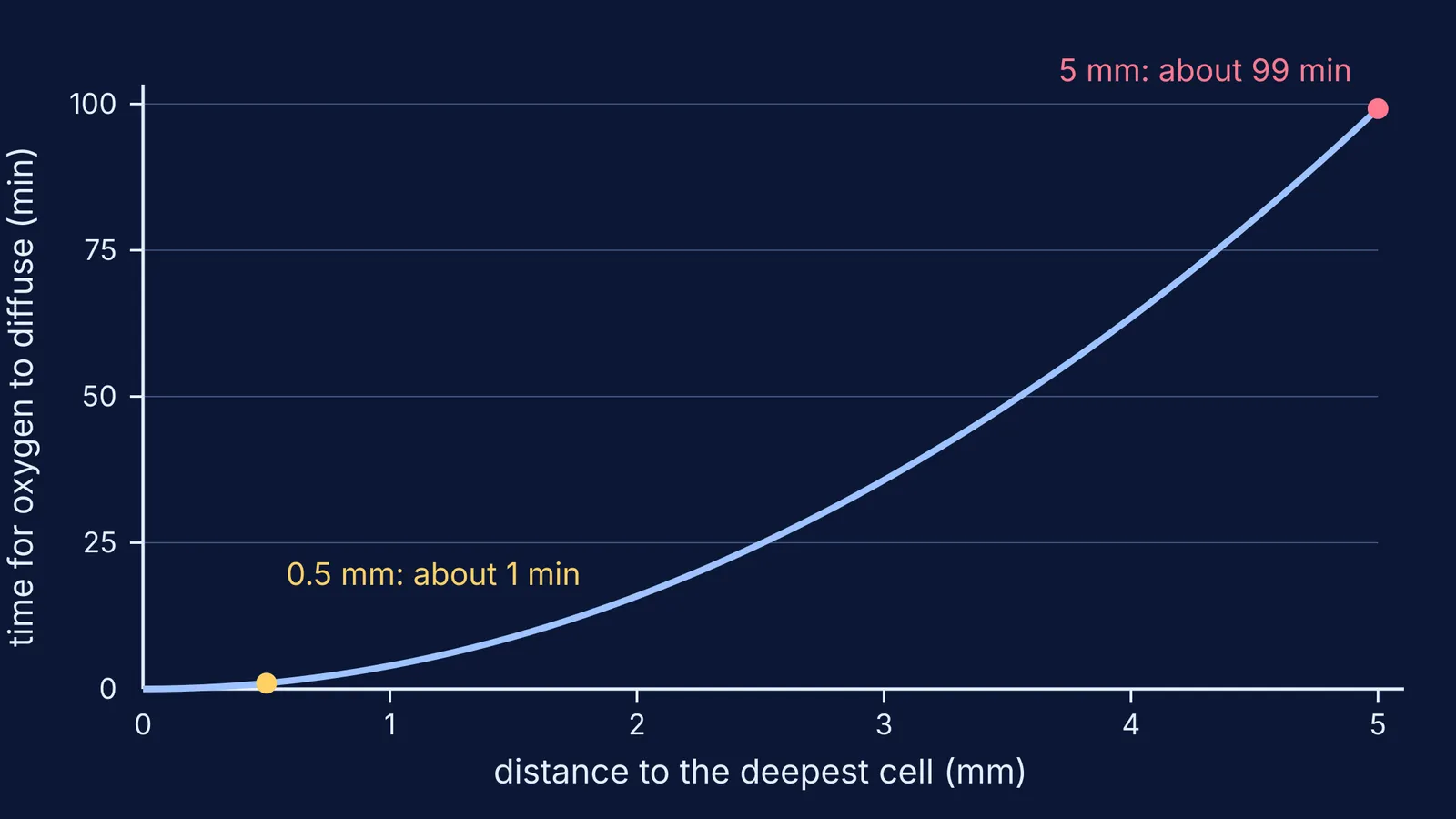
The ratio is only half the story. The other half is how long a molecule takes to travel. A standard approximation, given on PhysiologyWeb's diffusion time calculator, is t = x²/2D, where x is distance and D is the diffusion coefficient. For oxygen in water at 25 °C, D is 2.10 × 10⁻⁵ cm²/s.
The same page lists the results: oxygen takes about 23.8 milliseconds to diffuse 10 micrometres, 3.97 minutes to diffuse 1 mm and 6.61 hours to diffuse 1 cm.
Now apply it to the centre of each cube, half a side from the surface:
1 mm cube, centre 0.5 mm deep: about 1 minute.
1 cm cube, centre 5 mm deep: about 99 minutes.
10 cm cube, centre 5 cm deep: about 6.9 days.
A cell cannot wait a week for oxygen. That is why OpenStax says gas exchange by direct diffusion across surface membranes is efficient for organisms less than 1 mm in diameter.
Worked example: what happens if you flatten the cube?
This is the flatworm's trick, and you can repeat it on paper. Take the 1 cm cube (1,000 mm³) and roll it into a square sheet 0.2 mm thick.
Area of each face: 1,000 ÷ 0.2 = 5,000 mm², so each side is about 70.7 mm.
Total surface: two faces of 5,000 mm² plus four thin edges of about 14 mm² each, roughly 10,057 mm².
Ratio: about 10 per mm, against 0.6 per mm for the cube. Same volume, about 17 times more surface for each unit of volume.
Deepest cell: 0.1 mm from a surface. Using t = x²/2D with the PhysiologyWeb value of D, that is about 2.4 seconds, against 99 minutes for the cube's centre.
Cutting the distance 50 times speeds diffusion up 2,500 times. A planarian's branching gut helps in the same way, carrying food close to cells throughout the body; our post on flame cells in planaria shows how they handle waste water too.
If the square law is hard to picture, the Fermi Simulation Lab has interactive simulations for ideas that are easier to see than to read.
How do you write this in an exam answer?
If a question asks why some animals manage without a circulatory system, hit these points in order:
Name the body plan: diploblastic (Hydra) or thin and flat (flatworms).
Say every cell is close to an external surface or a fluid-filled cavity.
State that diffusion is fast over short distances but its time rises with distance squared.
Add that a small or flat body keeps a high surface area to volume ratio.
Conclude that diffusion meets their needs, so no blood or heart is required.
The same logic, run backwards, explains why large animals build huge exchange surfaces; see how alveoli increase surface area. If surface area to volume ratio itself is still shaky, the Fermi Concept Library gives each biology and maths concept its own lesson.
Try the cube test once more with a 2 mm cube and predict the time to its centre before you calculate it.


