

On this page
If you study biology, you will often hear that flatworms (the phylum Platyhelminthes) excrete waste through flame cells. Also known as protonephridia, these microscopic, bulb-shaped structures act as the animal's equivalent of a kidney.
But planaria have another party trick. If you cut one in half, both halves grow back, replacing their entire excretory system from scratch.
Here is how flame cells work, why they are mostly for water balance rather than nitrogen waste, and how planaria rebuild them.
How do flame cells in planaria and flatworms work?
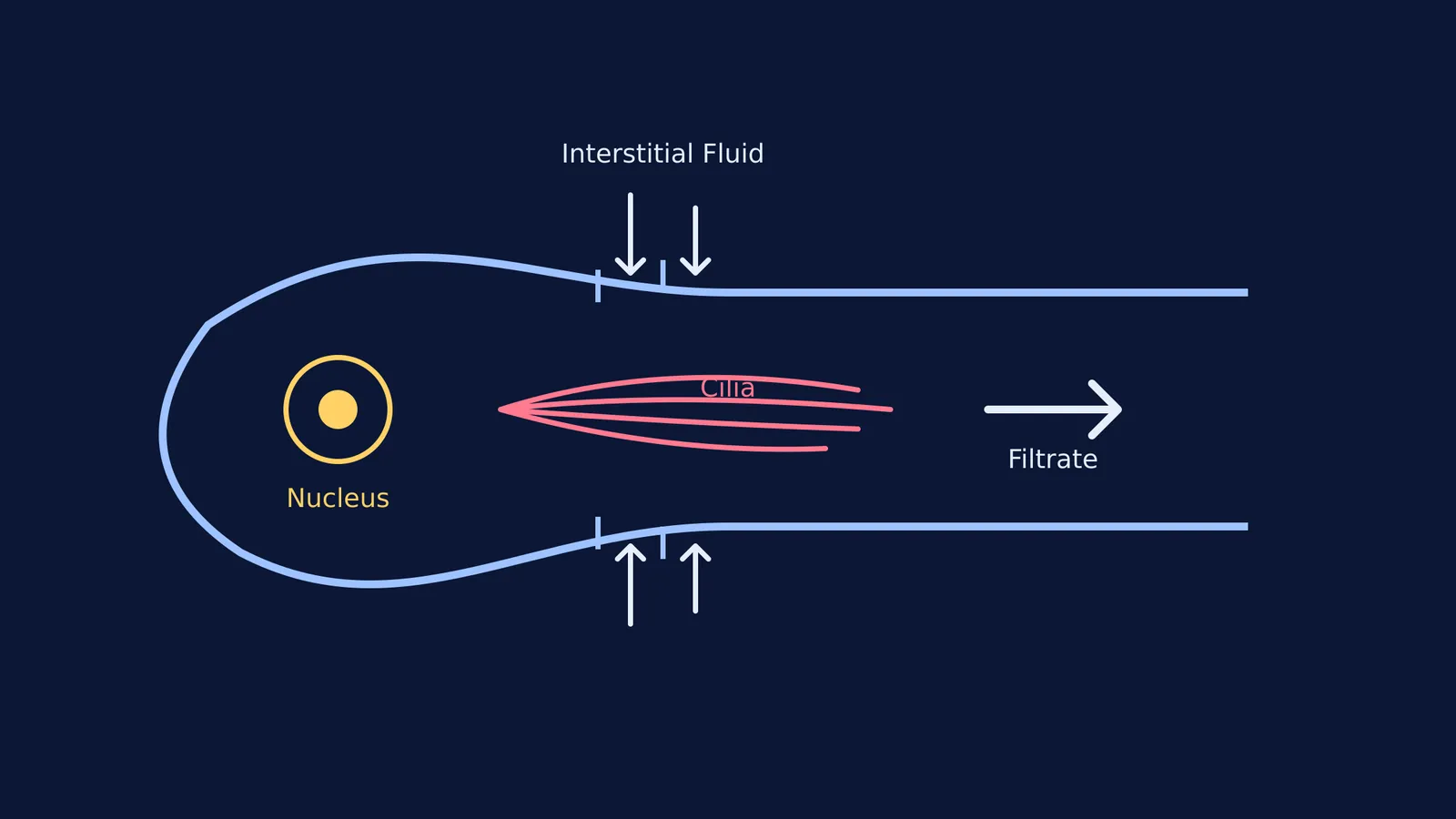
A flame cell system is a network of branched tubes that ends in specialized terminal cells. Under a microscope, these terminal cells contain a cluster of beating cilia that looks like a flickering candle flame.
This flame is a pump. The cilia beat to create negative pressure, pulling interstitial fluid (the fluid between the worm's cells) through tiny slits into the cup of the cell. From there, the fluid is pushed down into a tubule.
As the fluid flows along the cilia-lined tubule, the cells lining it reabsorb useful salts and ions. The remaining liquid—mostly excess water and some metabolic waste—is pushed out of the body through small pores called nephridiopores.
Osmoregulation vs excretion
There is a common trap in biology exams: asking how flatworms excrete ammonia.
Most freshwater planaria live in a hypotonic environment. This means the water outside has fewer dissolved salts than the fluids inside their bodies. Because they are hypertonic to their surroundings, water constantly floods into the worm by osmosis. If they did not pump it out, they would swell and burst.
Flame cells are primarily for osmoregulation, acting as a bilge pump to bail out that excess water.
While they do carry away some waste, the vast majority of a flatworm's nitrogenous waste (ammonia) simply diffuses out across the animal's general body surface. Because they are flat, they have a massive surface-area-to-volume ratio, making simple diffusion extremely efficient. You can contrast this with humans, where ADH and the RAAS regulate water and urea excretion in our complex kidneys, or ammonotelic, ureotelic and uricotelic animals that adapt their nitrogen waste to their environments.
How do planaria regenerate flame cells?
Planaria are famous for their ability to regenerate any missing body part, including a completely new head.
They do this using a vast reserve of adult stem cells called neoblasts. According to research by Reddien et al. (2005), these pluripotent cells make up roughly 25% to 30% of the planarian's body. They are the only cells capable of dividing.
When a planarian is injured, neoblasts migrate to the wound and form a mass called a blastema. But how do these blank-slate cells know to become flame cells instead of muscle or nerve tissue?
In 2011, researchers found that planaria use a genetic program strikingly similar to the one that builds the human kidney. A study by Scimone et al. (2011) revealed that specific genes, notably *Six1/2-2*, switch on inside a subset of neoblasts. This transcription factor directs the stem cells to differentiate specifically into flame cells, tubule cells, and tubule-associated cells, branching out to rebuild the entire protonephridial network. If those genes are silenced, the flatworm fails to regenerate its excretory system, rapidly bloats with water, and dies.
Learning the mechanisms
Biological structures like flame cells can be hard to visualize because they depend on microscopic fluid dynamics and genetic cascades.
If you are studying these systems for exams, you can use the Fermi Concept Library to look up protonephridia, osmoregulation, or stem cell differentiation. Fermi's AI tutor can walk you through how cilia create a pressure gradient, or explain why freshwater organisms face different osmotic challenges than marine ones, checking your understanding at each step.
A framework for tracing excretion
When tackling a biology question on excretion or osmoregulation, use this simple four-step checklist to trace the flow of fluid through a flame cell system:
Source: Interstitial fluid builds up between the worm's cells due to osmosis.
Filtration: Beating cilia in the terminal cell (flame cell) draw the fluid through slits.
Modification: As the filtrate moves down the tubule, the worm reabsorbs valuable ions and salts.
Expulsion: The remaining excess water is pushed out through the nephridiopore on the skin surface.
Remember this pathway, and you will never mix up the roles of diffusion and filtration in a flatworm again.


