

On this page
Look at almost any animal that reproduces sexually, from sparrows to people, and you find roughly as many males as females. That is odd: in many species a few males father most of the young, so a population with more females could grow faster. Why evolution keeps landing on half and half is a neat argument you can check with school arithmetic.
Why are males and females born in nearly equal numbers?
The explanation is called Fisher's principle, after the statistician and geneticist Ronald Fisher, who set it out in his 1930 book *The Genetical Theory of Natural Selection* (summary of Fisher's principle).
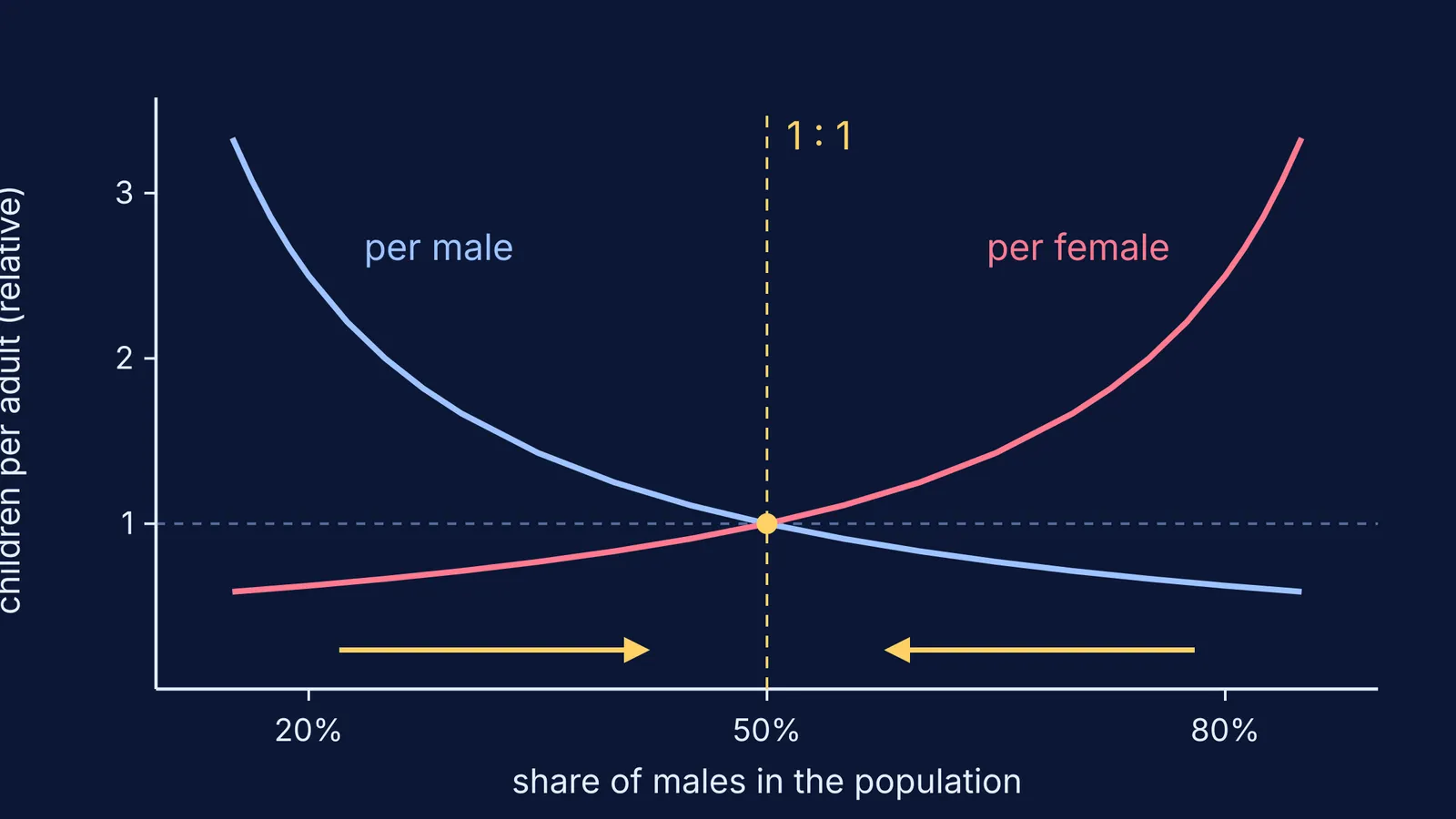
Fisher's principle says that whichever sex is rarer gives parents a better return in grandchildren, so natural selection pushes the sex ratio back towards 1:1.
The key fact is simple: every child has exactly one mother and one father. So all the males together have exactly as many children as all the females together. If males are fewer, each male fathers more children, on average, than each female mothers. Parents whose genes tilt them towards sons get more grandchildren, those genes spread, and sons become common. The same works in reverse when females are rare.
Strictly, Fisher argued that parents should spend equal total effort on sons and daughters, not necessarily produce equal numbers (Fisher's principle).
What happens when one sex is rare? A worked example
This follows W. D. Hamilton's 1967 version of the argument, which assumes sons and daughters cost the same to raise (Fisher's principle). Imagine 100 adults: 20 males and 80 females, producing 1,000 babies in total.
Each baby has one mother, so the 80 females share 1,000 births: 1,000 ÷ 80 = 12.5 children per female.
Each baby also has one father, so the 20 males share the same 1,000 births: 1,000 ÷ 20 = 50 children per male.
A son is therefore worth 50 ÷ 12.5 = 4 times as many grandchildren as a daughter.
Family A has four daughters and can expect 4 × 12.5 = 50 grandchildren. Family B has four sons and can expect 4 × 50 = 200.
Any inherited tendency to produce sons spreads, and the share of males rises.
Now flip it: 80 males and 20 females. Daughters are worth four times as much, and daughter-producing spreads. Only at 50 and 50 does every adult average the same 20 children, so no strategy beats another. That balance is the crossing point in the graph above.
For how chromosomes decide sex, see our guide to sex determination types: XO, XY and ZW.
Is the human sex ratio exactly 1:1?
Not quite. The World Health Organization's expected sex ratio at birth is around 105 boys per 100 girls, with a normal range of about 103 to 107 (Our World in Data, Gender ratio).
A large 2015 analysis led by Steven Orzack found that the sex ratio at conception is unbiased, that the proportion of males rises during the first trimester, and that total female mortality during pregnancy exceeds total male mortality (Orzack and colleagues, PNAS, 2015).
For reading census figures, see how literacy rate and sex ratio are calculated in India.
Why do ants and bees break the 1:1 rule?
Fisher's argument assumes sons and daughters cost the same, parents are equally related to both, and sons compete with the whole population for mates; when these assumptions break, ratios move away from 1:1 (Fisher's principle). W. D. Hamilton analysed such cases in his 1967 paper "Extraordinary sex ratios", a theory for sex linkage and inbreeding (Hamilton, Science, 1967).
Ants, bees and wasps add a genetic twist called haplodiploidy: males develop from unfertilised eggs and females from fertilised eggs (Haplodiploidy).
Because of this, when the queen has mated only once, a worker shares 75% of her genes with a sister but only 25% with a brother (Haplodiploidy). Workers, who raise the brood, should therefore prefer to invest three times as much in sisters as in brothers, while the queen, equally related to both, prefers 1:1.
Robert Trivers and Hope Hare tested this in 1976. Using data from 20 ant species, they found that ants with a single queen invest at roughly 1:3 in males versus females, the workers' preference, while slave-making ants, whose brood is raised by captured workers from other colonies, invest at about 1:1 (Trivers and Hare, Science, 1976). The ratio tracks who controls the investment.
How to write Fisher's principle in an exam answer
Cover four points:
State the fact: every offspring has one mother and one father.
State the consequence: the rarer sex has more offspring per individual.
State the selection: parents producing the rarer sex leave more grandchildren, so the ratio returns towards 1:1.
Name an exception: haplodiploid social insects, where workers favour sisters.
If frequency-dependent selection or relatedness still feels shaky, the Fermi Concept Library has a lesson for every concept in biology, each with its place in the map, so you can see what this idea builds on. For another case where selection does something surprising, read why peacocks have long tails.


