

On this page
Picture two photocopiers. One never checks its pages; the other rereads every line and fixes typos. That is the difference between flu or HIV and the bacterium that causes tuberculosis.
Why do viruses mutate faster than bacteria?
The short answer is the copying enzyme. Every cell and virus copies its genes with a polymerase, which sometimes inserts the wrong letter. What matters is whether anything catches the mistake.
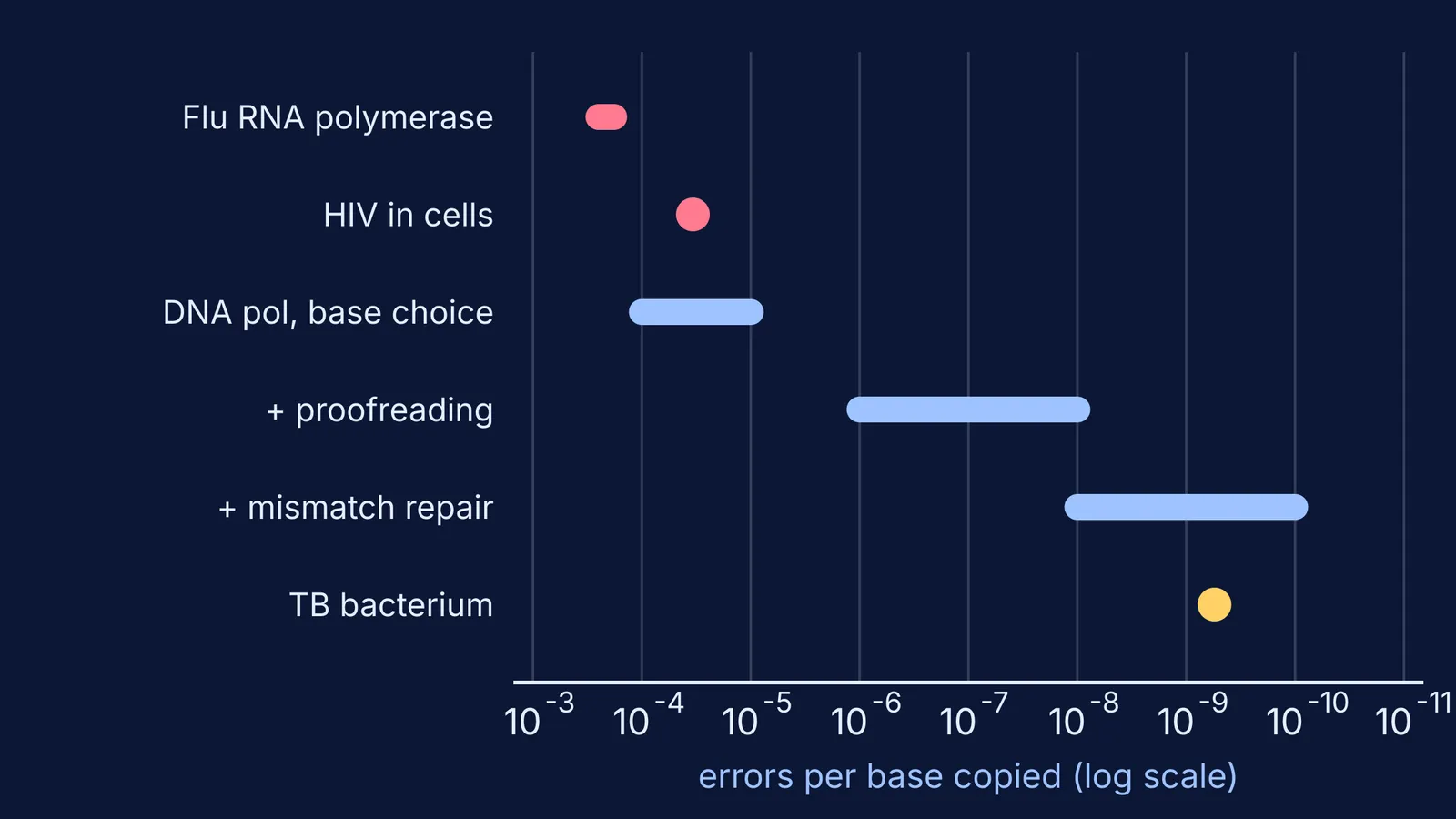
A review in Current Genetics describes three layers that protect DNA. A DNA polymerase on its own picks the wrong nucleotide about once every 10,000 to 100,000 letters. Proofreading, where the enzyme backs up and snips out a wrong letter, improves accuracy 100 to 1,000 times. With mismatch repair added, cells copy DNA with about one wrong letter per 100 million to 10 billion.
RNA viruses skip the middle layer. "The polymerases of the vast majority of RNA viruses lack 3′ exonuclease proofreading activity," write Rafael Sanjuán and Pilar Domingo-Calap in a 2016 review of viral mutation, and the reverse transcriptase that HIV uses lacks it too.
Across 23 viruses, a Journal of Virology analysis found RNA viruses mutate at 10⁻⁶ to 10⁻⁴ substitutions per nucleotide per cell infection, against 10⁻⁸ to 10⁻⁶ for DNA viruses.
How big is the gap between flu, HIV and TB?
Measured rates, per letter copied:
Influenza A: 1.8 × 10⁻⁴ (H1N1) and 2.5 × 10⁻⁴ (H3N2), about 2 to 3 new mutations per replicated genome, in a 2017 eLife study.
HIV-1: 3.4 × 10⁻⁵ mutations per base pair per replication cycle, measured in cells by Mansky and Temin in 1995.
HIV-1 inside patients: a 2015 PLOS Biology study found 4.1 × 10⁻³ per base per cell, with 98% of mutations caused by host enzymes that edit the viral genome; a large fraction are lethally mutated and never reach the blood plasma.
Mycobacterium tuberculosis: 5.5 × 10⁻¹⁰ mutations per base pair per generation in recently transmitted TB, assuming a 20-hour generation, in a 2014 PLoS ONE study.
Divide the flu figure by the TB figure and you get about 330,000. The studies count slightly differently, so read this as an order of magnitude: flu's copying is hundreds of thousands of times more error-prone.
Worked example: mutations per copy and per day
TB per copy. The TB genome has 4,411,529 base pairs. Multiply by 5.5 × 10⁻¹⁰ and you get 0.0024, about one new mutation in every 400 copies. That fits a 1991 PNAS finding that DNA-based microbes average about 0.0033 mutations per genome per replication.
Flu per copy. With 2 to 3 mutations in every copy (eLife study), flu gains about 1,000 times more mutations per genome copy than TB, even though its genome is far smaller.
HIV per day. A 1996 Science study estimated that an infected person produces about 10.3 billion HIV particles a day. Multiply by 3.4 × 10⁻⁵ and each position in the genome could be miscopied in roughly 350,000 new particles daily. Many particles never infect anything, but most one-letter changes likely arise again and again.
Speed is not the main story. The TB study assumes a 20-hour generation, shorter than HIV's 2.6 days in the Science study. At 438 generations a year, a dividing TB lineage would gain only about one mutation per year (438 × 0.0024 ≈ 1). The error rate, not the speed, makes the gap.
Why does this matter for vaccines and drugs?
More mutations mean more variants for natural selection to sort, which is microevolution happening in real time. Flu vaccines are reviewed often: WHO issues flu vaccine composition recommendations twice a year, in February for the northern hemisphere and September for the southern.
A 2011 Nature Genetics study in macaques found TB kept gaining mutations during latent infection at a rate similar to active disease, which the authors say may explain why treating latent TB with isoniazid alone is a risk factor for isoniazid resistance. Questions about treatment belong with a doctor. Evolution also works on the human side: read how a CCR5 gene variant makes some people resistant to HIV.
How do you write this answer in a biology exam?
Use this four-step frame for any "why does X mutate faster" question:
Name the enzyme: RNA-dependent RNA polymerase or reverse transcriptase versus DNA polymerase.
Name the missing check: 3′ to 5′ exonuclease proofreading, plus mismatch repair in cells.
Give one number for each side, such as about 10⁻⁴ per base for flu versus about 10⁻¹⁰ for TB.
Multiply by genome length and generations to show what the rate means.
If the enzymes blur together, our post on DNA replication vs transcription sets them side by side. The Fermi Concept Library gives every biology concept its own lesson and its place in the map. To practise the order-of-magnitude step, the Fermi Problem Library has worked problems with a step-by-step solver that explains the reasoning rather than printing an answer.
Next time a headline says a virus "mutated", check two numbers: errors per copy and copies per day.


