

On this page
Your immune system runs on helper T cells. HIV destroys them, and the reason it can is a molecular lock-and-key. The virus does not force its way in; it has to be let in by proteins the cell displays on its own surface. The CCR5 delta-32 deletion removes one of those proteins, and that explains why a small number of people are highly resistant to HIV.
How does HIV get into a T cell?
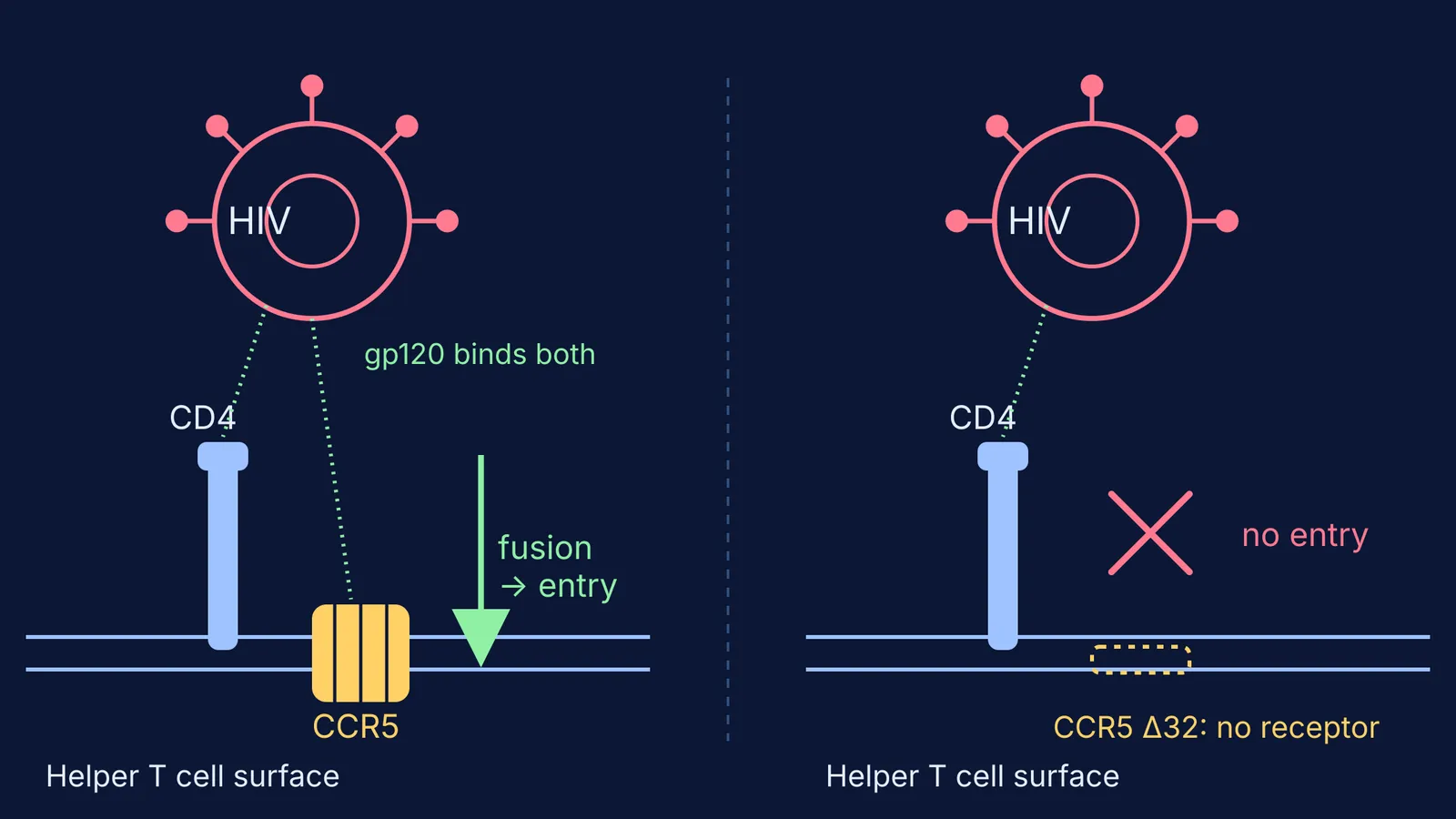
Entry takes two handshakes, not one. First, a spike on the virus called gp120 grips CD4, the protein that marks helper T cells. CD4 is the main receptor for HIV: in 1984, Dalgleish and colleagues showed in Nature that the CD4 (T4) antigen is an essential component of the receptor for the AIDS retrovirus. Receptors for the virus were found only on cells carrying CD4, and antibodies against CD4 blocked infection.
But CD4 alone is not enough. The gp120 spike then has to grab a second protein, a coreceptor. For the primary strains found in patients, that coreceptor is CCR5: in 1996, Deng and colleagues identified CC-CKR-5 (CCR5) as the principal cofactor for entry by primary macrophage-tropic HIV-1. Only after both CD4 and CCR5 are engaged do the membranes fuse and the viral RNA slips inside, the moment just before your NCERT chapter picks up with reverse transcription.
Why are some people resistant to HIV?
Because some people are born without working CCR5. A small fraction of humans carry a version of the CCR5 gene missing 32 letters of DNA, the CCR5 delta-32 allele. Samson and colleagues reported in Nature in 1996 that this 32-base-pair deletion causes a frame shift and generates a non-functional receptor that does not support membrane fusion or infection by the HIV-1 strains that use CCR5. The allele frequency was 0.092 (about 9% of gene copies) in the Caucasian populations they studied, and the deletion was absent in black populations from West and Central Africa and in Japanese populations.
Inherit the deletion from both parents and you have no working CCR5 on your cells. In the same year, Liu and colleagues reported in Cell80110-5) on two people who had been exposed to HIV many times yet stayed uninfected. Both were homozygous for the 32-base-pair deletion, and their CD4 T cells were highly resistant to entry by the usual primary strains. Such an allele, the authors wrote, appears to protect homozygous individuals from sexual transmission of HIV-1.
What does the deletion actually change?
The 32-base-pair deletion produces a truncated protein that is not expressed on the cell surface, as summarised by Gupta and Padh in 2012. CD4 is still there, so the first handshake still works. The second handshake fails: with no CCR5 to grab, gp120 cannot trigger fusion, and a CCR5-using virus is stranded outside the cell.
Does delta-32 make you completely immune?
No. Some HIV strains use a different coreceptor called CXCR4 instead of CCR5. Oh and colleagues reported in 2008 a man homozygous for delta-32 who was infected with a virus whose sequences indicated CXCR4 use. He was the 12th HIV infection in this genotype described worldwide, and his disease progressed extremely rapidly. In the same cohort, people with one copy had lower viral loads and a slower CD4 decline, but they had still become infected. Resistance is strong against CCR5-using strains, not an on-off shield.
The deletion is also uncommon in India. Chavhan and colleagues, in a 2013 study, summarised earlier Indian estimates: about 1.5% in North Indians, 1 to 3% in South Indians, 3 to 4% in the ethnic population of Kashmir and 0.05% in Rajasthan. In their own sample from Vidarbha in Maharashtra, five of the six tribes tested carried no copies at all. There is still no cure for HIV, which the WHO estimates 41.0 million people were living with at the end of 2025; with treatment it has become a manageable chronic condition.
How this links to NCERT's HIV life cycle
Your textbook starts after entry. Trace one virus from the outside in:
gp120 binds CD4, which is why HIV targets helper T cells and macrophages at all.
gp120 then binds CCR5; delta-32 blocks the cell here.
The membranes fuse and viral RNA enters, where your chapter begins.
Reverse transcriptase copies RNA into viral DNA.
Viral DNA joins the host DNA; macrophages become the HIV factory NCERT names.
New viruses bud off and infect more helper T cells, whose numbers fall.
Study any topic this way: anchor each exam fact to the step it belongs to. If a receptor name feels like loose vocabulary, read it in context in the Fermi Concept Library, where each concept has its own lesson and its place in the map. For ideas that are easier to see than to read, the Fermi Simulation Lab has interactive simulations.
For the steps after entry, see our walkthrough of how HIV replicates and why helper T cells fall, how to draw and label the structure of HIV, and the difference between B lymphocytes and T lymphocytes.


