On this page
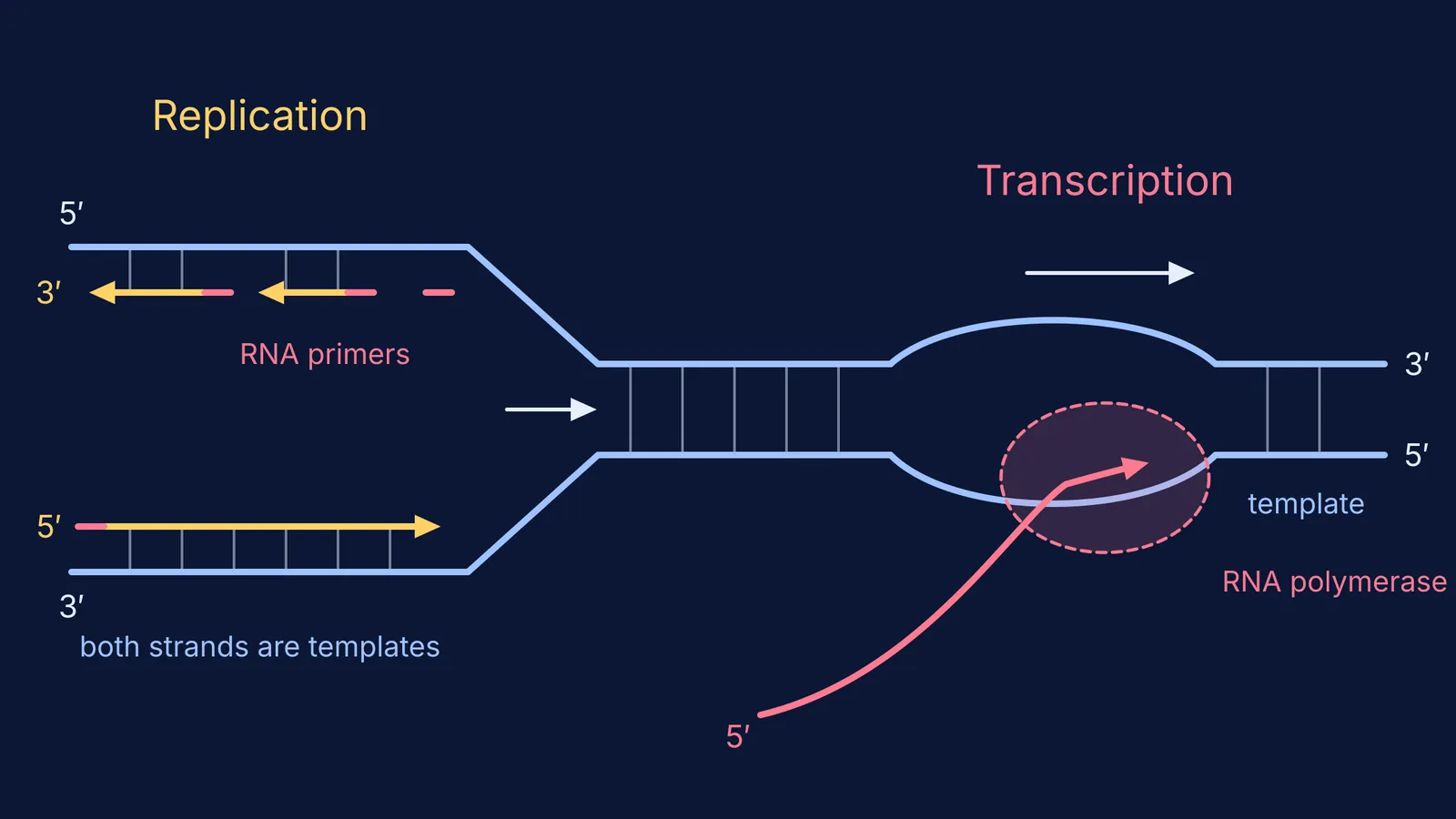
Replication and transcription both read DNA by base pairing, which is why they blur together in revision. To keep them apart, ask each process the same five questions: what is the template, which enzyme does the work, does it need a primer, what comes out, and how much of the DNA gets copied? The diagram at the top shows both on one stretch of DNA.
What is the difference between DNA replication and transcription?
Replication makes a complete copy of the DNA so that a dividing cell can hand a full set of instructions to each daughter cell. Transcription makes an RNA copy of one gene so the cell can use that instruction now.
NCERT's Class 12 chapter Molecular Basis of Inheritance states the central contrast in one line: in replication the total DNA of an organism gets duplicated, while in transcription only a segment of DNA, and only one of its strands, is copied into RNA.
The five differences, ready to copy into a two-column table:
Template: replication uses both strands, each as a template for a new partner; transcription uses one strand of one transcription unit, called the template strand.
Enzyme: replication is run by DNA-dependent DNA polymerase, with other enzymes such as DNA ligase helping; transcription is run by DNA-dependent RNA polymerase.
Primer: DNA polymerase needs a primer; RNA polymerase does not.
Product: replication gives two double-stranded DNA molecules, each with one old and one new strand; transcription gives single-stranded RNA (mRNA, tRNA or rRNA).
How much is copied: replication copies the whole genome, in the S phase of the cell cycle in eukaryotes; transcription copies only the structural gene between a promoter and a terminator.
The two processes also share two rules, according to the same NCERT chapter: bases pair by complementarity (with uracil in RNA where DNA has thymine), and both polymerases build their new chain only in the 5′→3′ direction.
Why does DNA polymerase need a primer but RNA polymerase does not?
DNA polymerase can only add a nucleotide to a free 3′-OH group, so it cannot start a new chain on bare template (OpenStax Biology 2e). An enzyme called RNA primase solves this by laying down an RNA segment about five to ten nucleotides long, complementary to the template, as that same OpenStax page explains.
OpenStax Microbiology gives the contrast in a single sentence: DNA polymerase requires a 3′-OH group, thus necessitating a primer, whereas RNA polymerase does not.
That is why primers appear only on the replication side of the diagram. The leading strand needs one primer at its start; on the lagging strand, every short fragment starts with its own. Our explainer on why the lagging strand is made in pieces covers that part in detail.
Which strand is copied in transcription?
The NCERT chapter defines the template strand as the strand with 3′→5′ polarity, and the coding strand as the other strand, which has the same sequence as the RNA except for thymine in place of uracil.
NCERT also explains why only one strand is transcribed: two RNAs from one segment would code for two different proteins, and being complementary, they would pair into double-stranded RNA that could not be translated.
How do you work out both copies from one sequence?
Take this short stretch of DNA, top strand 5′-ATGCCTAG-3′ and bottom strand 3′-TACGGATC-5′. Work through it in three steps:
Replication: each strand gets a new partner. The top strand pairs with a new 3′-TACGGATC-5′ and the bottom strand with a new 5′-ATGCCTAG-3′, giving two duplexes identical to the original, each half old and half new.
Transcription: say the bottom strand, running 3′→5′, is the template. RNA pairs A with U, so the transcript is 5′-AUGCCUAG-3′.
Check: the RNA should match the coding (top) strand with every T changed to U. If your answer looks like the template instead, you copied the wrong strand.
That AUG at the 5′ end is a start codon, which is where translation from mRNA codons to a protein picks up. If a step like this keeps going wrong, the Fermi Problem Library has worked problems with a step-by-step solver that explains the reasoning rather than printing an answer.
How fast are replication and transcription?
NCERT notes that E. coli, with 4.6 × 10⁶ base pairs, finishes replication within 18 minutes, an average polymerisation rate of roughly 2000 base pairs per second (NCERT). A single bacterial RNA polymerase makes mRNA at about 40 nucleotides per second (OpenStax Biology 2e). One is a whole-genome average and the other a single enzyme, so treat them as a sense of scale, not an exact ratio.
Then practise with our assertion-reason questions on DNA and gene expression. If a term such as promoter or coding strand is still hazy, the Fermi Concept Library covers every concept in biology, each with its own lesson and its place in the map.