On this page
Translation is the step where a cell reads an mRNA message and builds a protein from it. You understand it when you can do it with a pencil: find the start, step along three bases at a time, pair each codon with a tRNA, and know when to stop. Here is one strand to work through, and the traps that cost marks.
How does a ribosome read mRNA, codon by codon?
A codon is a sequence of three nucleotides that encodes one amino acid or signals the end of protein synthesis, as defined in the NHGRI genetics glossary. There are 64 codons: 61 encode amino acids and 3 are stop signals (NHGRI).
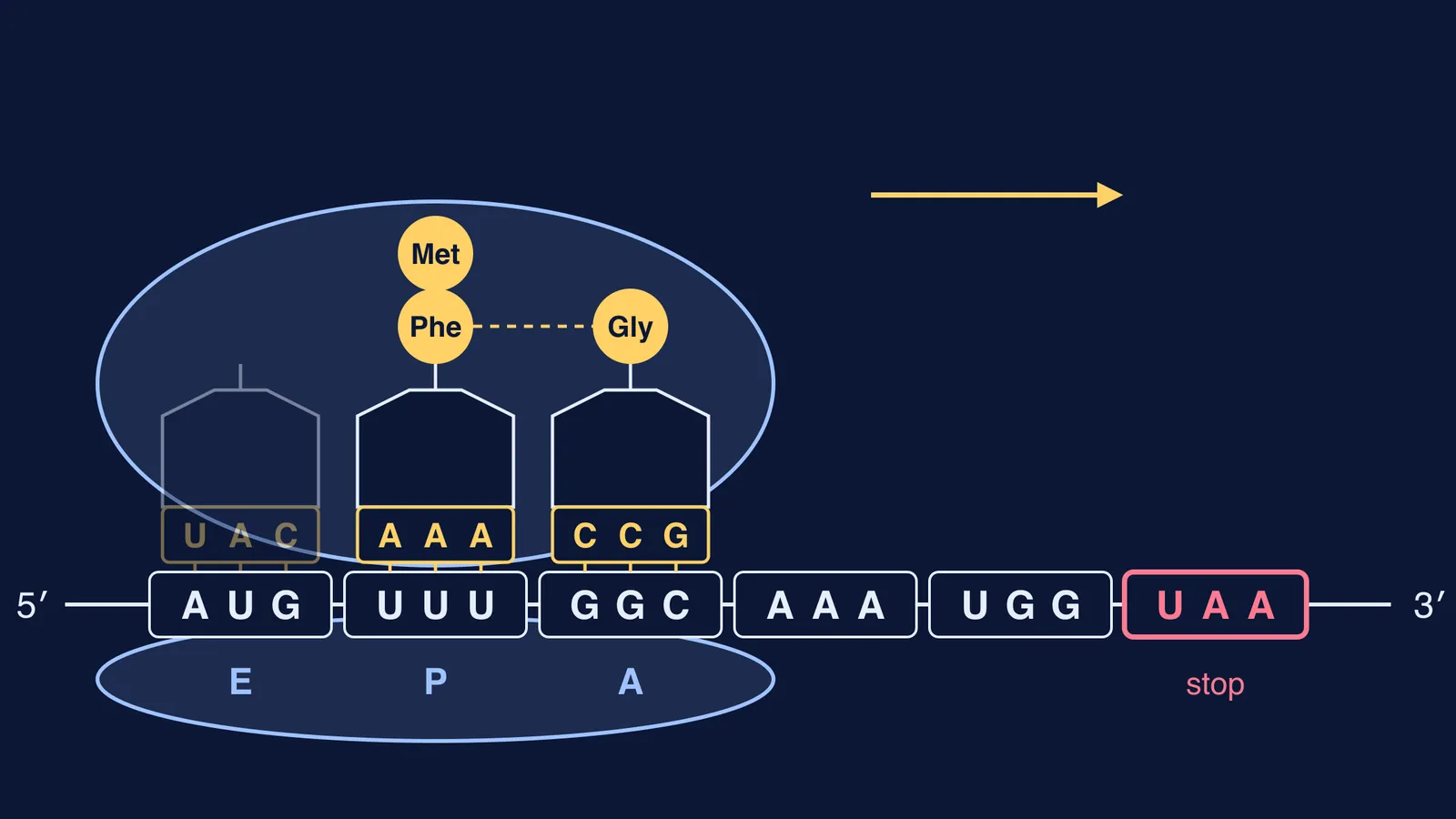
The ribosome moves along mRNA in the 5′-to-3′ direction, according to Nature Education's Scitable explainer on translation. It has three binding sites that work like a conveyor:
A site: an incoming tRNA's anticodon base-pairs with the codon.
P site: holds the tRNA carrying the growing chain.
E site: the exit site, where the empty tRNA sits before it leaves.
Each tRNA has one end that reads the codon by complementary base-pairing and another end that carries a specific amino acid (Scitable). A peptide bond forms between the amino acids in the P and A sites, then the ribosome moves one codon along and the cycle repeats. Reading begins at AUG, the initiation codon, which codes for methionine (Scitable).
How do you convert mRNA codons to amino acids?
Try this strand before reading the answer:
5′-CCAUGUUUGGCAAAUGGUAAGC-3′
Find the start. Scan from the 5′ end for the first AUG. It begins at the third base, so the leading CC is not translated.
Cut into codons from there: AUG, UUU, GGC, AAA, UGG, UAA, plus two leftover bases, GC.
Match the anticodons. RNA pairs A with U and G with C. Written 3′ to 5′ so they sit under their codons, the anticodons are UAC, AAA, CCG, UUU and ACC.
Look up each codon in the standard genetic code published by NCBI (it prints T in place of U): AUG is Met, UUU is Phe, GGC is Gly, AAA is Lys, UGG is Trp, and UAA is a stop.
Write the protein: Met-Phe-Gly-Lys-Trp. The stop codon adds nothing, and the final GC is never read.
The diagram at the top of this post freezes the ribosome mid-cycle on this strand: the tRNA that brought Met has moved to the E site, the P-site tRNA holds Met-Phe, and the tRNA carrying Gly has just paired with GGC in the A site.
What does a stop codon actually do?
The three termination codons are UAA, UAG and UGA, and no tRNA recognises them (Scitable). In their place a protein called a release factor binds, the mRNA is released from the ribosome and the ribosome comes apart (Scitable).
So a stop codon is not an amino acid, and it is not the end of the mRNA either. Our strand still has GC after UAA; the ribosome simply never gets there.
Now change one letter. Turn UGG into UGA and the fifth codon becomes a stop, so the protein shrinks to Met-Phe-Gly-Lys. A sequence change that creates a stop codon in place of a codon for an amino acid is called a nonsense mutation, according to the NHGRI glossary.
What happens if you start reading in the wrong place?
Ignore the AUG and start at the very first base: CCA, UGU, UUG, GCA, AAU, GGU, AAG. The same NCBI table gives Pro-Cys-Leu-Ala-Asn-Gly-Lys, a completely different chain with no stop in sight. Same letters, different reading frame, different protein.
Who worked out which codon means which amino acid?
In 1961 Marshall Nirenberg and J. Heinrich Matthaei reported protein synthesis in a cell-free extract of E. coli driven by synthetic RNA, in PNAS. Cold Spring Harbor's DNA Learning Center explains the key result: RNA made only of uracil produced chains made entirely of phenylalanine, so UUU had to code for phenylalanine.
The 1968 Nobel Prize in Physiology or Medicine went to Robert W. Holley, Har Gobind Khorana and Marshall W. Nirenberg "for their interpretation of the genetic code and its function in protein synthesis" (Nobel Prize).
How can you check your answer before writing the protein?
Run this five-point check on every translation question:
Is the strand mRNA (U, not T), read 5′ to 3′?
Did you start at the first AUG?
Are you counting in threes from that AUG, not from the first base?
Does each anticodon pair A with U and G with C?
Did you stop at UAA, UAG or UGA without adding an amino acid for it?
Stepping a ribosome one codon at a time is the kind of idea the Fermi Simulation Lab is for: interactive simulations for ideas that are easier to see than to read. If terms like reading frame still feel shaky, the Fermi Concept Library gives each biology concept its own lesson and its place in the map.
Try it now: write your own 20-base strand, swap one letter, and predict the new protein before you check.