

On this page
You are labelling the human excretory system and notice that a good diagram shows the right kidney a little lower than the left. That is not an artist's slip. It is how most bodies are built, and the reason fits in one word: the liver.
Why is the right kidney lower than the left kidney?
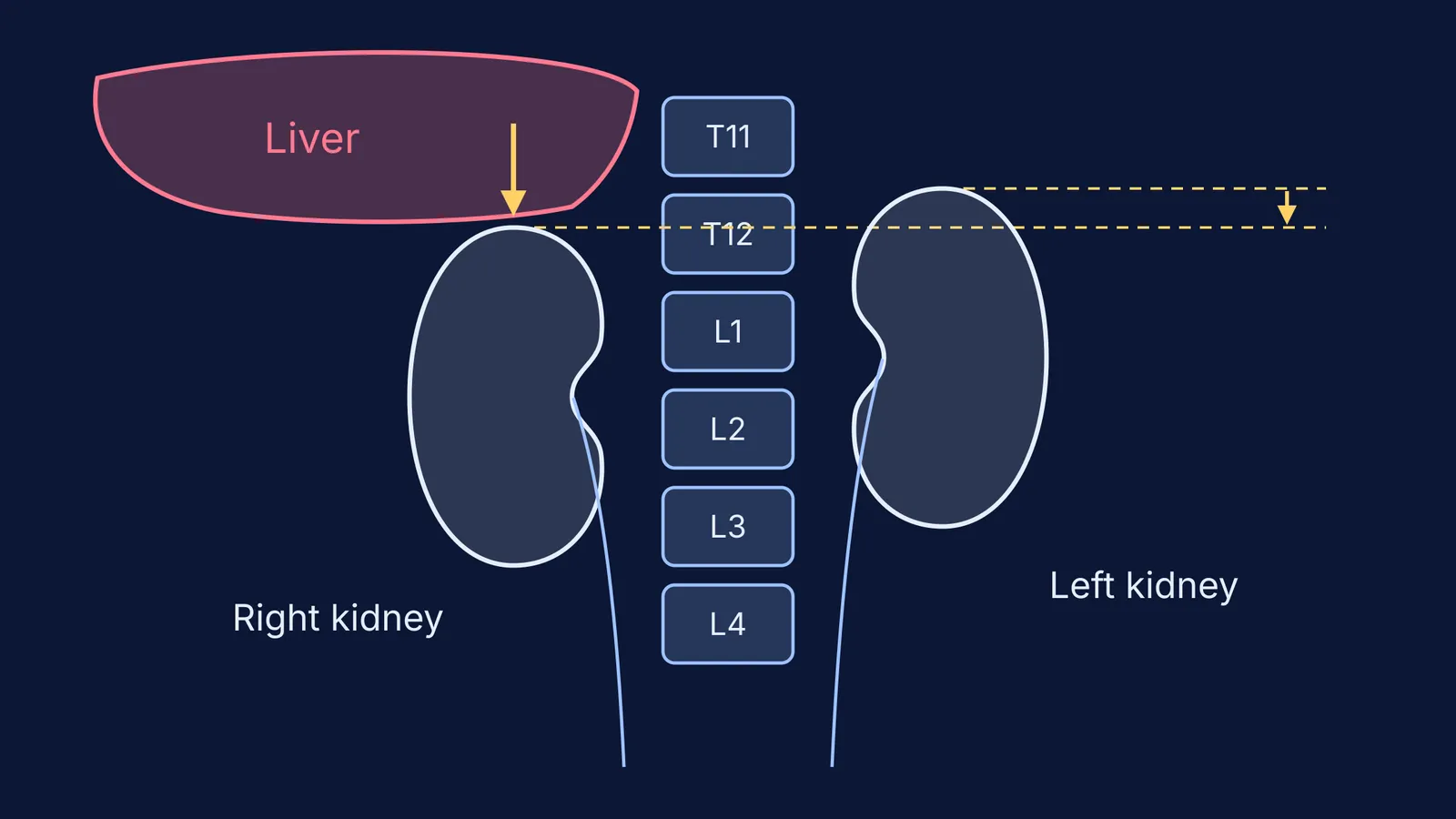
The liver sits in the right upper abdomen, above and in front of the right kidney. Kenhub's kidney anatomy page explains that the liver forces the right kidney a bit down, while the stomach forces the left kidney a bit up. TeachMeAnatomy says the same thing: the right kidney is often situated slightly lower because of the liver.
The Wikipedia article on the kidney sums it up: the asymmetry caused by the liver typically makes the right kidney slightly lower and slightly smaller than the left.
Two words matter here: "slightly" and "typically". The difference is small, and bodies vary. In a diagram, you show the right kidney a little lower, not far below the left.
What vertebral levels does NCERT give for the kidneys?
NCERT's Class 11 chapter Excretory Products and their Elimination says the kidneys are situated between the levels of the last thoracic and third lumbar vertebra, close to the dorsal inner wall of the abdominal cavity (NCERT Biology, Chapter 16). Anatomy references write this range as T12 to L3 (Kenhub).
The same NCERT section gives the numbers that turn up in one-mark questions. Each adult kidney measures:
Length: 10-12 cm
Width: 5-7 cm
Thickness: 2-3 cm
Average weight: 120-170 g
NCERT does not say which kidney is lower. Use that detail to draw and reason, and quote the T12 to L3 range when a question wants NCERT's words.
How do you draw the kidneys at the right height?
The diagram at the top of this page follows these six steps. It is a front view, so the body's right is on your left.
Draw six stacked blocks for the spine and label them T11, T12, L1, L2, L3 and L4 from the top.
Draw the left kidney (on the right of your page) as a bean from the top of T12 to the middle of L3. Each kidney is about three vertebrae long, according to TeachMeAnatomy.
Draw the right kidney (on the left of your page) the same size, shifted down a little, so its top sits just below the left kidney's top.
Turn the notch of each bean, the hilum, towards the spine. NCERT describes the hilum as a notch at the centre of the inner concave surface, through which the ureter, blood vessels and nerves enter.
Sketch the liver above the right kidney and add a short arrow pointing down.
Draw a ureter from each hilum towards the bladder, then label everything.
To add the bladder, urethra and blood vessels, follow our guide on how to draw and label the human excretory system diagram.
What do exam questions ask about kidney position?
Here are short answers you can write as they are.
Why is the right kidney slightly lower than the left? The liver occupies the right upper abdomen above the right kidney and pushes it down a little, so the right kidney sits slightly lower.
Where are the kidneys located? Between the levels of the last thoracic and third lumbar vertebrae, close to the dorsal inner wall of the abdominal cavity (NCERT's wording).
Which organs lie in front of the right kidney? TeachMeAnatomy lists the suprarenal gland, liver, duodenum and right colic flexure. This goes beyond NCERT, so use it for understanding.
Do the kidneys move? Yes, a little. The diaphragm covers the upper half of each kidney, so the kidneys move up and down with breathing (Kenhub), and they move down when you breathe in (Wikipedia).
These answers are for revision, not for reading your own body. If you have pain in your side or back, see a doctor rather than guessing which kidney is involved.
How can you make kidney position stick?
Tie the picture to the reason: remember where the liver sits and the lower right kidney follows. Our post on the functions of the liver is a good refresher. Then move inside the organ with the longitudinal section of the kidney: cortex, medulla and pelvis.
If the layout of the abdomen is hard to picture, Fermi's AI tutor can draw the figure with you and check your understanding as it goes. For a quick recap of each idea in this chapter, the Fermi Concept Library gives every biology concept its own lesson and its place in the map.
Tonight, close the book and draw the six-step sketch from memory. If both kidneys land beside T12 to L3 and the right one sits a little lower, you have it.


