

On this page
The human liver is a reddish-brown wedge sitting just under the right side of the diaphragm. The liver makes up about 2% of an adult's body weight 1. It is slightly larger in men than in women 2, and acts as a chemical factory, a storage depot and a waste-processing plant all at once. For biology exams such as NEET and the board exams, you need to know its exact roles in metabolism and digestion.
Is the liver a gland or an organ?
The liver is both an organ and a gland. It is widely recognised as the largest and most complex gland in the body, weighing between 1.2 and 1.6 kg in an adult 2.
A gland is defined as a structure that makes and secretes substances to be used by or cleared from the body. The liver does both. As an exocrine gland, it secretes bile into ducts that carry it to the intestine to help with digestion. As an endocrine-like gland, it makes essential proteins and releases them directly into the blood, fitting well with the systems you study in Chemical coordination for NEET: glands, hormones and their actions.
What are the main functions of the liver?
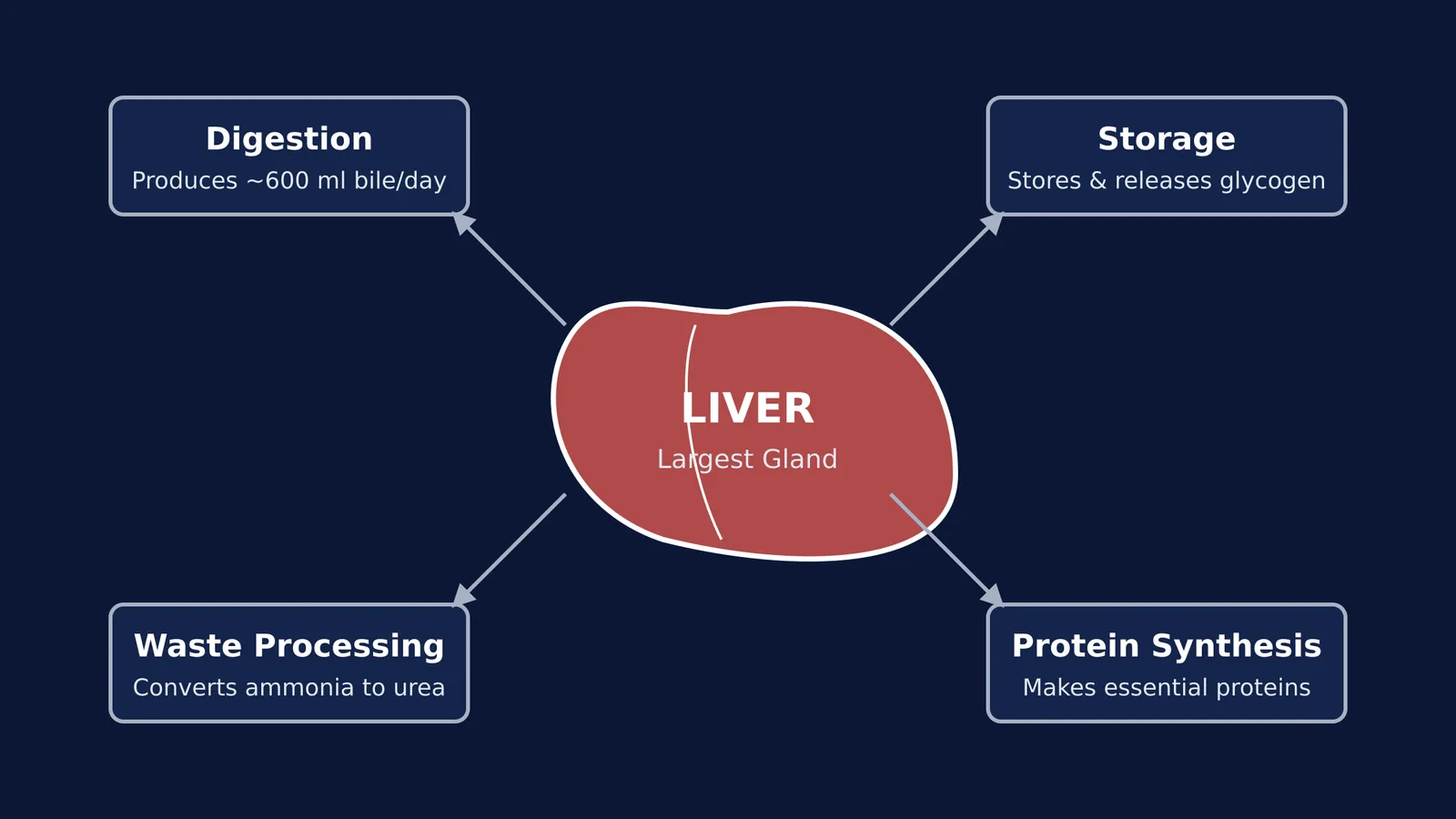
The liver performs hundreds of separate jobs, but the core ones you need to remember fall into four groups:
Producing bile for digestion: The liver produces approximately 600 ml of bile each day 3. The majority of this flow originates directly from the liver cells, or hepatocytes, driven by active transport systems. This greenish-yellow fluid contains bile salts that emulsify fats in the small intestine, breaking them down into tiny droplets so enzymes can work on them effectively. For a historical look at how scientists first tracked these processes, read about William Beaumont and watching digestion inside a living stomach.
Storing and releasing glycogen: It acts as the body's energy buffer. When blood glucose is high after a meal, the liver converts it into glycogen for storage. When you need energy between meals or during exercise, it breaks the glycogen back down into glucose and releases it into the blood to maintain steady energy levels.
Forming urea from toxic ammonia: When your body breaks down amino acids from proteins, it produces ammonia, which is highly toxic to the brain and nervous system. In a pathway called the urea cycle, which takes place across five enzymatic steps in the liver's mitochondria and cytoplasm, the liver converts this ammonia into water-soluble urea 4. The urea then travels in the blood to the kidneys, which filter it out into the urine. You can read more about the chemistry of this molecule in Friedrich Wöhler's urea synthesis and what it really showed.
Synthesising essential proteins: The liver builds almost all the proteins found in blood plasma, including albumin and critical clotting factors 1. Albumin is responsible for maintaining oncotic pressure, which keeps fluid from leaking out of blood vessels into surrounding tissues. Meanwhile, the clotting factors stop bleeding when you are cut.
How should you list liver functions for an exam?
When a board question asks for the functions of the liver, an unorganised paragraph is hard for an examiner to mark. Set your answer out as a clear, bulleted list so the key points stand out immediately.
Here is a checklist of points to include in a standard answer:
Digestion: Secretes bile to emulsify fats in the small intestine.
Carbohydrate metabolism: Stores excess glucose as glycogen and releases it when blood sugar drops.
Protein metabolism: Synthesises plasma proteins such as albumin and clotting factors.
Waste processing: Converts toxic ammonia into urea through the urea cycle for safe excretion.
Storage: Holds reserves of fat-soluble vitamins (A, D, E, K) and essential minerals such as iron.
Where do these functions fit into your revision?
Metabolic pathways such as the urea cycle or glycogen storage can feel abstract when you first learn them. If you are struggling to see how they connect to the digestive or circulatory systems, look up the topic in the Fermi Concept Library, which houses every concept in physics, chemistry, biology, mathematics and computing, each with its own lesson and its place in the map.
If you make mistakes when tracing these pathways in past papers, try working through them in the Fermi Problem Library. Fermi's AI tutor holds a line of reasoning across a whole session, notices where a student is stuck, and decides whether to explain, ask, or show.


