

On this page
Drop a grey tiger prawn into boiling water and within minutes it is coral red. Nothing red was added. The red pigment was in the shell all along, held by a protein that hid its colour. Cooking makes the protein let go.
What makes a raw prawn grey-blue?
The pigment is astaxanthin, a carotenoid. It belongs to the same broad family as bixin, the colour in annatto, and crocin, the colour in Kashmiri saffron. On its own, dilute astaxanthin is orange-red. In the shell, though, much of it sits inside a protein complex called crustacyanin.
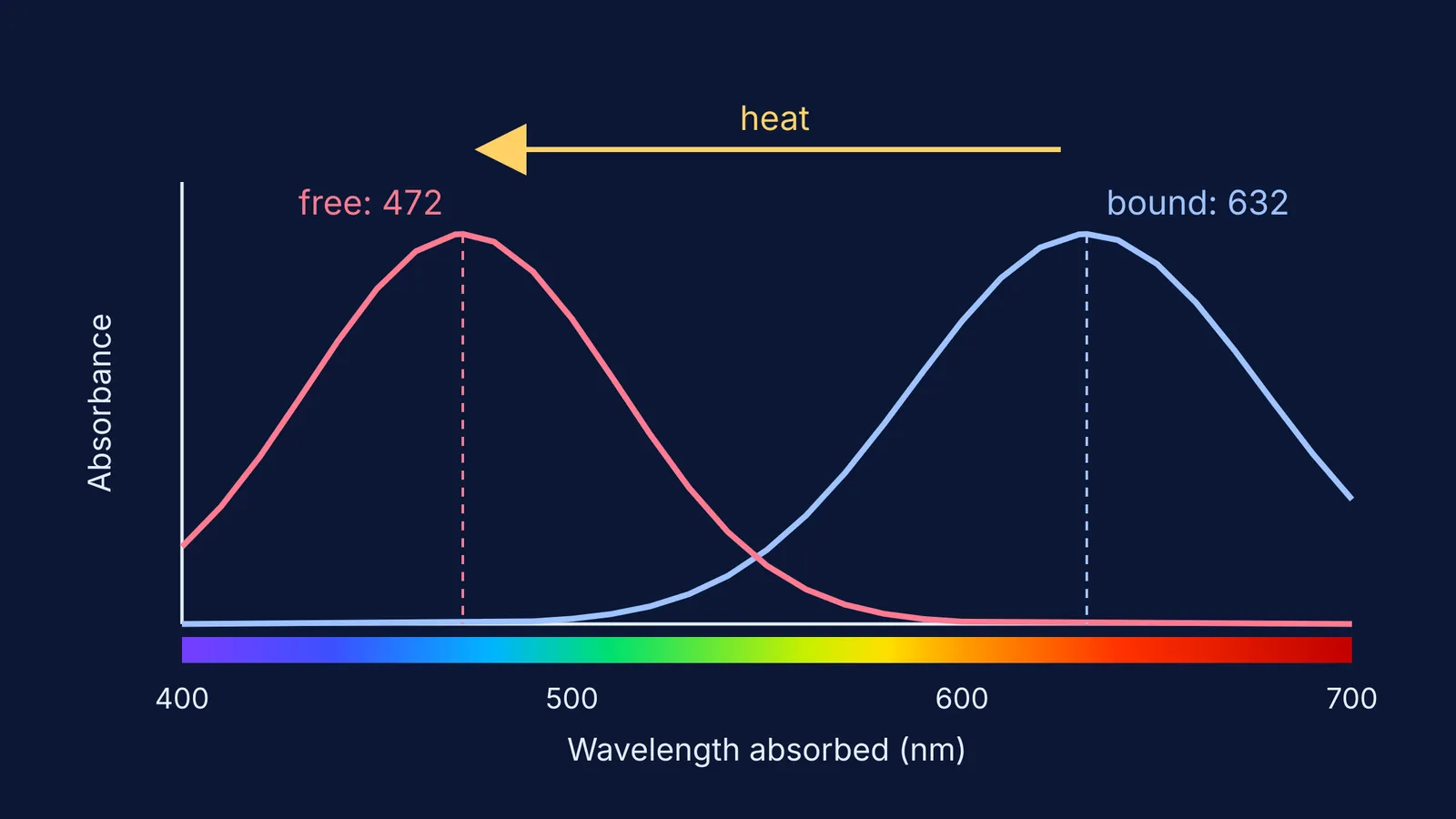
A UK team including Michele Cianci and John Helliwell solved the structure of part of this complex from lobster shell and published it in PNAS in 2002. They report that the full complex holds 16 astaxanthin molecules, built from eight paired protein units. Free astaxanthin absorbs light most strongly at 472 nm (in hexane), while astaxanthin inside the full crustacyanin complex absorbs most strongly at 632 nm, according to the same PNAS paper.
The rule that turns those numbers into colours: an object looks like the light it does not absorb. Absorb blue-green light near 472 nm and what reaches your eye is orange-red. Absorb orange-red light near 632 nm and the shell looks blue.
Why do prawns turn red when cooked?
Heat denatures proteins. It breaks the weak bonds that hold a protein in its folded shape, the same kind of change that turns egg white from clear to white (our explainer on denaturation of proteins covers the basics). The PNAS authors note that denaturation of the protein "can lead to relaxation of the clasp" on astaxanthin, and that cooking must involve complete and irreversible denaturation. Once the clasp opens, the pigment absorbs like free astaxanthin again, and the shell shows its orange-red.
They also point to a neat clue in the same PNAS paper: extracted crustacyanin turns red when it is dried out and goes back to blue when water is added again. So the blue does not come from a different molecule. It comes from the protein holding the same pigment in a particular shape.
Does the same thing happen in prawns, not just lobsters?
Yes. A 2012 study in the Journal of Experimental Biology by Nicholas Wade and colleagues worked with the black tiger prawn, Penaeus monodon. The authors describe the astaxanthin and crustacyanin pairing as the source of shell colour and write that during cooking "this interaction is disrupted, releasing the distinct red colouration of cooked seafood."
They kept prawns on black or white backgrounds for 6 weeks, then boiled each one for 2 minutes and measured its colour before and after, as reported in the same study. Prawns from black tanks had more crustacyanin protein, and their colour changed more on cooking than that of prawns kept on white. The total level of the pigment itself stayed about the same. The protein, not the amount of pigment, decided how dark the raw prawn looked and how red the cooked one turned.
How do you explain it in an exam answer?
Here is a four-step answer you can use for a short-answer question in chemistry or biology:
Name the pigment: astaxanthin, a carotenoid that is orange-red when free.
Name the protein and its effect: crustacyanin binds astaxanthin and shifts its absorption to longer wavelengths, so the live shell looks blue-grey.
Name the process: heat denatures crustacyanin and releases astaxanthin.
Link to colour: free astaxanthin absorbs blue-green light, so we see orange-red.
The common slip is writing "cooking makes a red pigment". The better line is "cooking reveals a pigment that was already there."
A worked example with energy
You can put a number on the shift using E = hc/λ, with hc of about 1240 eV nm and the two peak wavelengths from the PNAS paper. Light at 472 nm carries 1240/472, about 2.63 eV per photon. Light at 632 nm carries 1240/632, about 1.96 eV. So binding to crustacyanin moves the pigment's absorption peak to photons with roughly 0.67 eV less energy, and cooking undoes that. If this link between wavelength and energy is the shaky step for you, the Fermi Problem Library has worked problems with a step-by-step solver that explains the reasoning rather than printing an answer.
What to look at next
Three ideas meet in this one plate of prawns: carotenoid pigments, protein folding, and how absorbed light sets the colour you see. If any one of them feels thin, the Fermi Concept Library has a lesson for every concept in chemistry and biology, each with its place in the map, so you can see how they connect.


