

On this page
Your Class 10 textbook puts it in one line: food coming from the stomach “is acidic and has to be made alkaline for the pancreatic enzymes to act” (NCERT Class 10 Science, Life Processes). Here is the chemistry behind that line.
Why is pancreatic juice alkaline?
Pancreatic juice carries two things: digestive enzymes such as trypsin and lipase, and a watery fluid rich in bicarbonate ions (HCO₃⁻). The bicarbonate makes the juice alkaline.
In many species, the pancreatic duct lining secretes bicarbonate at a concentration of around 140 mM, according to a review by Steward, Ishiguro and Case (Annual Review of Physiology, 2005).
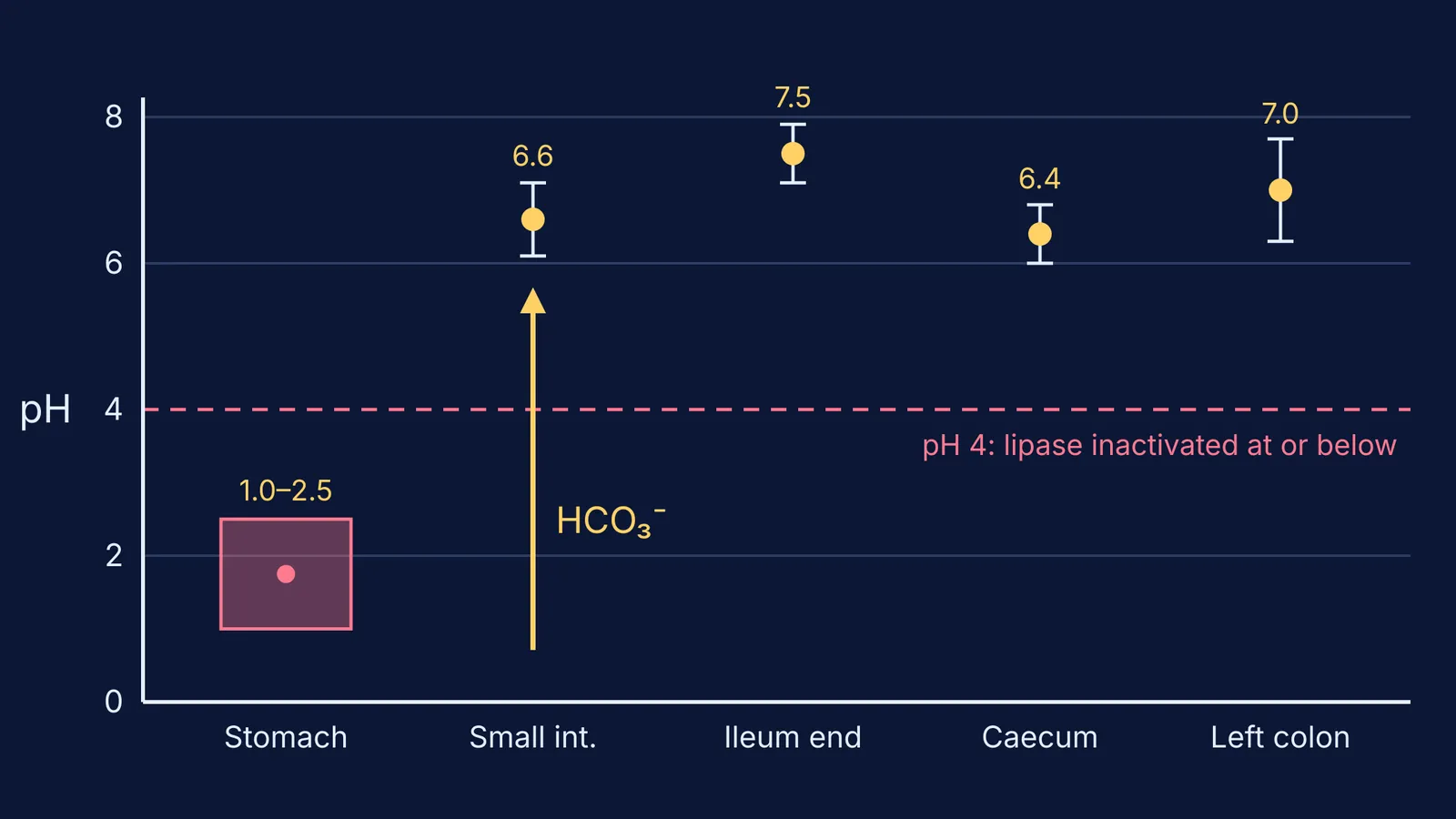
The reason the body goes to this trouble is stomach acid. In 66 healthy volunteers who swallowed a pH-sensing radio capsule, gastric pH ranged from 1.0 to 2.5 (Evans et al., Gut, 1988).
Pancreatic lipase cannot survive that: “Lipase is irreversibly inactivated at a pH of 4 or less” (Trang, Chan and Graham, World Journal of Gastroenterology, 2014). The same review says fat digestion is disrupted when pancreatic bicarbonate fails to neutralise acidic gastric contents.
The same pH rise also switches off the stomach's own protein enzyme; see why pepsin stops working in the small intestine.
What is the neutralisation equation?
Stomach acid is hydrochloric acid. If you write the bicarbonate as sodium bicarbonate, the reaction is the one you know from baking soda:
HCl + NaHCO₃ → NaCl + H₂O + CO₂
The ionic version shows what really matters:
H⁺ + HCO₃⁻ → H₂CO₃ → H₂O + CO₂
Two things to notice. First, the ratio is 1:1, so one bicarbonate ion removes one hydrogen ion. Second, the carbonic acid formed breaks down into water and carbon dioxide, so the acid is removed rather than just diluted.
What does the pH map of the gut look like?
The Evans study tracked the capsule from stomach to colon and reported these values (Gut, 1988):
Stomach: pH 1.0 to 2.5
Upper small intestine, first hour: mean pH 6.6
End of the ileum: mean pH 7.5
Caecum: mean pH 6.4
Left colon: mean pH 7.0
The biggest jump on the whole map is from stomach to upper small intestine, and that is where pancreatic juice enters.
How much bicarbonate does it take? A worked example
Here is a simplified sum. It treats chyme as plain hydrochloric acid and ignores the buffering done by food itself and by bile.
Chyme at pH 2 has [H⁺] = 10⁻² mol/L, which is 10 mmol/L.
In 10 mL of it: 10 mmol/L × 0.010 L = 0.1 mmol of H⁺.
The reaction is 1:1, so you need 0.1 mmol of HCO₃⁻.
At about 140 mmol/L of bicarbonate (Steward et al., 2005), the volume needed is 0.1 ÷ 140 L, which is about 0.71 mL.
So in this idealised model, less than a millilitre of juice neutralises 10 mL of pH 2 acid.
The log scale also tells you how big the change is. Going from pH 2 to the pH 6.6 measured in the upper small intestine (Evans et al., 1988) means 10^4.6, or roughly 40,000 times, fewer hydrogen ions.
If you want more practice with sums like this, the Fermi Problem Library has worked problems with a step-by-step solver that explains the reasoning rather than printing an answer.
What tells the pancreas to release bicarbonate?
The acid itself. Isenberg, Cano and Bloom put graded amounts of hydrochloric acid into the duodenum of healthy subjects and duodenal ulcer patients. They found graded increases in pancreatic bicarbonate output and a significant rise in the hormone secretin in the blood (Gastroenterology, 197780293-x)).
So the system matches its response to the load: more acid in the duodenum, more bicarbonate from the pancreas, with secretin as the signal. For how secretin fits with gastrin, CCK and GIP, read our guide to the four gut hormones.
How should you write this in an exam?
Cover these four points:
Source: the pancreatic ducts add bicarbonate (HCO₃⁻) to pancreatic juice.
Job: it neutralises the HCl in chyme, H⁺ + HCO₃⁻ → H₂O + CO₂.
Reason: pancreatic enzymes need a near-neutral medium, and lipase is irreversibly inactivated at pH 4 or below (Trang et al., 2014).
Trigger: acid in the duodenum raises secretin, which increases bicarbonate output.
Add that bile also helps make the food alkaline, as the NCERT chapter notes. For the full list of enzymes in the juice, see enzymes of pancreatic juice and succus entericus.
If pH as a log scale or acid-base reactions still feel shaky, the Fermi Concept Library covers every concept in chemistry and biology, each with its own lesson and its place in the map.


