

On this page
The small intestine is where digestion finishes. NCERT's Class 10 science book says the small intestine "is the site of the complete digestion of carbohydrates, proteins and fats", using secretions from the liver and pancreas plus its own intestinal juice (NCERT Class 10 Science, Chapter 5). Class 11 students need the longer version: each enzyme, what it acts on and what it makes. This page gives you that list, then a blank chart to fill in from memory.
One thing to know first. The current NCERT Class 11 Biology book (reprint 2026-27) has no digestion chapter, and its Chapter 16 is now Excretory Products and their Elimination (NCERT Class 11 Biology, contents). CBSE still publishes Digestion and Absorption as Class XI reading material for 2025-26, and that document names the January 2019 NCERT textbook as its source (CBSE Class XI Biology reading material). Every reaction below follows that text. If you are preparing for NEET-UG, check the current official syllabus before you decide how much time to give this topic.
Which enzymes are in pancreatic juice?
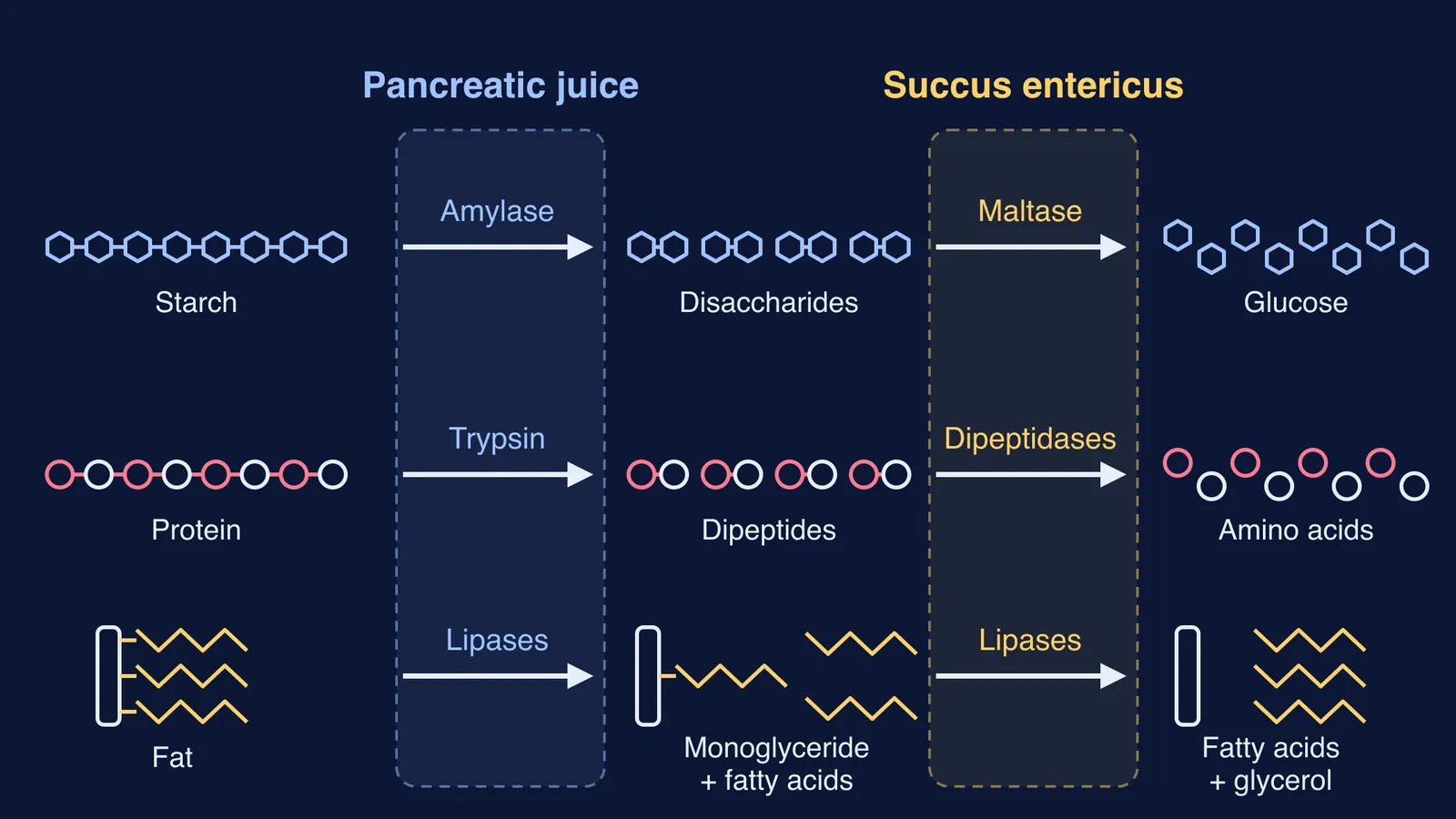
Pancreatic juice and bile enter the duodenum through the hepato-pancreatic duct. NCERT says pancreatic juice "contains inactive enzymes – trypsinogen, chymotrypsinogen, procarboxypeptidases, amylases, lipases and nucleases" (CBSE reading material, from NCERT). Here is what each one does once it is active:
Trypsin, chymotrypsin and carboxypeptidase: proteins, proteoses and peptones → dipeptides
Pancreatic amylase: polysaccharides (starch) → disaccharides
Lipases: fats → diglycerides → monoglycerides, with help from bile
Nucleases: nucleic acids → nucleotides → nucleosides
Enterokinase, secreted by the intestinal mucosa, converts trypsinogen into active trypsin, and trypsin then activates the other enzymes in pancreatic juice. That makes enterokinase an intestinal enzyme, not a pancreatic one, and an easy one to mix up. Our post on zymogens and how enterokinase activates trypsinogen explains why the pancreas makes these enzymes in inactive form.
Bile also arrives here, and NCERT is clear that it contains no enzymes. It emulsifies fats and activates lipases, as our explainer on how bile helps digest fat shows.
Which enzymes are in succus entericus?
Succus entericus is the intestinal juice: the secretions of the brush border cells of the intestinal mucosa together with the secretions of the goblet cells (CBSE reading material, from NCERT). NCERT lists "disaccharidases (e.g., maltase), dipeptidases, lipases, nucleosidases, etc." and gives these reactions:
Dipeptidases: dipeptides → amino acids
Maltase: maltose → glucose + glucose
Lactase: lactose → glucose + galactose
Sucrase: sucrose → glucose + fructose
Nucleotidases: nucleotides → nucleosides
Nucleosidases: nucleosides → sugars + bases
Lipases: di- and monoglycerides → fatty acids + glycerol
The same text says mucus and bicarbonates from the pancreas give these enzymes an alkaline medium of pH 7.8. The breakdown happens in the duodenum, very close to the mucosal epithelial cells, and the simple products are absorbed in the jejunum and ileum. For that next step, see our guide to villi and absorption in the small intestine.
Does NCERT's list match university textbooks?
Yes, but university textbooks go into more detail. OpenStax's Anatomy and Physiology textbook also names elastase among the pancreatic protein-digesting enzymes, lists aminopeptidase and α-dextrinase among the brush border enzymes, and splits pancreatic nucleases into deoxyribonuclease for DNA and ribonuclease for RNA (OpenStax Anatomy and Physiology 2e, section 23.7). It also says pancreatic lipase breaks each triglyceride into two free fatty acids and a monoglyceride. In school exams, write NCERT's version.
How do you revise it with a fill-in chart?
Copy this chart onto a blank page and leave the gaps empty. Fill every blank from memory, check it against the lists above, and mark each wrong blank in a different colour.
Proteins, proteoses, peptones → ______, ______, ______ (pancreatic) → ______
Dipeptides → ______ (intestinal) → ______
Starch → ______ (pancreatic) → ______
Maltose → ______ → glucose + ______
Lactose → lactase → ______ + ______
Sucrose → ______ → glucose + ______
Fats → ______ (helped by bile) → ______ → ______
Di- and monoglycerides → lipases → ______ + ______
Nucleic acids → ______ → ______ → nucleosides
Nucleosides → ______ → ______ + ______
Trypsinogen → trypsin, activated by ______, which comes from the ______
Redo the chart the next day and again at the end of the week. Each time, re-read only the rows you got wrong. Then test yourself with three quick questions:
Which secretion entering the small intestine contains no enzymes? (Bile.)
Which enzyme activates trypsinogen, and where does it come from? (Enterokinase, from the intestinal mucosa.)
Which disaccharide gives galactose? (Lactose, broken down by lactase.)
If one row keeps coming back wrong because the reason never clicked, look it up in the Fermi Concept Library, which has a lesson for every concept in biology.
Once the chart comes back clean twice in a row, move on to absorption.


