

On this page
If you have ever tried to wash an oily kadhai with plain water, you know the problem your small intestine faces. Fat does not mix with water, but the enzyme that digests fat works from the watery side. Bile solves this without digesting anything itself.
What does bile do to fat in the small intestine?
NCERT's Class 10 chapter Life Processes says fats reach the intestine as large globules that are hard for enzymes to act on, and bile salts break them into smaller globules, increasing the efficiency of enzyme action (NCERT Class 10 Science, Chapter 5). It compares this to soap acting on dirt.
Emulsification is the breaking of large fat globules into many small droplets spread through the watery intestinal contents. Bile salts can do this because each molecule has a nonpolar, water-hating region and a polar, water-loving region (OpenStax Anatomy and Physiology 2e, section 23.6). OpenStax puts the resulting fat fragments at about 1 µm in diameter.
Pancreatic lipase then breaks each triglyceride into two free fatty acids and a monoglyceride (OpenStax section 23.7). Bile salts help again: with lecithin, they wrap these products into micelles, tiny spheres with water-loving ends facing out. Without micelles, OpenStax notes, lipids would sit on the surface of the chyme and never reach the absorbing cells.
Why does bile have no enzyme if it helps digestion?
Because its job is physical, not chemical. An enzyme breaks bonds. Emulsification only turns one big drop into many small ones, and every fat molecule is still a fat molecule afterwards.
OpenStax section 23.6 lists what bile contains: water, bile salts, bile pigments, phospholipids such as lecithin, electrolytes, cholesterol and triglycerides. There is no digestive enzyme on that list, and the StatPearls review of bile secretion gives the same main components.
NCERT also notes that food leaving the stomach is acidic and must be made alkaline for pancreatic enzymes to act, and bile does this. The enzymes come from the pancreas: NCERT names trypsin for proteins and lipase for emulsified fats.
One trap: the liver does use enzymes to make bile acids from cholesterol (StatPearls names cholesterol 7-alpha-hydroxylase as the rate-limiting one) inside liver cells. The bile that reaches your intestine carries no digestive enzyme.
Where is bile made and stored?
Made in the liver, by cells called hepatocytes. OpenStax says they secrete about one litre of bile a day; StatPearls puts total bile flow at about 600 mL a day.
Stored in the gallbladder, an 8 to 10 cm sac on the back surface of the liver's right lobe, which concentrates bile by up to 10-fold by absorbing water and ions.
Released into the small intestine through the common bile duct. When fatty chyme enters the duodenum, it triggers the hormone cholecystokinin (CCK), which makes the gallbladder contract and push bile into the common bile duct.
Recycled: only about 5% of bile acids are eventually excreted; most are reabsorbed from the ileum and returned to the liver.
Our post on the functions of the liver, the largest gland covers its other jobs.
How much surface does emulsification add? A worked example
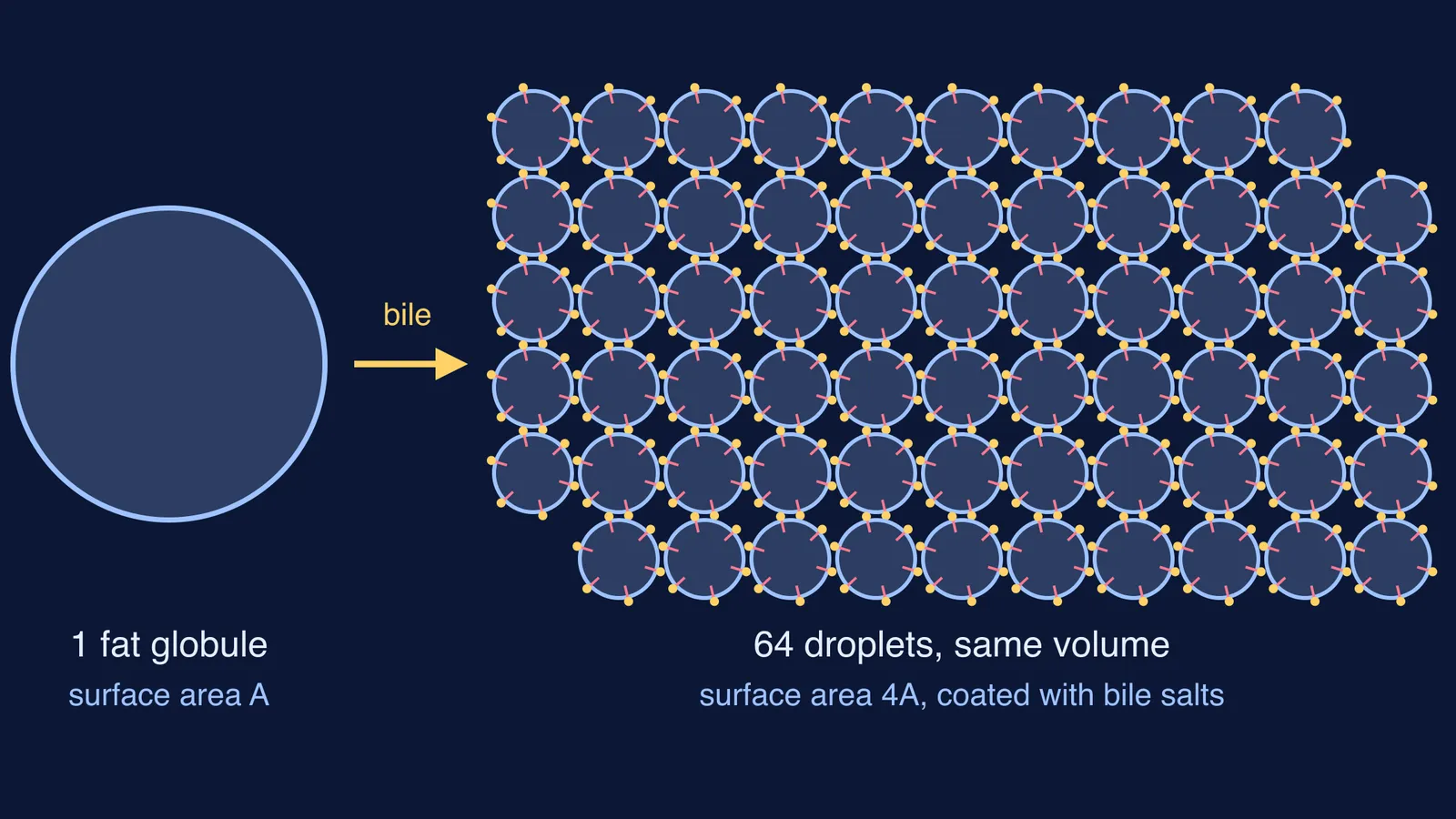
A sphere's volume grows with r³ but its surface grows with r². Split one globule of radius R into droplets of radius r and you get (R/r)³ droplets, with (R/r) times the original surface.
Suppose a fat globule 10 µm across splits into droplets 1 µm across, the size OpenStax gives.
R/r = 10, so you get 10³ = 1,000 droplets.
A sphere's surface is π × d², where d is its diameter. Big globule: π × 10² ≈ 314 µm². Each droplet: π × 1² ≈ 3.14 µm². All 1,000 droplets: about 3,140 µm².
The surface has grown tenfold, and not a single chemical bond has broken.
Lipase works from the watery side, so more surface means more places for it to act. The diagram above shows R/r = 4: 64 droplets, 4 times the surface. See also how bile boosts surface area for lipase.
How do you write this in a board or NEET-UG answer?
Use this checklist for a 3-mark answer:
Name the process: emulsification of fats.
Say who makes bile and who stores it: liver, gallbladder.
Say what bile salts do: break large fat globules into small droplets, increasing surface area for lipase.
State that bile contains no digestive enzyme, and name the enzyme that acts: pancreatic lipase.
Add the extra point: bile makes the acidic food alkaline so pancreatic enzymes can act.
To place lipase alongside every other enzyme, see our guide to digestive enzymes for Class 10 and where each one acts. If micelles or the surface-area maths still feel shaky, the Fermi Concept Library gives every biology concept its own lesson and its place in the map. For practice, the Fermi Problem Library has worked problems with a step-by-step solver that explains the reasoning rather than printing an answer.
Remember it as: bile emulsifies, lipase digests.


