On this page
Ask a class what bile does and many students will say it digests fat. Make your own prediction now, then test it with the numbers below. The answer: bile does a physical job, not a chemical one.
Does bile digest fat itself?
No. NCERT's Class 10 science textbook, in the chapter Life Processes, says fats reach the small intestine "in the form of large globules which makes it difficult for enzymes to act on them", and that "bile salts break them down into smaller globules increasing the efficiency of enzyme action." The same page says pancreatic juice contains "lipase for breaking down emulsified fats".
Bile is an aqueous solution made by the liver that consists mainly of bile salts, phospholipids, cholesterol, conjugated bilirubin, electrolytes and water, according to the review Physiology, Bile Secretion on NCBI Bookshelf. There is no fat-digesting enzyme on that list.
So the exam-ready line is short: bile emulsifies fat; lipase digests it. If you want to place the liver, gall bladder and pancreas on the gut before going further, our labelled figure of the alimentary canal and digestive glands shows where each juice enters.
Why does surface area matter for lipase?
Lipase dissolves in water and fat does not, so the two can only meet at the boundary between them. In a review in Advances in Colloid and Interface Science, P. J. Wilde and B. S. Chu write that digestive lipases "have to adsorb to the oil water interface in order to hydrolyse triacylglycerols into fatty acids and mono glycerides". Fat buried inside a big globule is out of reach until the globule is split.
A second review, The role of bile salts in digestion, describes bile salts as bio-surfactants that adsorb onto fat droplets. Wilde and Chu add that pancreatic lipase also needs bile salts and colipase to work well, and that bile salts carry the products away in mixed micelles. Bile helps in several ways; cutting fat molecules is not one of them.
NCERT compares bile to the way soap emulsifies dirt, and our post on why mayonnaise does not separate shows the same trick in a kitchen.
How much does splitting a fat droplet raise the surface area?
Here is a paper simulation you can run in two minutes. Keep the amount of fat fixed and split it into equal spheres. Total surface area equals 6 × volume ÷ diameter, so halving the diameter makes 8 droplets and doubles the area.
Predict first: if you split one 8 µm droplet down to 1 µm droplets, how many times more surface does lipase get? Then check:
One droplet, 8 µm across: area 1 unit.
Split to 4 µm: 8 droplets, area 2 units.
Split to 2 µm: 64 droplets, area 4 units.
Split to 1 µm: 512 droplets, area 8 units.
If lipase is plentiful and works only at the surface, the starting rate of digestion rises in step with area: 8 times faster at step 4 in this model.
The model breaks when something else runs short. Wilde and Chu note that fatty acids and monoglycerides pile up at the interface and slow lipase down, one reason bile's micelles matter. Once enzyme, not surface, is the limit, extra surface stops helping.
What did a human study find about droplet size?
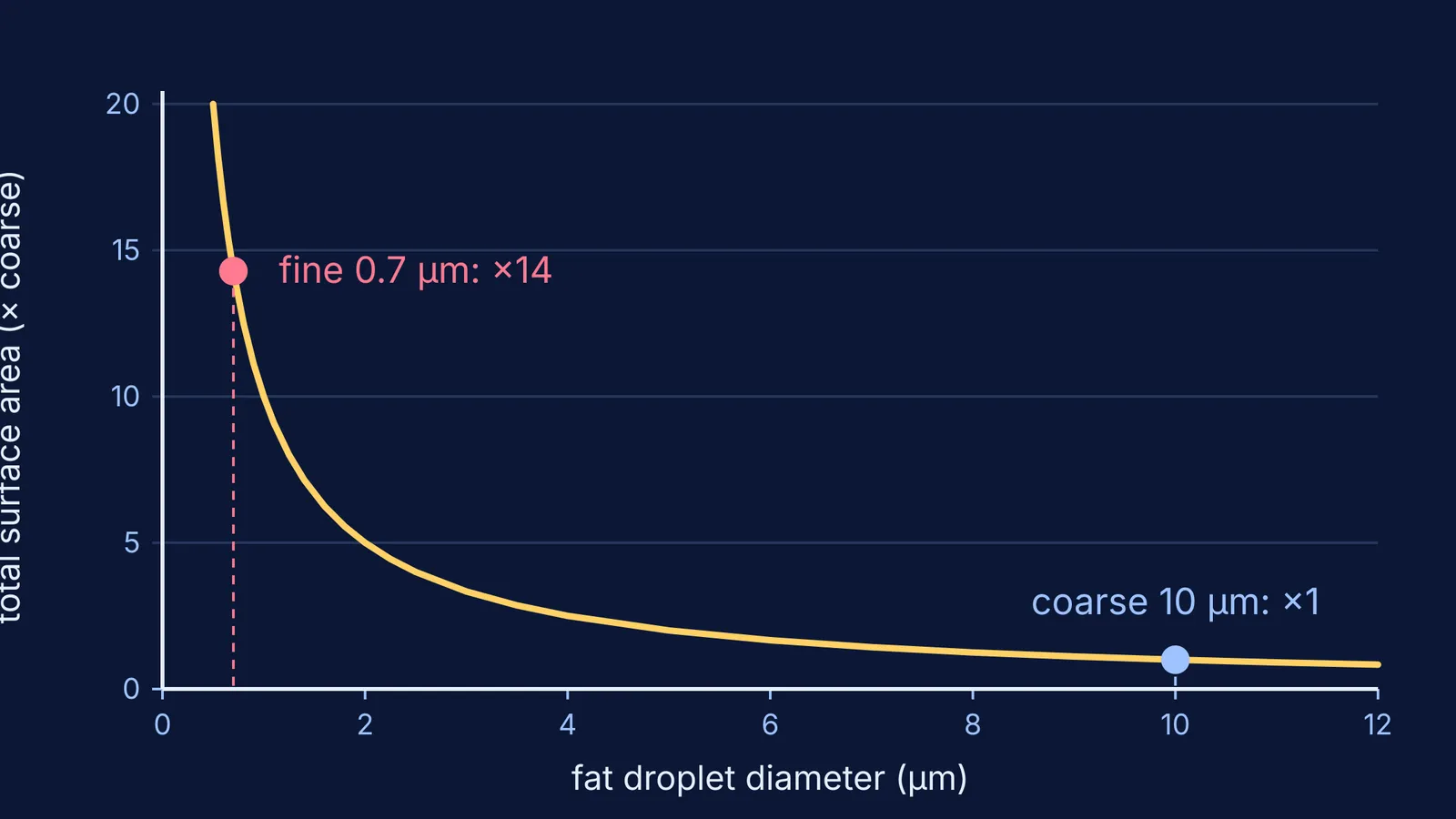
In a 1999 study in The American Journal of Clinical Nutrition, Armand and colleagues put a coarse emulsion with 10 µm fat droplets and a fine one with 0.7 µm droplets, identical in composition, into healthy volunteers' stomachs by tube. The fine droplets grew in the stomach but stayed smaller, and lipolysis there was 36.5% against 15.8%. That stomach step is gastric lipase working before bile arrives. In the duodenum, lipolysis of the fine emulsion was on the whole higher: 73.3% against 46.3%.
By the rule above, the same fat as 0.7 µm droplets starts with 10 ÷ 0.7, or about 14 times, the surface of 10 µm droplets. Yet the study found overall fat assimilation in the healthy volunteers was not affected, which the authors put down to efficient digestion by pancreatic lipase in the small intestine. Surface area changes the speed; a healthy gut still gets there. This is physiology, not diet advice; take digestion symptoms to a doctor.
How can you test this yourself?
Shake cooking oil and water in a jar and watch the blobs rejoin. Repeat with a drop of washing-up liquid and look for a cloudy, slow-to-separate mix.
Redo the paper simulation from 12 µm down to 3 µm, predicting each answer before you calculate it.
Compare with starch: our amylase and iodine test post shows an enzyme acting on a substrate that dissolves, so no emulsifier is needed.
Some ideas, like the jump from droplet size to surface area, are easier to see than to read; the Fermi Simulation Lab has interactive simulations for ideas like these.