On this page
If you pour oil and water into a glass, they immediately separate into two distinct layers. Yet mayonnaise, which is mostly oil and water (in the form of vinegar or lemon juice), remains thick, creamy and perfectly mixed for months.
The difference is egg yolk, which contains a powerful chemical emulsifier called lecithin.
Why do oil and water separate?
Water molecules are polar, meaning they have a slightly positive end and a slightly negative end. This polarity allows them to form strong hydrogen bonds with each other. Oil molecules, however, are non-polar. They cannot form hydrogen bonds with water.
When mixed, water molecules attract each other so strongly that they squeeze the oil molecules out. The oil and water separate to minimise their surface area of contact, a phenomenon known as the hydrophobic effect.
What makes mayonnaise an emulsion?
Mayonnaise is an oil-in-water emulsion. It typically consists of 65% to 80% oil by volume, suspended as microscopic droplets within a continuous water phase (Food Hydrocolloids).
If you vigorously whisk oil and vinegar together, you create a temporary dispersion. The mechanical force of the whisk breaks the oil into tiny droplets, but the moment you stop, the droplets collide and merge (coalesce) back into a single layer of oil. To keep the droplets permanently suspended, the mixture needs an emulsifier.
How does lecithin act as an emulsifier?
Egg yolk contains a phospholipid called lecithin (phosphatidylcholine), which is the primary emulsifier in mayonnaise (Foods).
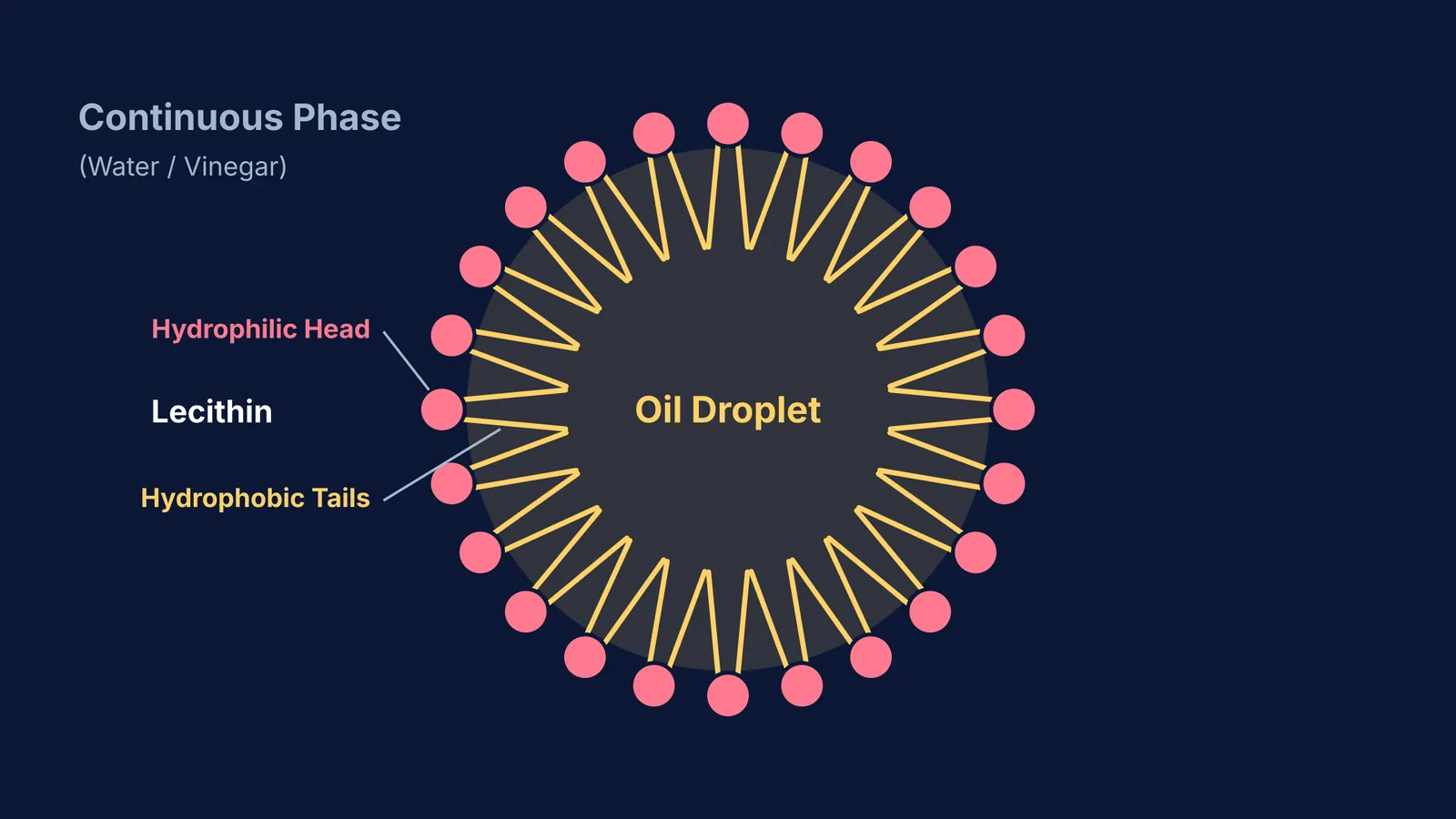
Lecithin is an amphiphilic molecule, meaning it has two distinct regions with opposite properties:
A hydrophilic (water-loving) head: A polar phosphate group that is strongly attracted to water.
A hydrophobic (oil-loving) tail: Two long fatty acid chains that are repelled by water and attracted to oil.
When you whisk oil into the water base, the oil breaks into tiny droplets. The lecithin molecules immediately align themselves at the interface between the two liquids. Their hydrophobic tails bury into the oil droplets, while their hydrophilic heads point outward into the surrounding water.
This creates a protective film around each oil droplet. The outward-facing hydrophilic heads act as a physical and electrostatic barrier, repelling other coated oil droplets and preventing them from coalescing. Because the droplets are kept so small and are packed so tightly together, they cannot move freely, which gives mayonnaise its characteristic thick, semi-solid texture.
If you find it hard to picture how molecules arrange themselves at the boundaries of different liquids, the Fermi Simulation Lab lets you explore interactive models of molecular interactions and phases.
What causes mayonnaise to "break"?
Sometimes, mayonnaise separates into a curdled, oily mess. This happens when the emulsion "breaks," meaning the oil droplets have coalesced. This usually occurs for three reasons:
Adding oil too quickly: If you pour the oil in too fast, the mechanical whisking cannot break it into small enough droplets, and the lecithin cannot coat the surface area fast enough.
Saturation: If the ratio of oil to water exceeds about 80% (Food Hydrocolloids), there is no longer enough continuous water phase to keep the droplets separated.
Temperature extremes: High heat can denature the supporting proteins in the egg yolk, while freezing can force the water to crystallise, physically crushing the oil droplets and breaking the lecithin barrier.
How does this compare to other biological molecules?
The same chemical principles that stabilise mayonnaise also govern how living cells operate. The cell membrane is made of a phospholipid bilayer, which behaves much like lecithin. The hydrophilic heads face the watery environments inside and outside the cell, while the hydrophobic tails hide in the middle, creating a waterproof barrier.
You can read more about how molecules behave based on their solubility in our guide to the acid-soluble pool vs acid-insoluble fraction, explained. Understanding these non-polar interactions also explains why soap is necessary to wash grease off your hands, or how alcohol-based hand sanitiser kills germs by disrupting their lipid membranes. If you are experimenting with how density and buoyancy govern floating layers, you can test predictions in a buoyancy and density simulation.