

On this page
Diagrams often draw the sperm far too big next to the egg. In real life the egg is a giant ball and the sperm a tiny dart, because the two cells have opposite jobs.
How big are the human egg and sperm, really?
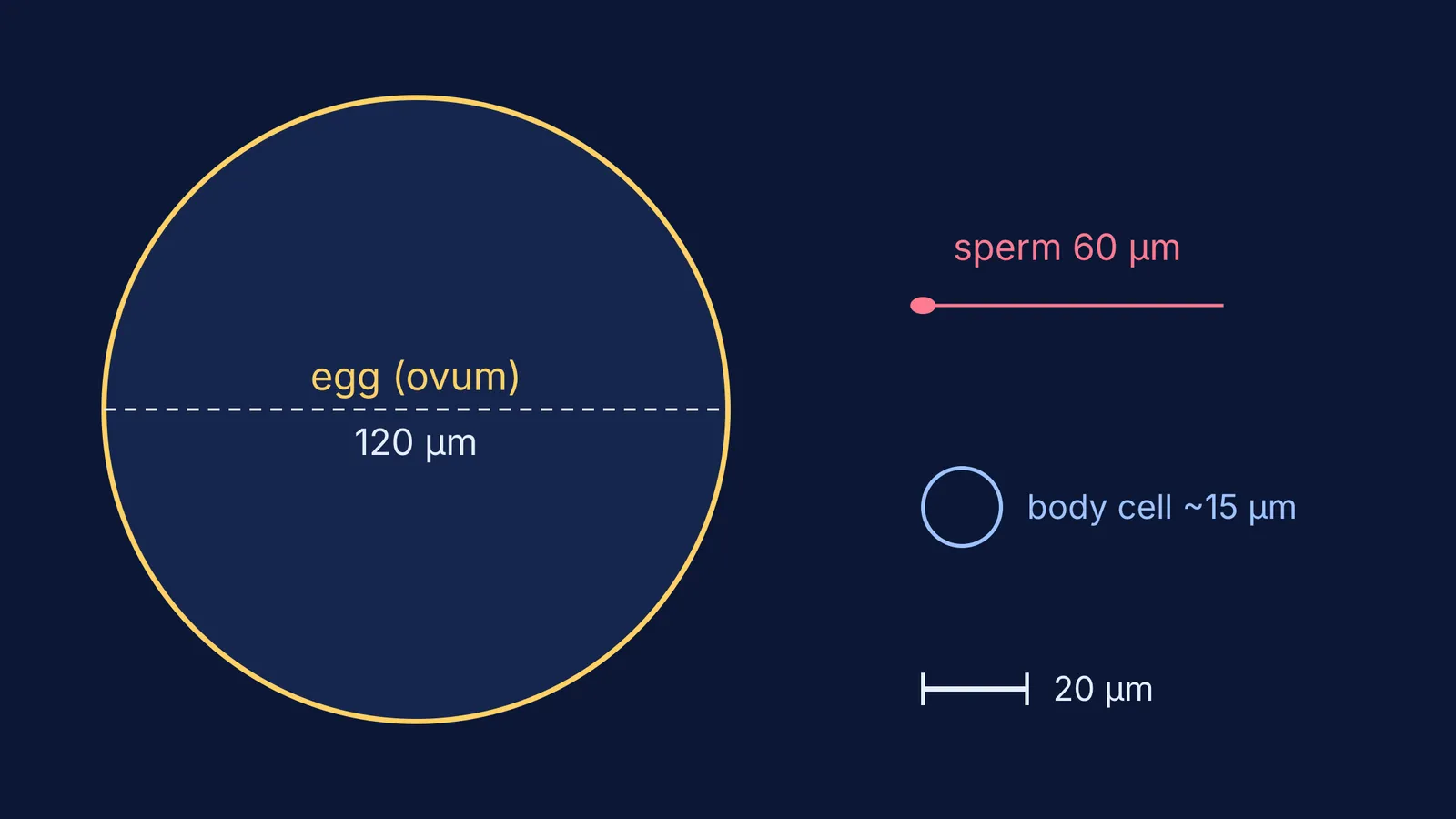
Human oocytes are spherical cells with a diameter of about 120–130 µm, according to a 2023 review in the Journal of Reproduction and Development. The same review notes that a typical body cell is only about 10–20 µm across.
A human sperm is about 60 µm long from head to tail tip, according to a review of sperm shapes across species.
The sperm head, which carries the DNA, is tiny: in a study that measured 7,942 human sperm by computer, the median head was 4.39 µm long and 2.79 µm wide.
So the whole sperm, tail included, is only half as long as the egg is wide. The drawing above shows the egg, a sperm and an ordinary body cell at the same scale.
Why is the ovum so much bigger than the sperm?
Because after fertilisation, most of the material the new embryo uses in its first days comes from the egg.
While the oocyte grows, it makes and stockpiles proteins, ribosomes and mRNA needed for early embryonic development, as the Journal of Reproduction and Development review explains. Its cytoplasm is more than 100 times larger than that of an ordinary body cell, which gives it room to store all those materials.
The egg also builds up its power supply. In mammalian oocytes, the number of mitochondria rises from about 6,000 in a primary oocyte to more than 100,000 by the end of maturation, according to a 2024 review in Frontiers in Cell and Developmental Biology.
Think of the egg as a stocked kitchen: it brings the groceries, the stove and the recipes the zygote needs at first.
Why is the sperm so small?
The sperm's job is to move and deliver one set of chromosomes, so extra cytoplasm would only be weight to push. As sperm mature in the testis, the leftover spermatid cytoplasm, called the residual body, is cut away and swallowed by Sertoli cells, as described in a review of sperm release in the journal Spermatogenesis. What remains is a packed head, a midpiece with mitochondria to power the tail (noted in a 2025 Reproductive Sciences study), and a long tail.
If you want the parts named in exam language, our post on the structure of human sperm: head, middle piece and tail walks through each one.
Is there an evolutionary reason for big eggs and small sperm?
Yes. In 1972, Geoff Parker, Robin Baker and Vic Smith proposed a model in the Journal of Theoretical Biology90007-0) for why two gamete sizes evolved. As a review of their model summarises, it rests on a trade-off: a parent with limited resources can make many small gametes, which helps in the competition to fertilise, or fewer large ones, which helps the zygote survive. Under the right conditions, selection pushes the two strategies apart, giving small sperm and large eggs.
You can see the in-between steps in algae, covered in our post on isogamy, anisogamy and oogamy with four examples.
Worked example: how many sperm heads fit inside one egg?
Egg volume: treat it as a sphere of diameter 120 µm, so radius 60 µm. V = (4/3) × π × 60³ ≈ 904,800 µm³.
Sperm head volume: treat it as an ellipsoid 4.39 µm long and 2.79 µm wide. We do not have a measured thickness, so use the width again as an upper limit. V = (π/6) × 4.39 × 2.79 × 2.79 ≈ 17.9 µm³.
Ratio: 904,800 ÷ 17.9 ≈ 50,500.
Because a real sperm head is flatter than it is wide, its true volume is smaller, so the egg holds more than 50,000 sperm heads' worth of volume. In a straight line, about 27 sperm heads (120 ÷ 4.39) would stretch across one egg.
If calculations like this trip you up, the Fermi Problem Library has worked problems with a step-by-step solver that explains the reasoning rather than printing an answer.
How to write this in a board or NEET answer
A short answer that covers the marks:
The ovum is large because it stores cytoplasm, nutrients, proteins, RNA and many mitochondria to support the zygote's early divisions.
The sperm is small and streamlined because its job is to swim to the egg; it sheds most of its cytoplasm and keeps a head (nucleus and acrosome), a mitochondria-rich middle piece and a tail.
Add one number if you can: human egg about 120 µm, sperm about 60 µm long.
To practise the counting side of gametogenesis, try our post on how many sperm and ova form from each starting cell. And if terms like cytoplasm, haploid or mitochondria still feel shaky, each has its own lesson in the Fermi Concept Library.


