

On this page
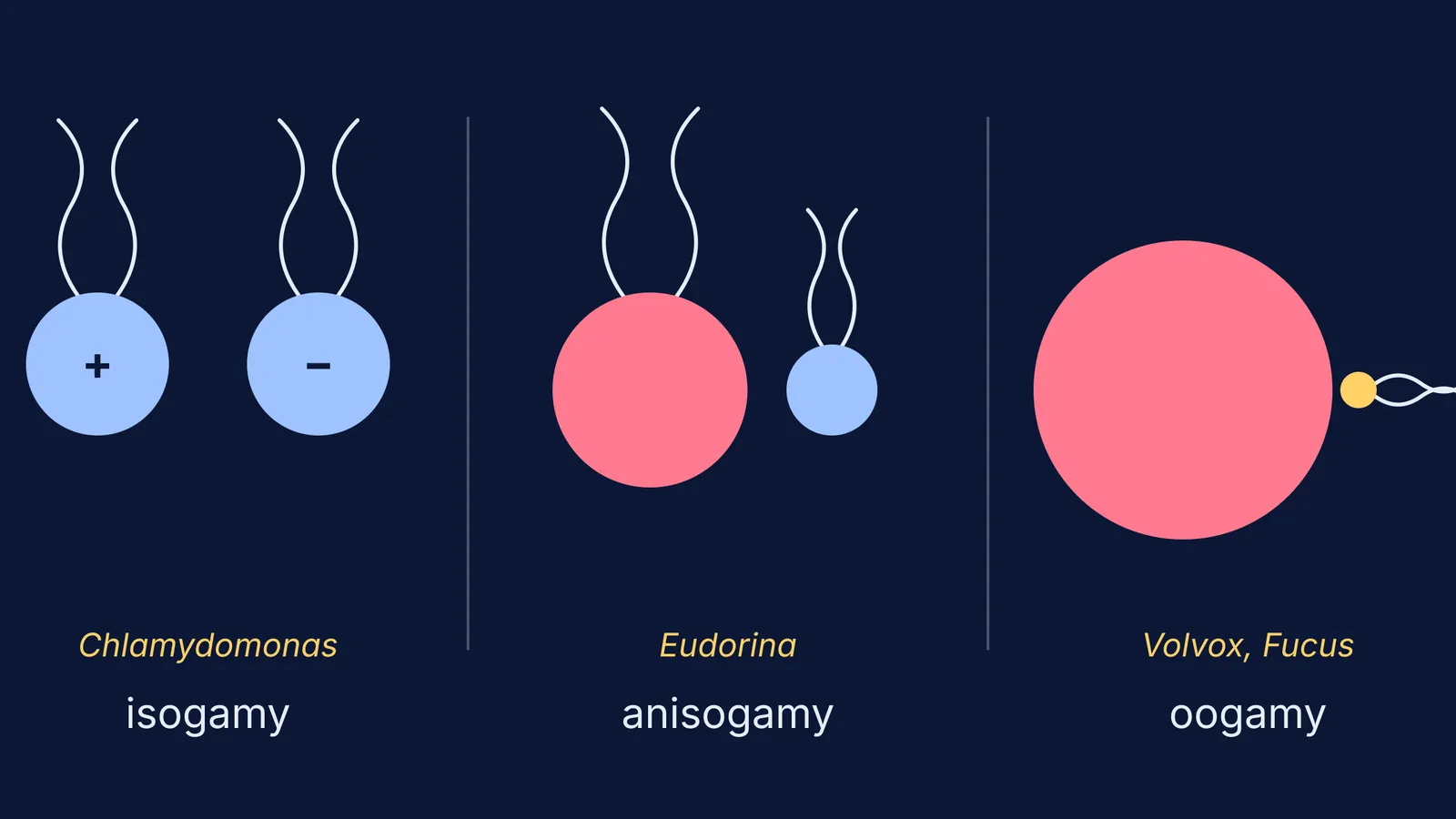
Naming the three types of sexual reproduction in algae is the easy part. Saying which type *Eudorina* shows, or why *Volvox* counts as oogamous when its sperm swim, is harder. The three words are easy to learn by heart and easy to mix up. Four algae make them easy to keep apart: *Chlamydomonas*, *Eudorina*, *Volvox* and *Fucus*.
What do isogamous, anisogamous and oogamous mean?
All three describe the two gametes that fuse during sexual reproduction. The definitions below follow the NCERT Class 11 Biology chapter Plant Kingdom, section 3.1.
Isogamous: the two fusing gametes are similar in size. NCERT notes they can be flagellated (as in *Ulothrix*) or non-flagellated (as in *Spirogyra*).
Anisogamous: the two fusing gametes are dissimilar in size, as in species of *Eudorina*.
Oogamous: one large, non-motile female gamete fuses with a smaller, motile male gamete, as in *Volvox* and *Fucus*.
The same NCERT chapter says sexual reproduction in green algae "may be isogamous, anisogamous or oogamous", and says the same of brown algae. So one class of algae can show all three. That is why exam questions ask about genera, not classes.
Which algae are isogamous, anisogamous or oogamous?
Chlamydomonas (isogamy). In the well-studied species *Chlamydomonas reinhardtii*, the two mating types, plus and minus, look alike, according to Geng, De Hoff and Umen in PLoS Biology (2014). Because neither gamete is larger, they are called mating types rather than male and female. If you want to revise the cell itself first, our post on the structure of Chlamydomonas, its cup-shaped chloroplast and flagella covers it.
Eudorina (anisogamy). *Eudorina* is a 32-celled colony that is anisogamous, according to a 2018 study in Communications Biology by Hamaji and colleagues. The same study says the step to anisogamy involved gaining the ability to form small male gametes.
Volvox (oogamy). *Volvox* colonies have more than 500 cells and are oogamous (Hamaji and colleagues, 2018). In *Volvox carteri*, females make large immotile eggs and males make small motile sperm, with 32 to 48 egg cells per female and sperm in packets of 64 or 128 (Geng and colleagues, 2014).
Fucus (oogamy). *Fucus* is a brown seaweed. A lab protocol for *Fucus serratus* describes it releasing large eggs and motile sperm into seawater, and the zygotes formed are up to 100 µm across (Siméon and Hervé, Bio-protocol, 2017). The same protocol notes that fertilisation happens within 15 minutes of mixing sperm with eggs.
Why do these algae show all three patterns?
*Chlamydomonas*, *Eudorina* and *Volvox* belong to one group, the volvocine green algae. The group began diverging from a single-celled, isogamous *Chlamydomonas*-like ancestor about 200 million years ago, according to Hamaji and colleagues (2018).
The study lists a series from that ancestor: single-celled isogamous *Chlamydomonas*, 8- or 16-celled isogamous *Gonium*, 32-celled isogamous *Yamagishiella*, 32-celled anisogamous *Eudorina* and more-than-500-celled oogamous *Volvox*. Along this series, colonies get bigger and the gametes become more unequal. *Fucus* is a brown alga from a different lineage, so oogamy is not limited to this group.
How do you tell the type in an exam question?
Ask two questions about the pair of gametes, in this order.
Are the two gametes similar in size? If yes, the answer is isogamous.
If they differ, does the larger one move? If it moves, the answer is anisogamous. If it is large and does not move, the answer is oogamous.
Try it on three statements.
"Plus and minus gametes of *Chlamydomonas reinhardtii* look alike." Question 1 says yes, so this is isogamy.
"*Eudorina* forms small male gametes that fuse with larger female gametes." Question 1 says no. The NCERT definition only asks that sizes differ, so this is anisogamy.
"*Fucus* releases large eggs and motile sperm into seawater." Question 1 says no, question 2 says the large gamete does not swim, so this is oogamy.
Three checks before you write the answer:
Write the genus with a capital first letter, and underline it when writing by hand.
Do not write *Chlamydomonas* as the only example of isogamy if the question asks for NCERT examples. NCERT names *Ulothrix* and *Spirogyra*.
Remember that red algae are oogamous, according to the same NCERT chapter.
Odd-one-out questions often mix these genera with other exceptions. Our list of plant group exceptions from algae to gymnosperms and our guide to commonly confused plant biology terms are good next reads.
If gametes, spores and zygotes still blur together, the Fermi Concept Library has every concept in biology, each with its own lesson and its place in the map. To practise applying definitions like these, the Fermi Problem Library has worked problems with a step-by-step solver that explains the reasoning rather than printing an answer.


