

On this page
Starfish, sea urchins, brittle stars, sea cucumbers and sea lilies turn up in rock pools, coral reefs and the deep ocean, but never in a river or a pond. NEET-UG and board questions can ask you to spot “all are marine” as a feature of Echinodermata. Knowing why helps, because the same osmosis reasoning answers many questions about where animals can live.
What does NCERT say about echinoderms and the sea?
The NCERT Class 11 Biology chapter on the Animal Kingdom (section 4.2.9) says of echinoderms: “All are marine with organ-system level of organisation.” The same section gives two facts that help explain it. The most distinctive feature of echinoderms is the water vascular system, which helps in locomotion, capture and transport of food, and respiration. And: “An excretory system is absent.”
An open university textbook, LibreTexts General Biology (Boundless)/28:_Invertebrates/28.05:_Superphylum_Deuterostomia/28.5A:_Phylum_Echinodermata), puts it just as plainly: “To date, no freshwater or terrestrial echinoderms are known.” It describes the madreporite as an opening used to filter water into the water vascular system.
Why can't echinoderms survive in fresh water?
The standard textbook explanation combines three features.
They are osmoconformers. An osmoconformer does not hold its body fluid at its own fixed concentration; the fluid follows the water outside. A 2024 study in the Journal of Experimental Biology describes echinoderms as osmoconformers that are “poorly equipped to regulate extracellular body fluid concentrations in response to changes in external salinity.”
They have no organ that pumps out extra water. NCERT's list of features says the excretory system is absent. Compare vertebrates, which the same NCERT chapter says have kidneys for excretion and osmoregulation. A freshwater fish copes partly because its kidneys keep pushing out the water that floods in.
Their plumbing is open to the outside. Water enters the water vascular system through the madreporite, per LibreTexts/28:_Invertebrates/28.05:_Superphylum_Deuterostomia/28.5A:_Phylum_Echinodermata). The same system handles gas exchange, so its tube feet work in direct contact with the water outside.
Put together: in fresh water, water rushes into an animal that has no organ to send it back out.
How dilute is too dilute for a sea urchin?
According to the USGS Water Science School, ocean water contains about 35,000 ppm of salt (about 35 parts per thousand, ‰), and fresh water has less than 1,000 ppm (under 1‰).
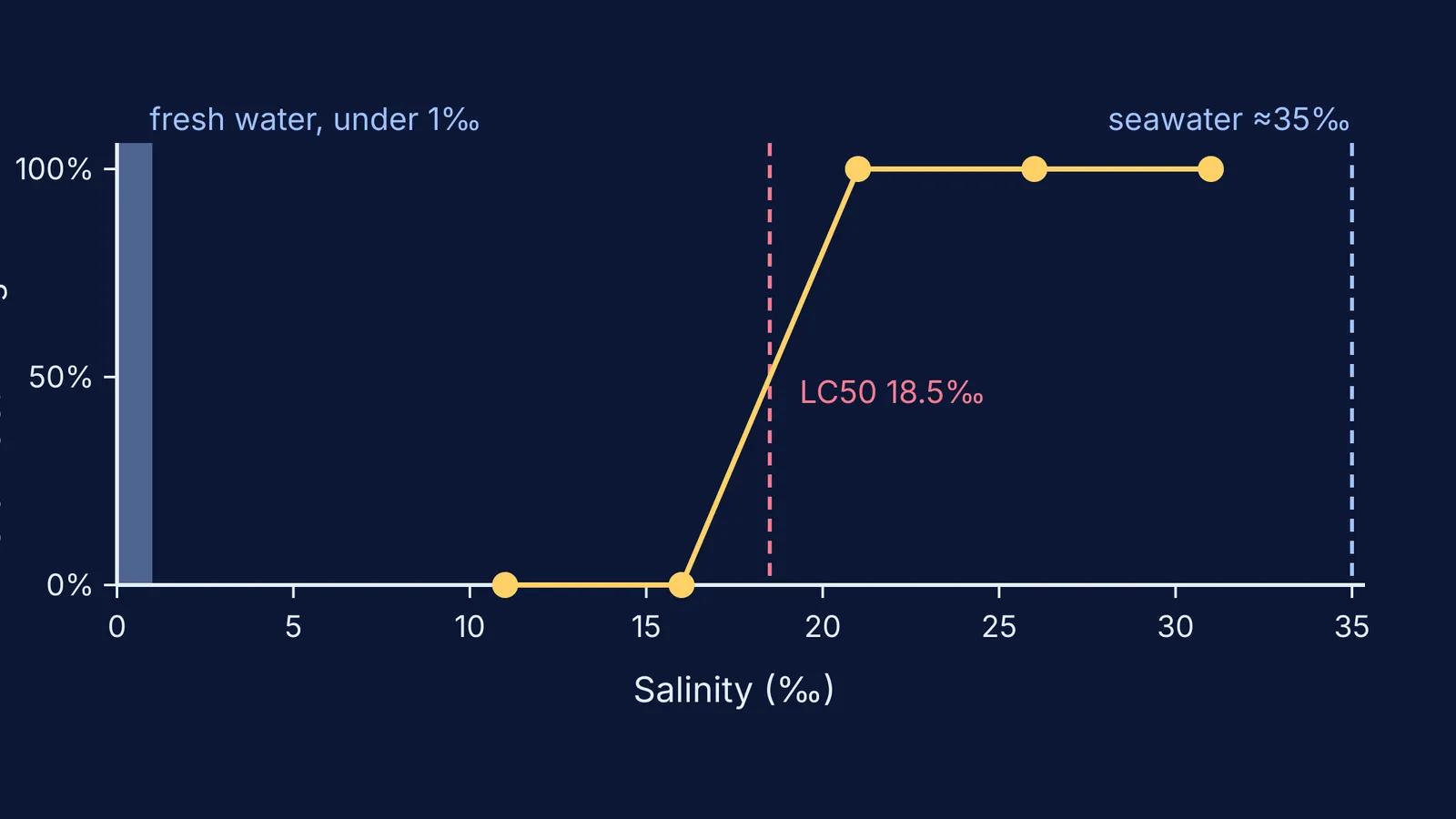
In the 2024 Journal of Experimental Biology study by Barrett and colleagues, ten European sea urchins (*Echinus esculentus*) were placed in each of five salinities for 24 hours: 11, 16, 21, 26 and 31‰. All survived at 21‰ and above. None survived at 16‰ or below, and the authors estimated the salinity that kills half of them (the LC50) at about 18.5‰. The urchins' coelomic fluid stayed only slightly more concentrated than the water around them at every salinity.
So these urchins could not survive a day in water about half the strength of the 31‰ water in the saltiest tank. Fresh water, under 1‰, is far beyond that.
A reusable osmosis check: will this animal survive here?
You can apply these four questions to any “why does X only live in Y” problem, from echinoderms to the marine and freshwater fish in osmoregulation questions.
Compare concentrations. Which is more concentrated, the body fluid or the water outside?
Predict the water flow. Water moves by osmosis from the dilute side to the concentrated side.
Find the defence. Does the animal have an organ (kidney, nephridia, contractile vacuole) or a waterproof covering that resists this flow?
Decide. If water floods in and nothing pushes it back, the animal swells and its cells stop working. It cannot live there.
Worked example: a starfish dropped into a pond.
As an osmoconformer, the starfish has body fluid close to seawater, about 35‰. Pond water is under 1‰ (USGS salinity figures). The body is far more concentrated.
Water moves into the starfish, through its tube feet and body surface.
There is no excretory system to remove the extra water, and the water vascular system takes in water from outside.
Water keeps entering and nothing removes it. The starfish cannot survive.
Now try a freshwater fish. Steps 1 and 2 are the same: water floods in. At step 3 the answer changes, because its kidneys keep removing the extra water. That one difference is a big part of why fish live in rivers and starfish do not.
Where does this fit in your revision?
“All are marine” also applies to some other groups, which NCERT lists in the same chapter; our post on which animal phyla are exclusively marine sorts them out. For the other echinoderm features examiners like, see why echinoderms are invertebrates with an endoskeleton.
If osmosis itself still feels shaky, the Fermi Concept Library covers every concept in physics, chemistry, biology, mathematics and computing, each with its own lesson, so you can revise osmosis and osmoregulation before coming back to animal diversity.


