

On this page
If a NEET question asks which phylum lives only in the sea, the answer comes down to one word in NCERT: "exclusively", "all", "mostly" or "generally". This guide sorts the non-chordate phyla by that word, flags the freshwater exceptions, and ends with a quick habitat quiz.
Which animal phylum is exclusively marine?
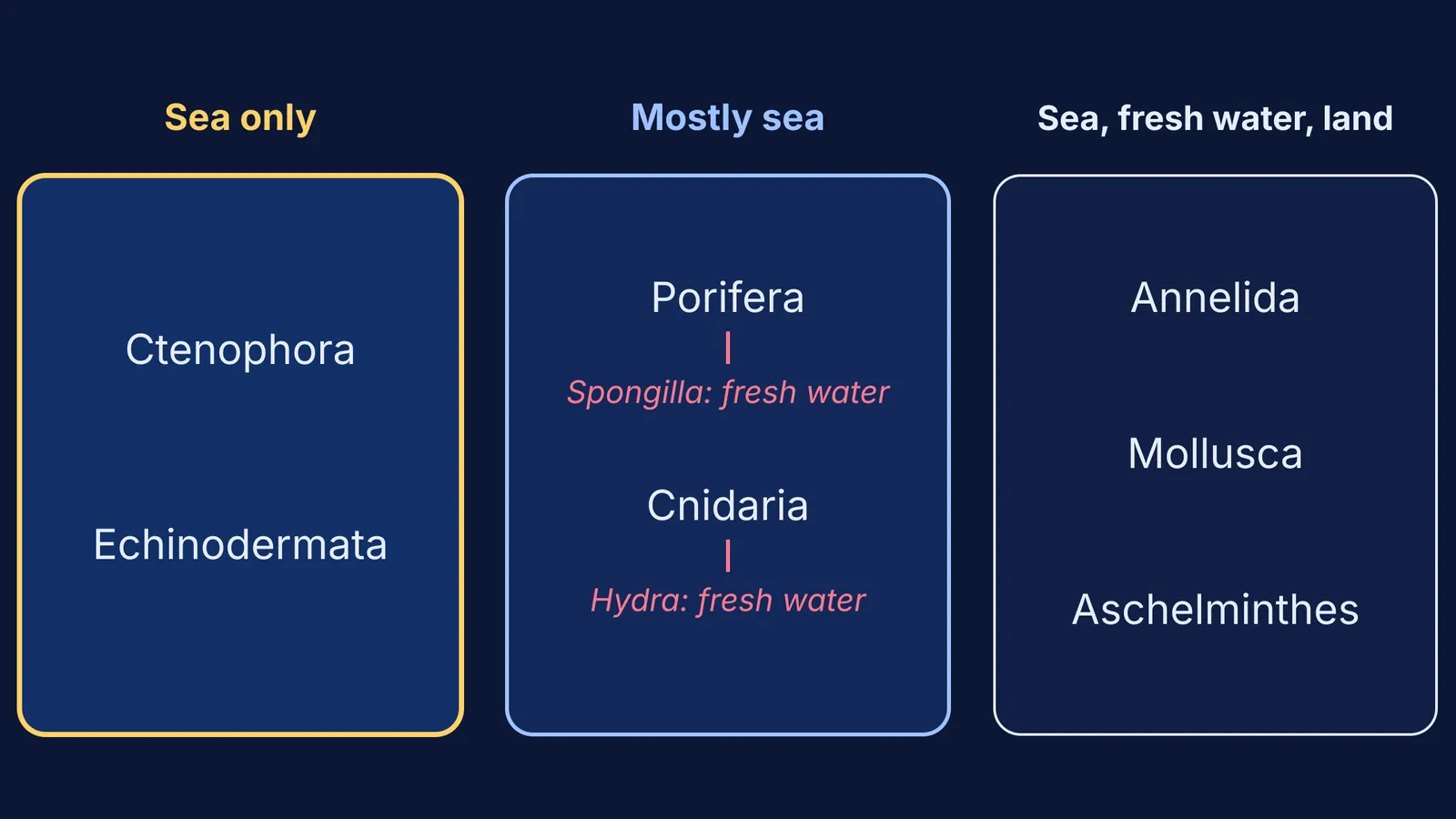
In the Class 11 Biology chapter Animal Kingdom (NCERT, Chapter 4), two phyla are described in words that mean they live only in the sea.
Ctenophora: NCERT calls comb jellies (sea walnuts) "exclusively marine, radially symmetrical, diploblastic organisms". Its examples are *Pleurobrachia* and *Ctenoplana*.
Echinodermata: NCERT says "All are marine". Its examples are *Asterias* (starfish), *Echinus* (sea urchin), *Antedon* (sea lily), *Cucumaria* (sea cucumber) and *Ophiura* (brittle star).
So if the options include either of these phyla, that is your answer. If both appear, read the question again: it may be asking which one is diploblastic (Ctenophora) or which has a water vascular system (Echinodermata). If *Antedon* trips you up, we explain why the sea lily is an animal, not a plant.
Which phyla are mostly marine, and what are the freshwater exceptions?
Two phyla come with a hedge word in the same NCERT chapter, and each has a well-known freshwater member.
Porifera: sponges are "generally marine". NCERT's own example list includes *Spongilla* (freshwater sponge), next to *Sycon* and *Euspongia* (bath sponge).
Coelenterata (Cnidaria): NCERT calls them "aquatic, mostly marine". *Hydra*, which NCERT uses as its example of the sessile polyp form, is the freshwater exception.
NCERT does not state Hydra's habitat itself, so here is an outside source: a 2025 bioRxiv preprint describes Hydra as "a simple freshwater cnidarian" that occurs in both moving and still water. The other cnidarian examples NCERT names, from *Physalia* (Portuguese man-of-war) to *Meandrina* (brain coral), are sea animals.
Then come the phyla that NCERT says also live in fresh water or on land. It says annelids may be aquatic (marine and fresh water) or terrestrial, molluscs are terrestrial or aquatic (marine or fresh water), and roundworms may be aquatic, terrestrial or parasitic. Earthworms (*Pheretima*) are the reminder that annelids are not just water animals. Don't trust common names either: our list of animals named fish that are not fish sorts jellyfish, starfish and others into their real phyla.
Are Hemichordata and the protochordates exclusively marine too?
These are the two traps in the NCERT chapter.
Hemichordata (*Balanoglossus*, *Saccoglossus*) is "a small group of worm-like marine animals". NCERT says marine but does not use the word "exclusively". If the options also include Ctenophora or Echinodermata, pick those.
Urochordata and Cephalochordata (the protochordates) are called "exclusively marine". But they are subphyla of Chordata, not phyla. If the question says phylum, they are not the answer.
Two vertebrate classes are also worth knowing. NCERT calls Chondrichthyes "marine animals". Cyclostomes "are marine but migrate for spawning to fresh water", and their larvae return to the ocean.
Habitat quiz: sea only, mostly sea, or fresh water?
Cover the answers and say the habitat and group for each animal out loud. Every answer comes from the NCERT Animal Kingdom chapter, except Hydra's habitat, which comes from the freshwater Hydra preprint.
*Pleurobrachia*
*Spongilla*
*Hydra*
*Asterias*
*Balanoglossus*
*Branchiostoma*
*Petromyzon*
*Labeo* (rohu)
Answers:
Sea only. Ctenophora, an exclusively marine phylum.
Fresh water. Porifera, a phylum that is generally marine.
Fresh water. Cnidaria, a phylum that is mostly marine.
Sea only. Echinodermata, where all members are marine.
Sea. Hemichordata, described as marine.
Sea only, but Cephalochordata is a subphylum, not a phylum.
Sea as an adult, migrating to fresh water to spawn (Cyclostomata, a vertebrate class).
Fresh water. NCERT lists it as a freshwater bony fish.
If you missed 2 or 3, you are not alone. Those are the exceptions to "sponges and cnidarians live in the sea". For more slips from this chapter, see our list of common animal kingdom mistakes in NEET Biology.
How do you make the habitat facts stick?
Tie each habitat to a body plan you already know. Comb plates and bioluminescence point to Ctenophora. A water vascular system and an endoskeleton of calcareous ossicles point to Echinodermata. Collar cells and spicules point to Porifera, and *Spongilla* is the one to remember in fresh water.
If you want each phylum as its own lesson, with its place in the wider classification, the Fermi Concept Library covers every concept in biology, as well as physics, chemistry, mathematics and computing. When a question on the chapter still trips you up, the Fermi Problem Library has worked problems with a step-by-step solver that explains the reasoning rather than printing an answer.
Next step: write the eight quiz animals on a card and test yourself again in a few days.


