

On this page
Your skin replaces itself all the time and a cut finger heals in days. Yet a neuron in your cerebral cortex is, in most cases, about as old as you are. Here is why, and why the glial cells around neurons follow different rules.
Why can't mature nerve cells divide?
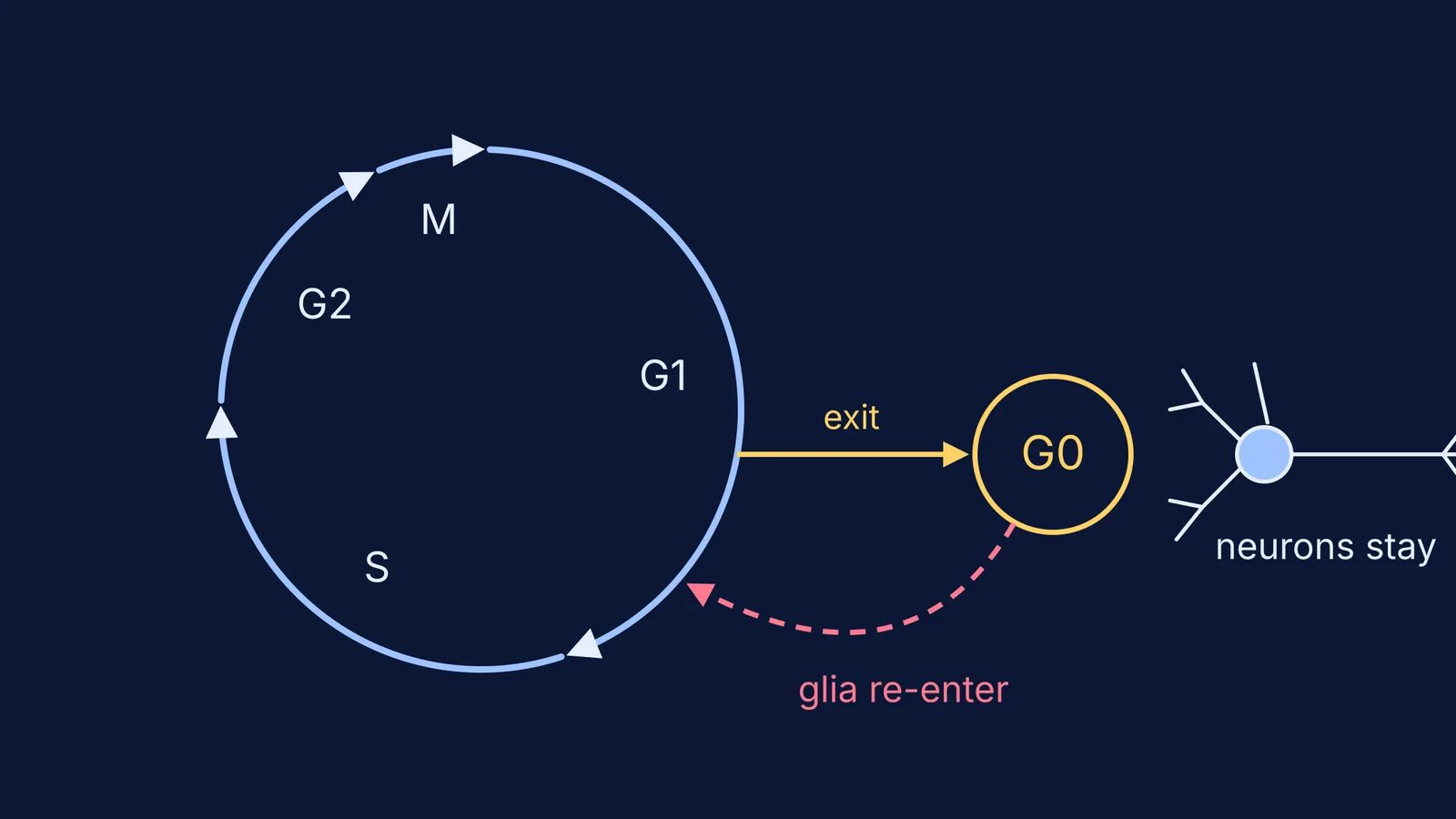
A cell that stops dividing leaves the cycle after G1 and rests in a non-dividing state called G0. We explain that stage in what the G0 phase is and why some cells never divide. Most neurons enter G0 as they mature and stay there.
Textbooks call adult neurons "postmitotic", but the arrest is not passive. A 2007 review by Karl Herrup and Yan Yang argued that adult neurons must constantly keep their cell cycle in check, and that when this control slips, the neuron enters a vulnerable state that often ends in its death (Herrup and Yang, Nature Reviews Neuroscience, 2007). The same review links failed cell-cycle control to several neurodegenerative disorders.
So the honest answer is not that neurons lack the machinery to divide. It is that switching it back on often kills them.
Shape matters too: in the adult brain, most dendrite branches and dendritic spines stay stable for months, years and possibly decades (Koleske, Nature Reviews Neuroscience, 2013). Picture mitosis in a cell like that: it would have to pull in its branches and split one set of connections between two daughters.
Does the adult brain make any new neurons?
In most of the brain, no. Researchers dated neurons using carbon-14 left in DNA by Cold War nuclear bomb tests and found that neurons in the human cerebral neocortex are generated around birth, not in adulthood at detectable levels, while non-neuronal cells there do turn over (Bhardwaj and colleagues, PNAS, 2006). The same paper notes that new neurons after birth come from stem cells in a few discrete regions, not from mature neurons splitting.
The hippocampus is still debated. One carbon-14 study estimated that 700 new neurons are added in each adult human hippocampus per day (Spalding and colleagues, Cell, 2013). A later study concluded that this neurogenesis drops sharply in childhood and is absent or extremely rare in adults (Sorrells and colleagues, Nature, 2018).
What does this mean when a nerve is damaged?
A dead neuron is not replaced by its neighbours dividing. But a cut axon is not the same as a dead neuron. Injured nerves in the peripheral nervous system can regrow and reconnect to their targets, unlike nerves in the brain and spinal cord (Gordon, International Journal of Molecular Sciences, 2020). The neuron stays put and grows a new axon.
That regrowth is slow: about 1 mm per day in humans, so a nerve can take a year or more to reach the hand muscles, according to the same review.
A worked example: if an injury is 30 cm (300 mm) from the muscle it supplies, then 300 mm divided by 1 mm per day gives about 300 days, roughly ten months, before the first regrowing fibres arrive.
How are neuroglia different?
Neuroglia, the support cells we describe in what neuroglia are and what they do, keep the ability to divide.
Oligodendrocyte precursor cells make up about 5-10% of brain cells and are the most proliferative cell type in the adult brain (Galichet and colleagues, Frontiers in Cellular Neuroscience, 2021).
Microglia in the human brain renew at a median rate of 28% per year (Réu and colleagues, Cell Reports, 2017).
Astrocytes show little or no proliferation after mild or moderate injury but do proliferate after severe injury, forming a glial scar that inhibits axon regrowth (Sofroniew and Vinters, Acta Neuropathologica, 2010).
Schwann cells in peripheral nerves proliferate after injury and line the tubes that guide the regrowing axon (Gordon, 2020).
So when the nervous system repairs itself, it is mostly glia that divide, and the neurons that regrow their axons.
How do you answer this in an exam?
For a 3-mark "Why can't neurons divide?" question, build the answer in four moves:
Stage: mature neurons exit after G1 and stay in G0.
Maintenance: the cycle is actively held off; neurons that restart it tend to die.
Consequence: lost neurons are not replaced by division.
Contrast: glial cells such as Schwann cells and astrocytes can divide.
Two traps to avoid:
Do not write that neurons have no nucleus. They do.
Do not write that nerves can never heal. Peripheral axons can regrow; it is the neuron dividing that does not happen.
If G1, G0 and the checkpoints still blur together, the Fermi Concept Library gives each concept in biology its own lesson and shows where it sits in the map. And if you are not sure where to start a revision session, Fermi's AI tutor works out what you already know and builds a plan for the session.
Next, sort out the vocabulary with nerve vs neuron vs nerve fibre.


