

On this page
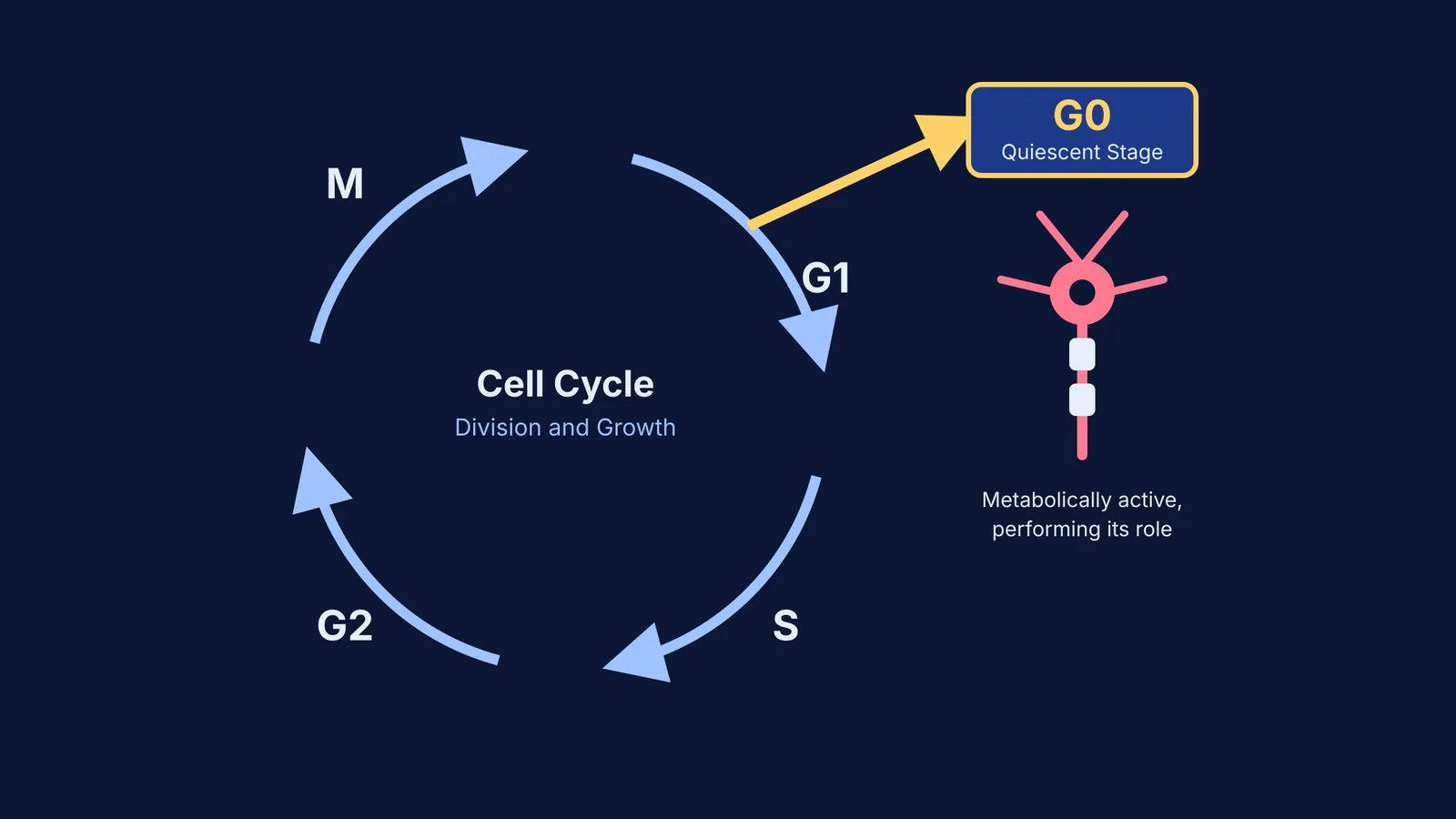
Cells are the fundamental building blocks of life, and their ability to divide is what allows organisms to grow, heal, and replace dead tissue. They usually progress through the active phases of the cell cycle: G1 (growth), S (DNA synthesis), G2 (preparation for division), and M (mitosis, where the cell physically splits). However, not all cells need to keep dividing forever. When the environment is unfavourable or a cell has reached its fully mature, specialized form, it exits the active cycle from the G1 phase and enters a specialized resting state called G0.
According to the textbook *Molecular Biology of the Cell*, the G0 phase is a quiescent state where the cell-cycle control system is often dismantled. This means the cell stops preparing the proteins and enzymes needed for DNA replication and division. Depending on the cell type, this pause can be temporary—waiting for better conditions or a signal to heal an injury—or it can last for the entire lifetime of the organism.
Why do cells stay metabolically active in G0?
When you hear that a cell is in a "quiescent" or resting stage, it is easy to imagine it doing absolutely nothing, like a bear in hibernation. However, that rest only applies to cell division. A cell in the G0 phase does not shut down its day-to-day operations.
Instead of spending massive amounts of energy on replicating its DNA and physically splitting in two, the cell redirects its resources to its actual job in your body. While the overall rate of protein and RNA synthesis is reduced compared to a rapidly dividing cell, the cell remains functionally active (*Molecular Biology of the Cell*).
For example, a cell in G0 still generates ATP through cellular respiration, repairs its own internal structures, and performs highly specialized tasks. It produces the specific enzymes, structural proteins, and signalling molecules required for the tissue it belongs to. By exiting the loop of constant division, the cell can dedicate its energy to keeping you alive.
Which cells stay in G0 permanently?
The duration of the G0 phase depends entirely on the cell's role. Some cells, like fibroblasts in your skin or liver cells, enter G0 temporarily. They remain quiescent until a tissue injury occurs, at which point they receive chemical signals that trigger them to re-enter the G1 phase, divide, and repair the damage.
However, other cells are terminally differentiated, meaning their form is so specialized that dividing would disrupt their complex architecture. Once cells such as neurons and heart muscle cells mature, they enter a permanent G0 state for the rest of your life (*Molecular Biology of the Cell*).
Think about a neuron: it grows long, delicate axons and dendrites to form precise networks that store your memories and control your movements. If that neuron were to round up and divide, it would have to tear down those connections. Similarly, a heart muscle cell (myocyte) is packed tightly with contractile proteins perfectly aligned to keep your heart beating in a synchronized rhythm. Because they cannot re-enter the cell cycle to divide, they must survive and function for decades without replacement.
This permanence is exactly why understanding the cell cycle and differentiation is a major focus in biology. If medical researchers can figure out how to safely coax human heart cells out of the G0 phase, they could potentially repair heart tissue after a heart attack.
If you are studying for exams and need to see how the cell cycle fits into human physiology, you can explore the entire map of these topics in the Fermi Concept Library. You can trace exactly how the parts of the human brain are built from intricate networks of cells that have permanently exited the cycle.
How to remember the cell cycle phases for exams?
Keeping the phases straight is essential when answering multiple-choice questions in competitive exams like NEET or JEE. Use this simple framework to visualise the timeline:
G1 (Gap 1): The cell grows, increases its cytoplasm, and checks its environment to see if it is safe to divide.
G0 (Quiescent Stage): The exit ramp. The cell leaves G1 and stops dividing so it can work or wait. Some cells stay here forever.
S (Synthesis): The cell commits to division and completely copies its DNA.
G2 (Gap 2): The cell double-checks the copied DNA for errors and prepares the physical machinery for division.
M (Mitosis): The nucleus and cytoplasm split, dividing the cell into two identical daughter cells, which then enter G1 to start the cycle again.


