

On this page
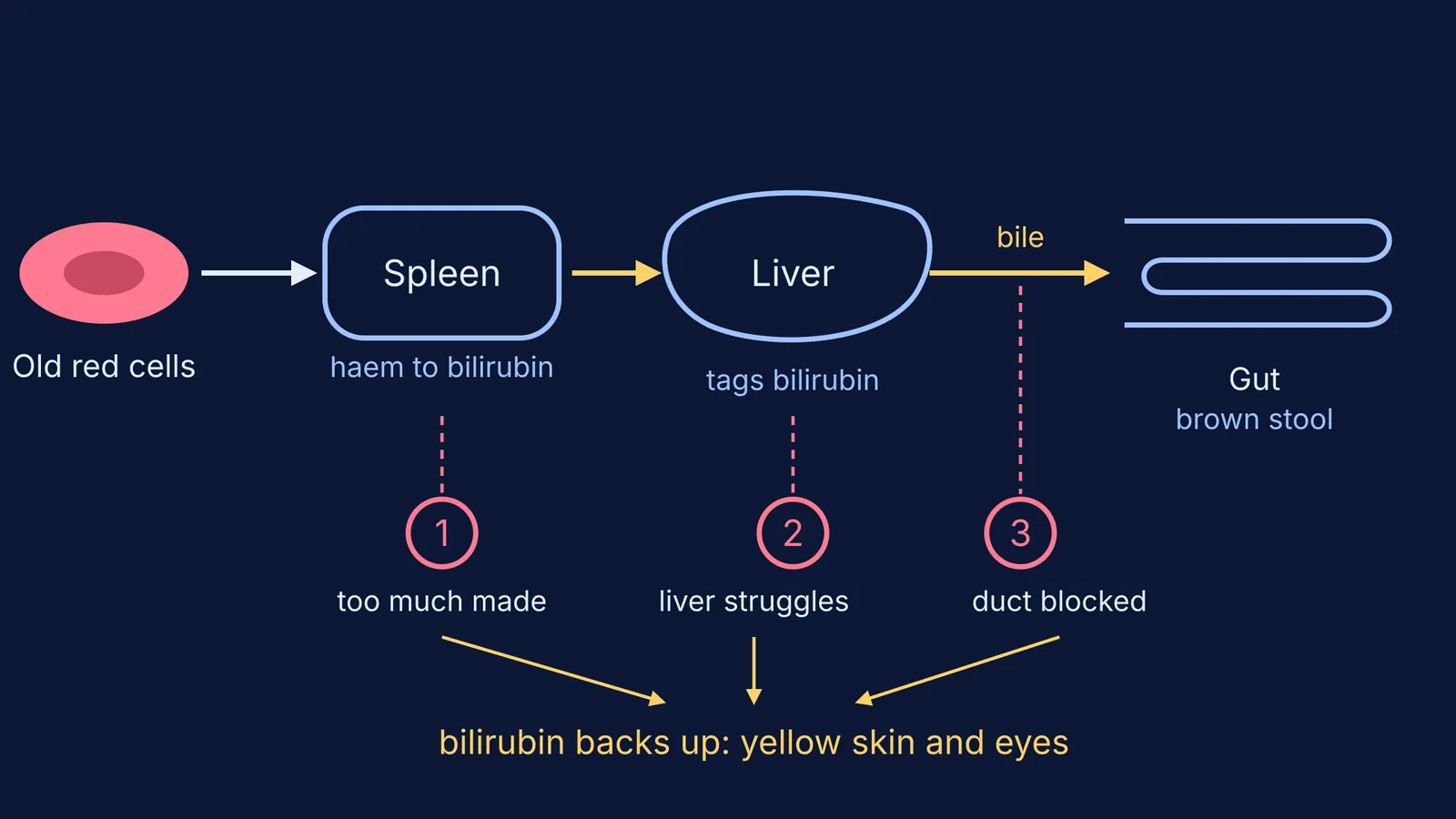
Jaundice is not a disease in itself. It is a sign that a yellow pigment called bilirubin is entering the blood faster than the body can clear it. To see why, follow one batch of bilirubin from a worn-out red blood cell all the way to the toilet. This is a biology explainer for students and parents, not medical advice.
Where does bilirubin come from?
Red blood cells reach the end of their lifespan at about 120 days and are broken down by macrophages in the spleen, as the Royal College of Emergency Medicine's jaundice module explains. The haem part of haemoglobin is oxidised to biliverdin and then reduced to unconjugated bilirubin.
The enzymes behind those two steps are haem oxygenase-1 and biliverdin reductase, according to a 2025 review in Frontiers in Oncology.
About 70% of bilirubin comes from the haemoglobin of ageing red blood cells, according to the American Association for the Study of Liver Diseases (AASLD). For why those cells are built to be disposable, read why mammalian red blood cells have no nucleus.
How does the liver get rid of bilirubin?
Freshly made bilirubin is lipophilic, meaning it mixes with fats rather than water, so it does not dissolve in plasma on its own (Frontiers in Oncology review). The body handles it in four steps, described by RCEM and AASLD:
Ride: unconjugated bilirubin travels to the liver bound to the blood protein albumin.
Tag: inside liver cells, the enzyme UGT1A1 attaches glucuronic acid, making conjugated bilirubin.
Export: a transporter called MRP2 pumps conjugated bilirubin into bile, which flows into the small intestine.
Exit: in the intestine it is converted to stercobilinogen and urobilinogen. Stercobilinogen becomes stercobilin, which leaves in faeces; urobilinogen travels in the blood to the kidneys, where it is oxidised to urobilin.
Why does jaundice make skin and eyes yellow?
Bilirubin is a yellowish substance, and too much of it in the blood causes the yellowing called jaundice (MedlinePlus). The normal level of bilirubin in blood is below 1 mg/dL, and above 3 mg/dL its effects can be seen, according to AASLD. Jaundice is the yellow colouring of the skin, the whites of the eyes (sclera) and the mucous membranes. On brown or black skin the yellowing can be harder to notice, but the whites of the eyes still look yellow (NHS).
Think of the route as a conveyor belt: yellowing appears whenever bilirubin lands on the belt faster than it comes off.
Where can the bilirubin route get stuck?
Jaundice is usually sorted by where the problem sits, matching the three stages of the route: pre-hepatic, hepatic and post-hepatic (RCEM). The NHS jaundice page lists causes that fit each one.
Before the liver (too much made): conditions that destroy red blood cells faster, such as sickle cell disease, flood the belt with unconjugated bilirubin.
In the liver (processing slows): hepatitis and alcohol-related liver disease damage the cells that tag and export bilirubin. Our posts on how hepatitis A and B spread and how alcohol damages the liver cover those in detail. Many newborns get jaundice for a related reason: their livers are not mature enough to clear bilirubin well yet (MedlinePlus).
After the liver (exit blocked): gallstones or pancreatitis can block the bile duct, so conjugated bilirubin backs up into the blood.
An exit blockage also changes urine and stool colour. More conjugated bilirubin leaves through urine, making it dark, and less bilirubin reaches the gut, so stools turn pale (AASLD).
Worked example: how do you find the blockage?
Try this exam-style question: a patient has yellow eyes, dark urine and pale stools. Where is the problem?
Yellow eyes: blood bilirubin is high, but that alone does not say where.
Dark urine: conjugated bilirubin is reaching the kidneys, so the liver is still tagging it.
Pale stools: little bilirubin reaches the gut, so little stercobilin forms.
Answer: the jam is after the tagging step, most likely a blocked bile duct, which is post-hepatic jaundice.
If the steps still feel like a list to memorise, the Fermi Concept Library gives each biology concept its own lesson and its place in the map. For more practice, the Fermi Problem Library has worked problems with a step-by-step solver that explains the reasoning rather than printing an answer.
What does the NHS say about yellow skin or eyes?
This route explains textbook logic; only a doctor, with blood tests and an examination, can find the real cause. The NHS says to ask for an urgent GP appointment or get help from NHS 111 if the skin or the whites of the eyes look yellow, because jaundice can be a sign of something serious such as liver disease. In newborns, jaundice usually clears within a few weeks, but high bilirubin levels can lead to brain damage, which is why babies are often tested as a precaution (MedlinePlus).
Next time you revise excretion or digestion, trace the route out loud from spleen to stool and ask where each disease jams it.


