

On this page
Hepatitis A and hepatitis B both inflame the liver, but A comes in through the mouth and B through blood and body fluids. That one difference explains most of what an examiner asks.
How does hepatitis A spread?
The WHO hepatitis A fact sheet says the virus "is transmitted through ingestion of contaminated food and water or through direct contact with an infectious person." This is the faecal-oral route: virus from one person's stool reaches another's mouth through unwashed hands, water or food. WHO links the risk to a lack of safe water, poor sanitation and poor hygiene, such as dirty hands.
According to the CDC clinical overview, the average incubation period is 28 days, with a range of 15 to 50 days. The CDC's hepatitis A page adds that a person can spread the virus up to 2 weeks before having any symptoms. Hepatitis A does not become chronic, and the antibodies made during recovery protect you from catching it again.
How does hepatitis B spread?
The CDC's hepatitis B page says it is primarily spread "when blood, semen, or certain other body fluids – even in microscopic amounts – from a person infected with HBV enter the body of someone who is not infected." The WHO hepatitis B fact sheet lists the commonest routes: from mother to child during birth and delivery, in early childhood, during sex with an infected partner, and through unsafe injections or sharp instruments.
The CDC says it does not spread through sneezing, coughing, hugging, breastfeeding, food, water, sharing utensils or kissing. Our post on direct and indirect disease transmission sorts routes like these with NCERT examples.
The CDC clinical overview for hepatitis B gives an average of 90 days from exposure to signs and symptoms, with a range of 60 to 150 days. See also which tests are done on donated blood in India.
Why can only hepatitis B turn chronic?
The CDC's hepatitis B page says most people who do not clear the virus within six months are diagnosed with chronic hepatitis B.
The reason it can stay is a molecule called cccDNA. In a 2015 review in Gut, Michael Nassal explains that after infection, the genome brought in by the virus is converted into covalently closed circular DNA, a plasmid-like loop in the liver cell's nucleus that is the template for all viral RNAs. His title calls it the key obstacle to a cure. Hepatitis A leaves no such reservoir, and the WHO hepatitis A fact sheet states that it does not cause chronic liver disease.
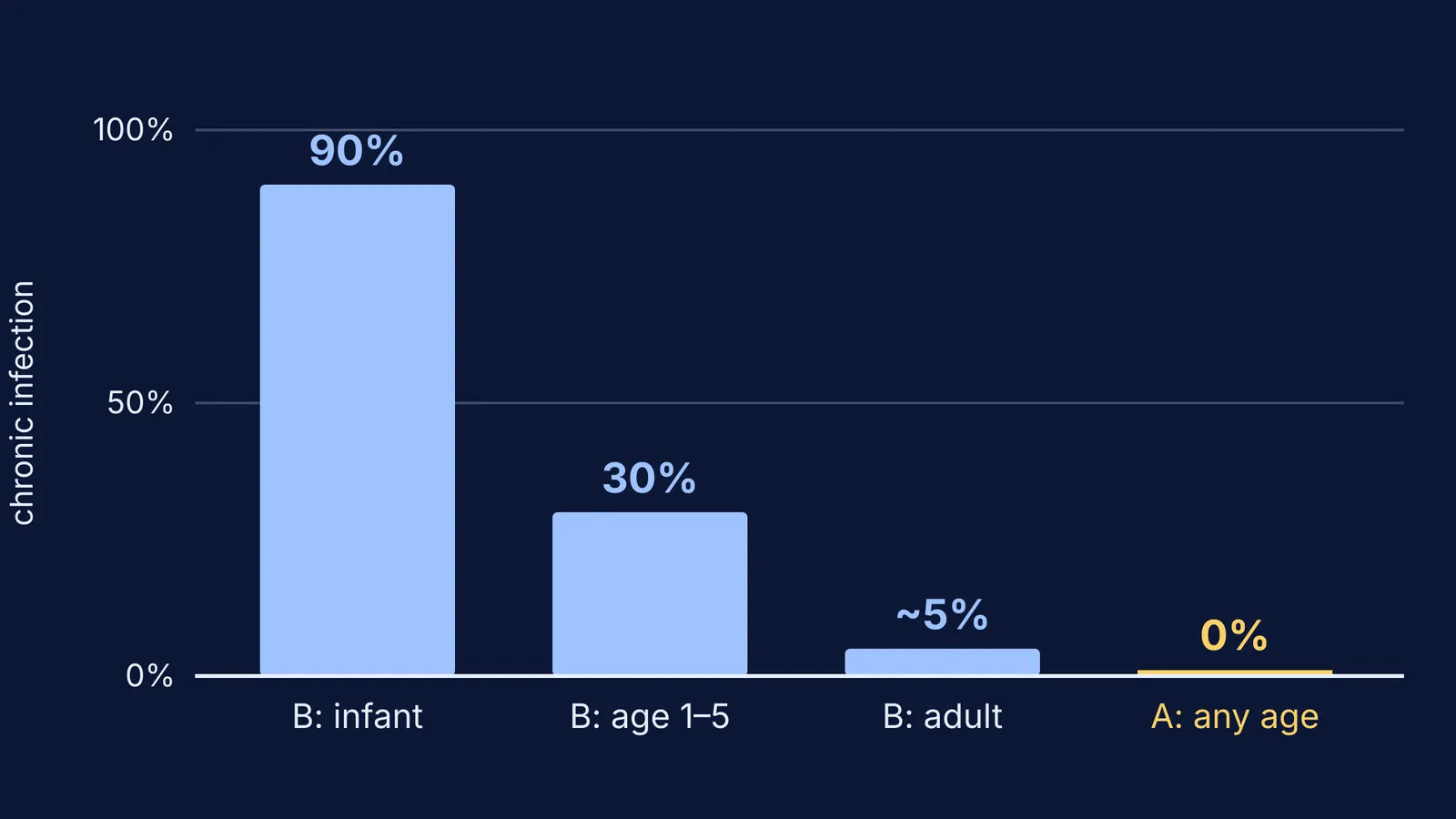
The WHO hepatitis B fact sheet says infection in infancy and early childhood leads to chronic hepatitis in about 95% of cases, against less than 5% in adulthood. WHO estimates that 240 million people were living with chronic hepatitis B in 2024.
Hepatitis A vs B: a comparison for board and NEET-UG answers
Sources: WHO fact sheets on hepatitis A and B; CDC overviews of A and B.
Route: A is faecal-oral (food, water, close contact). B is blood and body fluids (birth, sex, unsafe needles).
Incubation: A averages 28 days (15 to 50). B averages 90 days to symptoms (60 to 150).
Chronic?: A does not. B can, in about 95% of those infected in infancy and early childhood and under 5% of adults.
Main prevention: for A, safe water, sewage disposal and handwashing. For B, vaccination at birth and safe injections.
Vaccine: both have one. WHO says the hepatitis B vaccine protects for at least 20 years and probably for life.
In India, the national immunisation schedule published by the National Health Mission includes a hepatitis B birth dose within 24 hours for babies born in hospital, then three doses in the pentavalent vaccine at 6, 10 and 14 weeks. Hepatitis A is not on that schedule.
How do you write a three-mark answer on hepatitis A and B?
Question: Distinguish between hepatitis A and hepatitis B on the basis of transmission and outcome.
Hepatitis A spreads by the faecal-oral route, through contaminated food and water. Hepatitis B spreads through infected blood and body fluids, including from mother to child at birth.
Hepatitis A has a shorter incubation (about 4 weeks) than hepatitis B (about 3 months).
Hepatitis A does not become chronic. Hepatitis B can become chronic, especially when caught in infancy.
Never write "hepatitis spreads through water" without naming the type. Our list of human health and disease mistakes in NEET-UG biology covers other slips like this.
How do you revise this so it sticks?
Write the three-mark answer from memory.
Test yourself on the two incubation periods and the two chronic-infection figures by age.
Explain cccDNA to a parent in two sentences.
To connect viruses and DNA, the Fermi Concept Library gives every biology concept its own lesson and its place in the map. For practice, the Fermi Problem Library has worked problems with a step-by-step solver that explains the reasoning rather than printing an answer.


