On this page
If you open the NCERT Class 11 chapter on body fluids, you will read that red blood cells "are devoid of nucleus in most of the mammals and are biconcave in shape" (NCERT Biology, Chapter 15). The same page says RBCs live about 120 days before the spleen destroys them. Notice the wording: "most of the mammals", not "all vertebrates". The camel, the chicken and the frog all live in that small phrase.
Why do mammalian red blood cells have no nucleus?
Red blood cells start life in the bone marrow as erythroblasts, which do have a nucleus. In every vertebrate the nucleus shrinks and its chromatin condenses as the cell matures, but Ji, Murata-Hori and Lodish (2011) write that "only mammalian erythroblasts enucleate": the cell pushes its nucleus out and leaves it behind. Mammalian red cells also lose their mitochondria as they mature (Stier et al., 2013).
The same review gives the two textbook reasons. First, with the nucleus gone, the cell can hold more haemoglobin, the iron-containing protein that carries oxygen. Second, the cell becomes a flexible biconcave disc that can bend through capillaries narrower than itself, so deformed cells do not block small vessels.
Is the haemoglobin explanation the whole story?
Not quite, and it helps to know this. Yap and Zhang (2021) compared 181 bird species and 194 mammal species. They found no difference in mean corpuscular haemoglobin concentration (how densely haemoglobin is packed inside a red cell) between birds and mammals, and the difference in cell volume disappeared once they allowed for how the species are related. Their conclusion was that birds and mammals "may employ different strategies to solve a common problem".
For board and entrance exams, write the haemoglobin-and-flexibility answer. Just know that biologists still debate it.
Why are camel red blood cells oval if they have no nucleus?
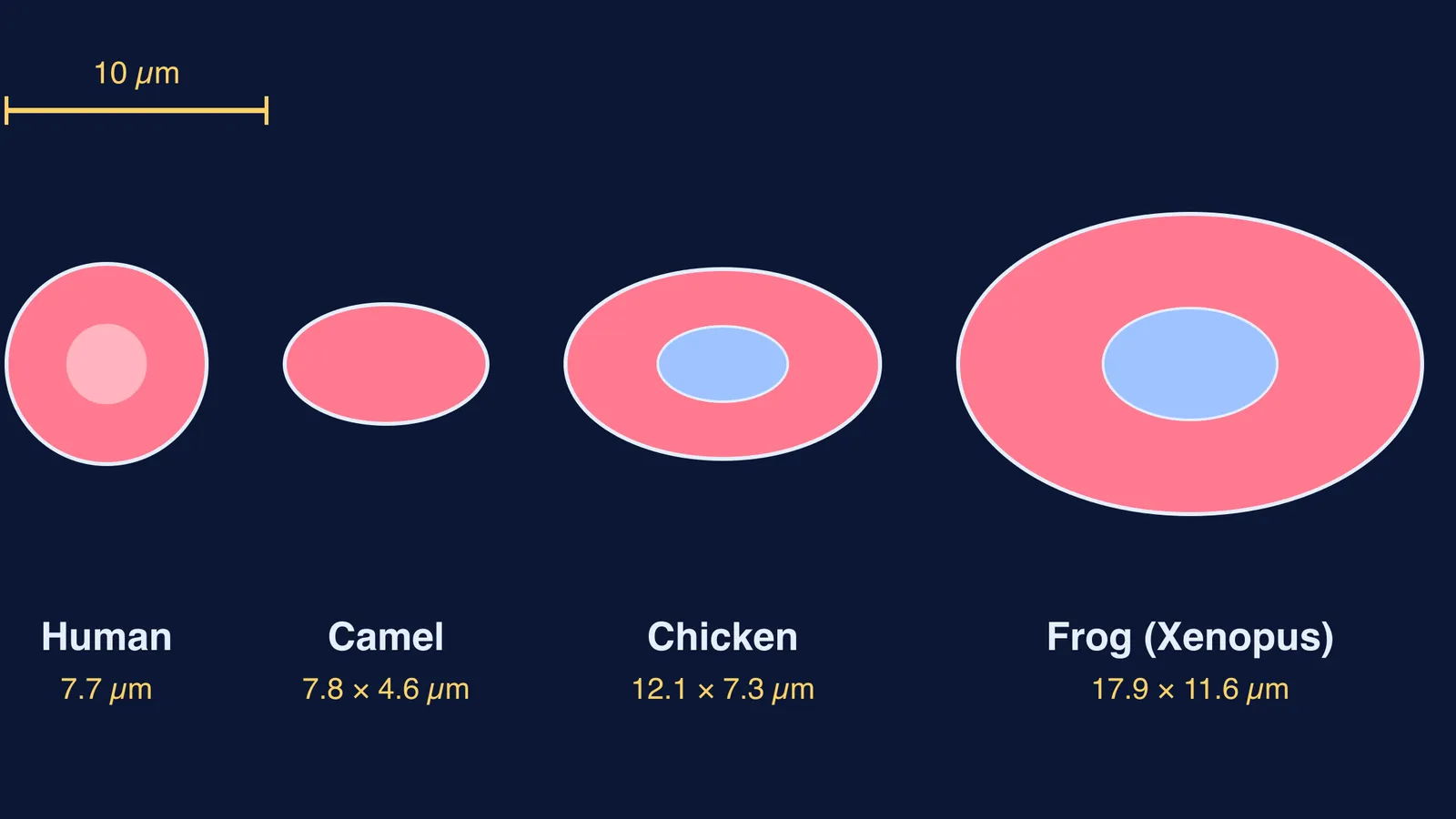
Camels are mammals, so their red cells enucleate like ours. A 2024 study describes camel red cells as unnucleated and elliptical; averaged across studies, they measure 7.8 µm long, 4.6 µm wide and 0.95 µm thick (Alhaddad et al., 2024).
So an oval shape and a nucleus are two separate traits. The Cell Size Database notes, via BioNumbers, that mammal red cells are enucleated and circular, "with the exception of some artiodactyls" (the group that includes camels).
Why oval? A veterinary review by Susan Tornquist says the elliptical shape makes camelid red cells much more resistant to changes in blood osmolality. That matters for an animal that dehydrates and then drinks fast. In the 2024 study, camel red cells placed in dilute salt solutions roughly doubled in area without bursting, and the authors note that when a camel rehydrates rapidly its red cells "do not lyse, and just swell and get rounder in shape" (Alhaddad et al., 2024). For more on desert survival, see our post on how polar bears and camels adapt to extreme habitats.
How are bird and frog red blood cells different?
According to Stier et al. (2013), the mature red cells of almost all fish, amphibians, reptiles and birds keep their nucleus. Bird and amphibian red cells are elliptical, and bird cells sit between human and frog cells in size.
Birds: chicken red cells are about 12.1 by 7.3 µm (BioNumbers). Stier's team found that bird red cells keep functional mitochondria, and in their lab measurements bird red cells used almost 40 times as much oxygen at rest as mammalian red cells.
Frogs: in the African clawed frog, two sets of measurements gave long diameters of 16 and 19.7 µm and short diameters of 9.5 and 13.6 µm (BioNumbers), compared with 7.7 µm for a human red cell (BioNumbers).
If you want the rest of the blood picture, read our guide to the formed elements of blood: RBCs, WBC types and platelets, and for the oxygen-carrying protein itself, haemoglobin vs myoglobin.
How do you answer this in an exam?
Name the process: enucleation, which only mammals do.
Give both advantages: more space for haemoglobin, and a flexible biconcave shape for narrow capillaries.
Add the exception if the question allows: camels and llamas have oval red cells, still without a nucleus.
Contrast with other vertebrates: birds and frogs keep a nucleus in oval red cells.
Then test yourself on these traps. Each statement is false.
"All mammalian red cells are round." Camel red cells are oval.
"An oval red cell must have a nucleus." Camel red cells are oval with none.
"Red cells of all vertebrates lack a nucleus." Only mammals enucleate.
"Mammalian red cells use mitochondria for energy." They lose their mitochondria as they mature.
If structure and function still feel loosely linked, the Fermi Concept Library gives every biology concept its own lesson and its place in the map. For practice, the Fermi Problem Library has worked problems with a step-by-step solver that explains the reasoning rather than printing an answer.