

On this page
NCERT's Class 12 Biology chapter on human health and disease covers alcohol's long-term damage in one line in section 7.5.3: "The chronic use of drugs and alcohol damages nervous system and liver (cirrhosis)." You can read it in the NCERT Human Health and Disease chapter. This guide fills in the chemistry and cell biology between the first drink and the scarred liver.
What happens to alcohol inside a liver cell?
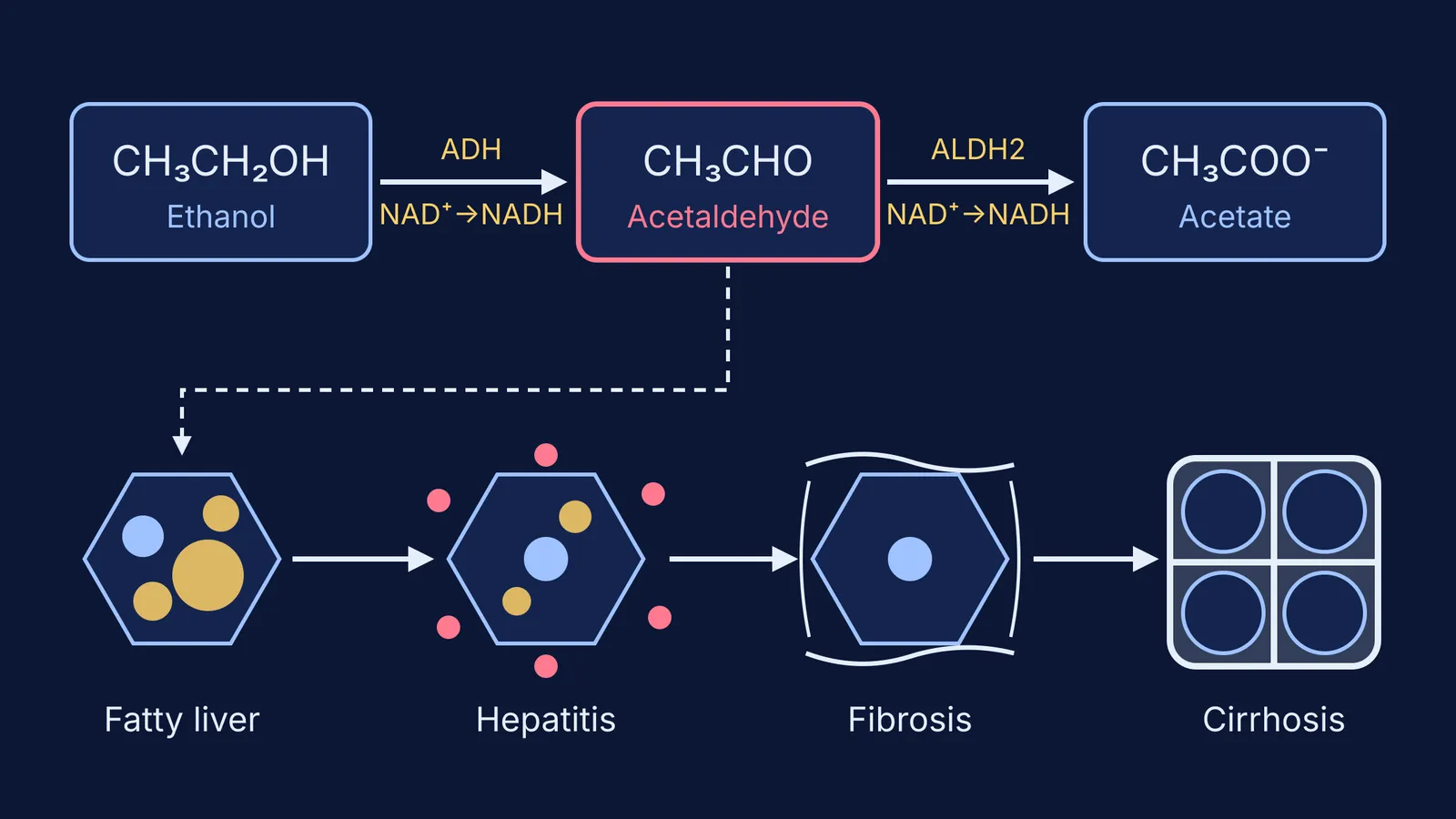
The liver takes more damage from heavy drinking than any other tissue because it is the main place the body breaks ethanol down, according to a 2017 review by Osna, Donohue and Kharbanda in Alcohol Research: Current Reviews. Inside a liver cell (a hepatocyte), the main pathway takes two oxidation steps:
Alcohol dehydrogenase (ADH) oxidises ethanol to acetaldehyde, using NAD+ and producing NADH.
Aldehyde dehydrogenase 2 (ALDH2), inside the mitochondria, oxidises acetaldehyde to acetate.
You already know this pattern from chemistry: a primary alcohol oxidises to an aldehyde and then to a carboxylic acid. The trouble comes from two by-products.
Acetaldehyde is toxic. It binds to proteins and DNA to form acetaldehyde adducts, which can disrupt the structure and function of those molecules.
NADH builds up. The shift in the NAD+/NADH ratio moves the cell away from burning fuel and towards making fatty acids, so fat starts to collect in the hepatocytes.
What are the stages of alcoholic liver disease?
The same review describes how the injury progresses through four stages.
Fatty liver (steatosis). Fat is deposited in hepatocytes. It is the earliest and most common response, developing in more than 90 percent of problem drinkers who have 4 to 5 standard drinks a day over decades. It is reversible and has a good outlook if the person stops drinking.
Alcoholic hepatitis (steatohepatitis). The liver becomes inflamed. Kupffer cells, the liver's resident immune cells, release inflammatory signals such as TNF-alpha. Alcoholic hepatitis occurs in about 30 to 40 percent of people who report chronic alcohol abuse.
Fibrosis. Hepatic stellate cells lay down too much extracellular matrix, the protein mesh that forms scar tissue. The review calls fibrosis a reversible wound-healing response that may return to normal in some people who stop drinking, but it progresses if drinking continues.
Cirrhosis. Heavy scarring and changes in the blood vessels distort the liver, which can end in liver failure. This is the word NCERT uses. The review notes that only about 35 percent of problem drinkers develop advanced liver disease, because other factors speed up, slow down or prevent the progression.
Stopping drinking is an integral part of treatment, the review adds; end-stage disease may need a liver transplant.
How does this match NCERT's drugs and alcohol section?
Section 7.5 of the NCERT chapter has four parts.
7.5.1 Adolescence and drug/alcohol abuse: curiosity, need for adventure and excitement, experimentation, and stress from pressure to excel in academics or exams are named as causes; peer pressure is listed among other factors.
7.5.2 Addiction and dependence: with repeated use, the tolerance level of receptors rises, so they respond only to higher doses. Withdrawal syndrome includes anxiety, shakiness, nausea and sweating. Our human health and disease key terms for Class 12 collects the chapter's vocabulary.
7.5.3 Effects: this is where cirrhosis appears, along with the warning that drinking in adolescence could lead to heavy drinking in adulthood.
7.5.4 Prevention and control: NCERT links parenting that combines high nurturance with consistent discipline to a lower risk of substance abuse.
Here is a worked answer to a likely 3-mark question, "How does chronic alcohol consumption damage the liver?":
The liver metabolises alcohol: ADH turns ethanol into acetaldehyde, and ALDH turns acetaldehyde into acetate.
Acetaldehyde is toxic and damages proteins, and excess NADH makes hepatocytes build up fat (fatty liver).
Continued drinking causes inflammation (hepatitis), then fibrosis, and finally cirrhosis, where scar tissue replaces normal liver tissue and the liver can fail.
If the enzyme names or the NAD+/NADH step feel shaky, the Fermi Concept Library gives each concept in biology and chemistry its own lesson. For the chapter's other figures, see our human health and disease NCERT numbers for NEET, then try our human health and disease case study questions for Class 12.
Is any amount of alcohol safe for the liver?
The World Health Organization's statement in The Lancet Public Health, published in January 2023, says there is no safe amount of alcohol that does not affect health. The International Agency for Research on Cancer classifies alcohol as a Group 1 carcinogen, the same group as asbestos, radiation and tobacco.
For parents, one way to open a calm conversation: "We read the cirrhosis line in your biology book. What do you think makes people your age try drinking?" Then listen. If you or your child is worried about drinking, talk to a doctor, or call Tele MANAS, the government's toll-free tele-mental health helpline, open 24/7 on 14416.
When you are ready to test yourself, work through problems in the Fermi Problem Library, where a step-by-step solver explains the reasoning rather than printing an answer.


