

On this page
Ask Class 11 students to name a hormone that raises blood sugar and you will hear four answers. Ask for one that lowers it and you will hear one. That lopsided list is not a gap in the syllabus. It is how the body is designed, and once you see why, the chapter becomes easier to remember.
Which hormones raise blood glucose?
The NCERT Class 11 chapter Chemical Coordination and Integration describes three of them. Glucagon, from the alpha cells of the islets of Langerhans, acts mainly on the liver, breaking down glycogen and driving gluconeogenesis, so NCERT calls it a hyperglycemic hormone. Adrenaline from the adrenal medulla stimulates the breakdown of glycogen, which raises blood glucose. Cortisol, the main glucocorticoid of the adrenal cortex, stimulates gluconeogenesis.
Growth hormone is the fourth. A review by Sprague and Arbeláez (2011) describes it with cortisol as a counterregulatory hormone whose effects during low blood sugar are delayed, unlike the rapid effects of glucagon and adrenaline. In studies they review, a missing cortisol rise showed up as lower glucose production after 6 hours.
If glucagon, glycogen and glucose still blur together, our explainer on glucagon vs glycogen vs glucose sorts out the three words first.
Which hormone lowers blood glucose?
Just one. Insulin from the beta cells speeds up glucose uptake into liver and fat cells and converts glucose to glycogen, which lowers blood glucose (NCERT, Section 19.2.8). To see how alpha and beta cells sit side by side, read our post on alpha and beta cells of the islets of Langerhans.
Philip Cryer described the imbalance in a 1993 review in the American Journal of Physiology: insulin is the dominant glucose-lowering factor, while several redundant factors defend against a fall, with glucagon playing the primary role and adrenaline becoming critical when glucagon is deficient.
Why is insulin the only hormone that lowers blood sugar?
The clearest answer comes from James Cantley and Frances Ashcroft, writing in BMC Biology in 2015. Several hormones can raise blood glucose, they write, but only insulin can reduce it, because too much insulin has far more immediate and devastating effects than too little.
Blood glucose below 2 mmol/l for as little as 5 minutes can cause lethal brain damage, according to Cantley and Ashcroft. High glucose, by contrast, causes the complications of diabetes only when it stays raised over many weeks and months. The brain relies almost exclusively on glucose for fuel, as Sprague and Arbeláez note, which is why a fall is the emergency.
Cantley and Ashcroft add an evolutionary reason. Through human history, with too little food and sudden escapes from predators, low blood sugar was a likelier danger than high. A single way to lower glucose means less chance of pushing it too low by accident. Several feedback systems to raise it give the body back-ups against a fall.
In what order does the body defend against low sugar?
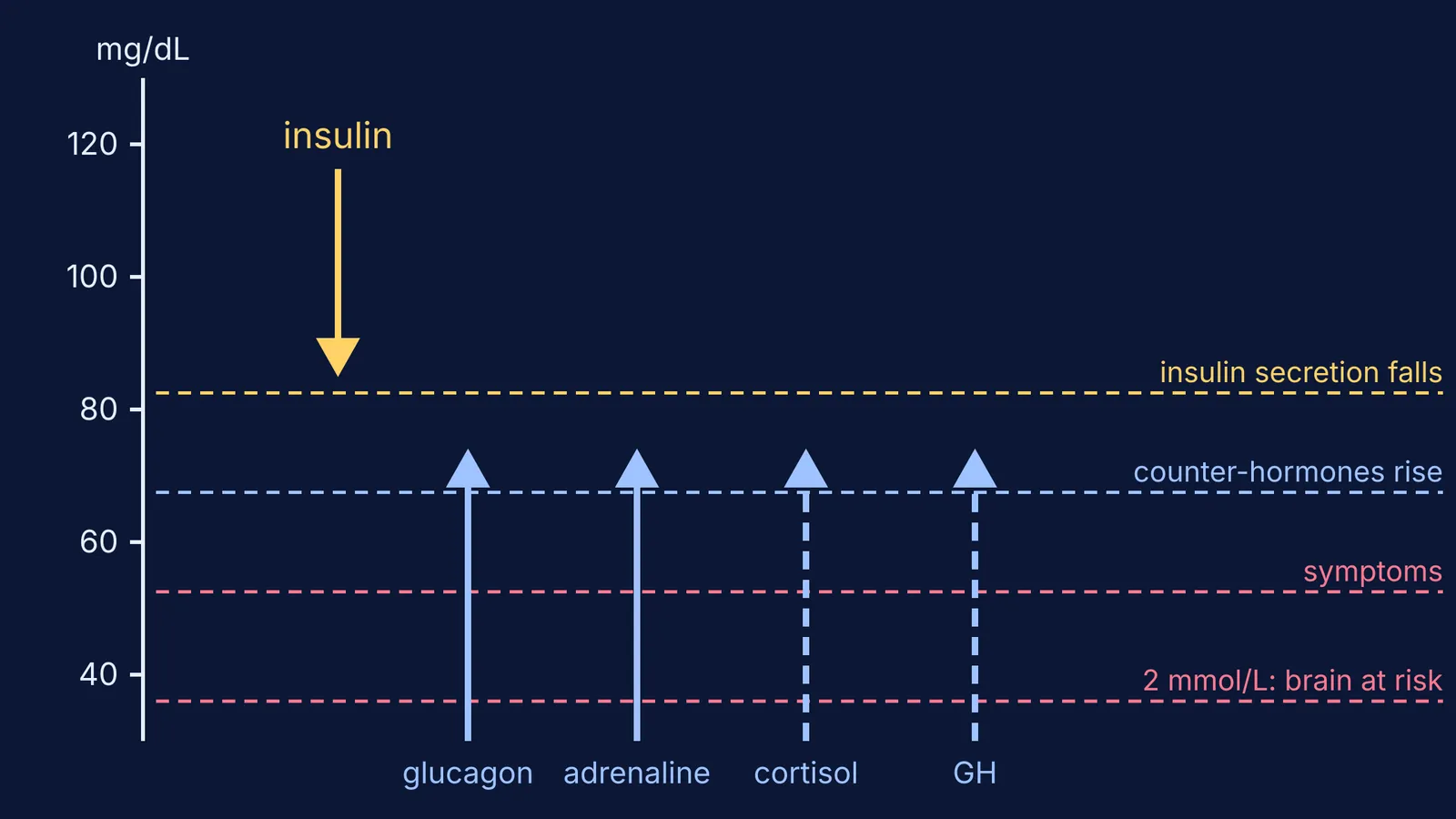
Sprague and Arbeláez give the thresholds in their 2011 review:
At about 80 to 85 mg/dL (4.4 to 4.7 mmol/L), insulin secretion falls. This is the first defence.
At about 65 to 70 mg/dL (3.6 to 3.9 mmol/L), glucagon and adrenaline are secreted.
At about 50 to 55 mg/dL (2.8 to 3.0 mmol/L), symptoms appear, and below about 50 mg/dL the brain stops working properly.
Cortisol and growth hormone add a slower push, with effects that are delayed by hours rather than minutes.
The defences switch on well above the level where symptoms start. That safety margin is the design. If someone at home has diabetes, glucose targets and handling a low are questions for their doctor, not a textbook.
Summary chart: glucose-raising hormones vs insulin
Glucagon: alpha cells, pancreas; glycogen breakdown and gluconeogenesis in the liver; fast.
Adrenaline: adrenal medulla; glycogen breakdown; fast. More in what adrenaline does in an emergency.
Cortisol: adrenal cortex; gluconeogenesis; slow, delayed.
Growth hormone: anterior pituitary; delayed counterregulation; slow, delayed.
Insulin: beta cells, pancreas; the only one that lowers glucose, by cellular uptake and glycogen formation.
How do you write this answer in an exam?
Use this three-line script for a short answer:
Name them: insulin lowers blood glucose; glucagon, adrenaline, cortisol and growth hormone raise it.
Give the reason: the brain depends on glucose, very low glucose can damage it within minutes, and high glucose does harm over weeks and months.
Conclude: so the body has several redundant ways to raise glucose and one controlled way to lower it.
If a link in that chain feels shaky, the Fermi Concept Library gives every biology concept its own lesson and its place in the map, and the Fermi Problem Library has worked problems with a step-by-step solver that explains the reasoning rather than printing an answer.


