

On this page
Three words, one letter apart in places, and three completely different kinds of molecule. Mix them up in a NEET-UG or board MCQ and you lose marks on a question you actually understood. Here is one line for each, which one turns into which, and the traps built on the mix-up.
What is the difference between glucagon, glycogen and glucose?
Glucose is a sugar. It is a single monosaccharide with the formula C6H12O6, shown among the small sugars in NCERT Class 11 Biology, Chapter 9 (Biomolecules).
Glycogen is a store. NCERT describes starch as the energy store of plant tissues and says animals have another variant called glycogen, a polysaccharide with branches (NCERT Chapter 9).
Glucagon is a signal. It is a peptide hormone secreted by the alpha-cells of the islets of Langerhans in the pancreas (NCERT Class 11 Biology, Chapter 19).
At the chemical level, glycogen is a large, highly branched polysaccharide of glucose units joined by alpha-1,4 and alpha-1,6 glycosidic bonds, according to a review by Navdeep Chandel in Cold Spring Harbor Perspectives in Biology. So glycogen is built from glucose, while glucagon, a peptide, is built from amino acids.
If the stores themselves blur together, our post on starch vs glycogen as storage polysaccharides separates the plant and animal versions.
Which one turns into which?
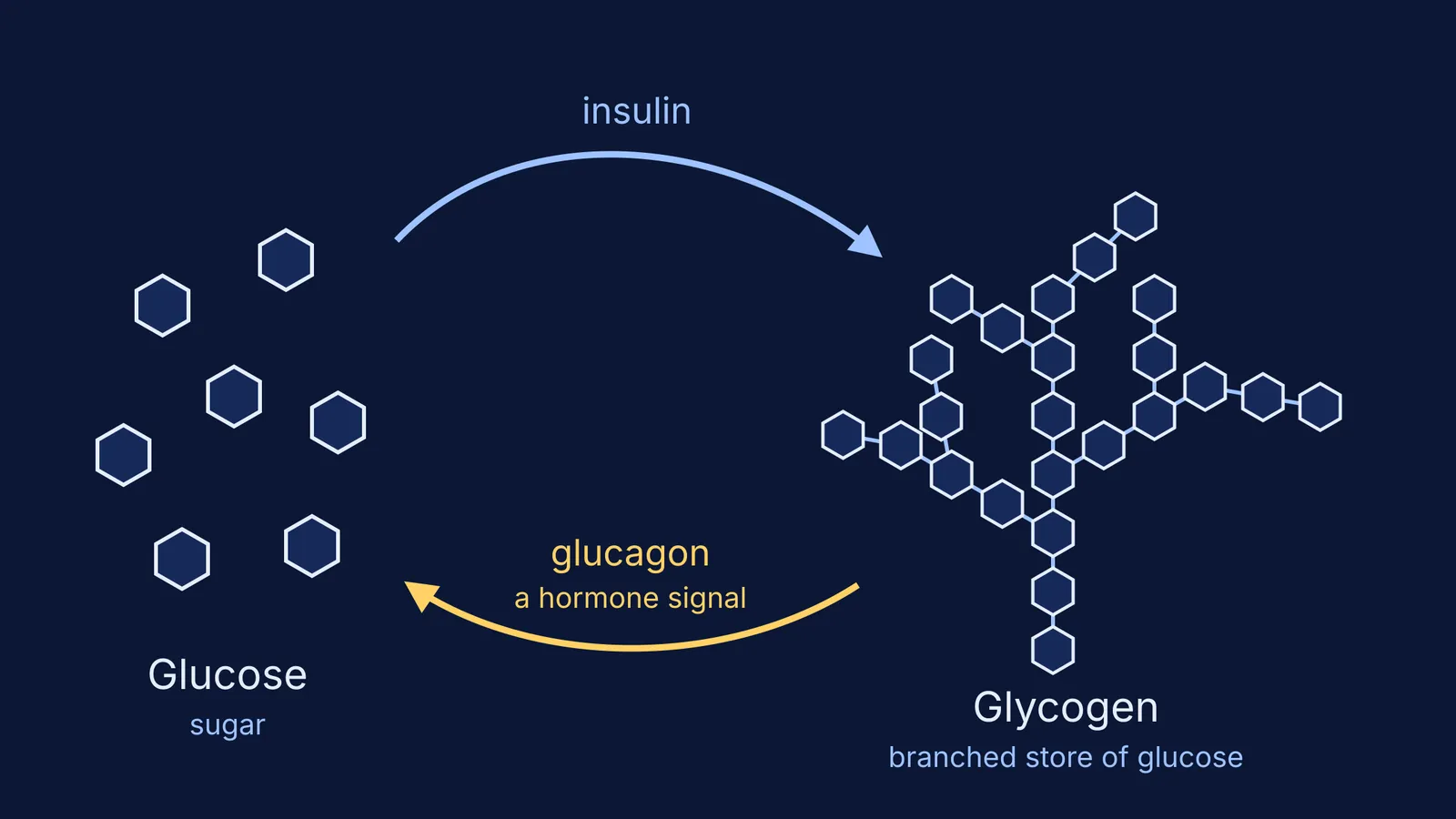
Only two of the three ever convert into each other: glucose and glycogen. Glucagon is the messenger that tells the conversion which way to run. Here is the flow, built from NCERT Chapter 19:
Beta-cells secrete insulin, which stimulates the conversion of glucose to glycogen (glycogenesis) in target cells and lowers blood glucose.
Alpha-cells secrete glucagon.
Glucagon acts mainly on liver cells (hepatocytes) and stimulates glycogenolysis, the breakdown of glycogen, which raises blood sugar.
Glucagon also stimulates gluconeogenesis, making new glucose, and reduces cellular glucose uptake and utilisation. That is why NCERT calls it a hyperglycemic hormone.
So the chain reads: glucose to glycogen (insulin), glycogen to glucose (glucagon). Glucagon itself never becomes glucose. It is a hormone, not an enzyme, a difference our explainer on hormones versus enzymes covers in detail.
One more detail that examiners like: liver and muscle both store glycogen, but liver can release free glucose from it into blood and muscle cannot. Chandel's review explains that liver has the enzyme glucose 6-phosphatase, while muscle lacks it, so muscle keeps the glucose from its glycogen for its own use.
What MCQ traps use glucagon, glycogen and glucose?
Each trap swaps one word. The facts come from NCERT Chapter 19 unless another link is given.
"Glucagon is the storage form of glucose in animals." False. That is glycogen.
"Beta-cells secrete glucagon." False. Alpha-cells secrete glucagon; beta-cells secrete insulin.
"Glucagon is a hypoglycemic hormone." False. It raises blood sugar, so it is hyperglycemic. Insulin lowers it.
"Insulin stimulates glycogenolysis." False. Insulin stimulates glycogenesis; glucagon stimulates glycogenolysis.
"Muscle glycogen directly maintains blood glucose." False. Muscle lacks glucose 6-phosphatase (Chandel).
"Islets make up most of the pancreas." False. NCERT says there are about 1 to 2 million islets in a normal human pancreas, representing only 1 to 2 per cent of the pancreatic tissue.
For the cell-level picture, read our guide to the alpha and beta cells of the islets of Langerhans.
How do you solve an assertion-reason question on this?
Assertion (A): Glucagon is a hyperglycemic hormone.
Reason (R): Glucagon stimulates glycogenolysis in hepatocytes.
Check A against the flow: glucagon raises blood sugar, so A is true. Check R: NCERT says glucagon acts on hepatocytes and stimulates glycogenolysis, so R is true. Does R explain A? Yes, breaking glycogen into glucose is how blood sugar rises. Answer: both true, and R is the correct explanation of A.
Now change R to "Glucagon is converted into glucose in the liver." A stays true, but R is false, because glucagon is a peptide signal, not a store of sugar.
How do you make this stick before the exam?
Write the three one-liners (sugar, store, signal) from memory, then check them against the NCERT lines above.
Redraw the two-arrow flow: insulin from glucose to glycogen, glucagon from glycogen back to glucose, with the liver labelled.
Make up two false statements of your own by swapping one word, then correct them.
If the gap is in the underlying chapter rather than the names, the Fermi Concept Library gives each biology concept its own lesson and its place in the map. To practise questions, the Fermi Problem Library has worked problems with a step-by-step solver that explains the reasoning rather than printing an answer.
This post is for exam study only. For questions about blood sugar, diabetes or any symptom, talk to a doctor.


