

On this page
The pancreas has a dual role in the human body. While its exocrine tissue secretes digestive enzymes, its endocrine tissue coordinates the hormonal control of metabolic homeostasis. This endocrine function happens inside tiny clusters of cells known as the islets of Langerhans.
What are the islets of Langerhans alpha and beta cells?
The islets of Langerhans are spherical clusters scattered throughout the pancreas. Even though they make up a small fraction of the organ's total mass, they are heavily vascularised to constantly sense blood glucose levels and release hormones directly into the bloodstream.
The two main cell types inside these islets work in opposition:
Beta cells (β-cells): These secrete the hormone insulin.
Alpha cells (α-cells): These produce the hormone glucagon.
The islets also contain a smaller number of delta cells (δ-cells) that secrete somatostatin, a hormone that fine-tunes the balance by inhibiting the release of both insulin and glucagon.
Which cells make glucagon and which make insulin?
It is easy to mix these up in exam pressure. A simple way to remember is alphabetical order: alpha (α) comes before beta (β), and glucagon (G) comes before insulin (I).
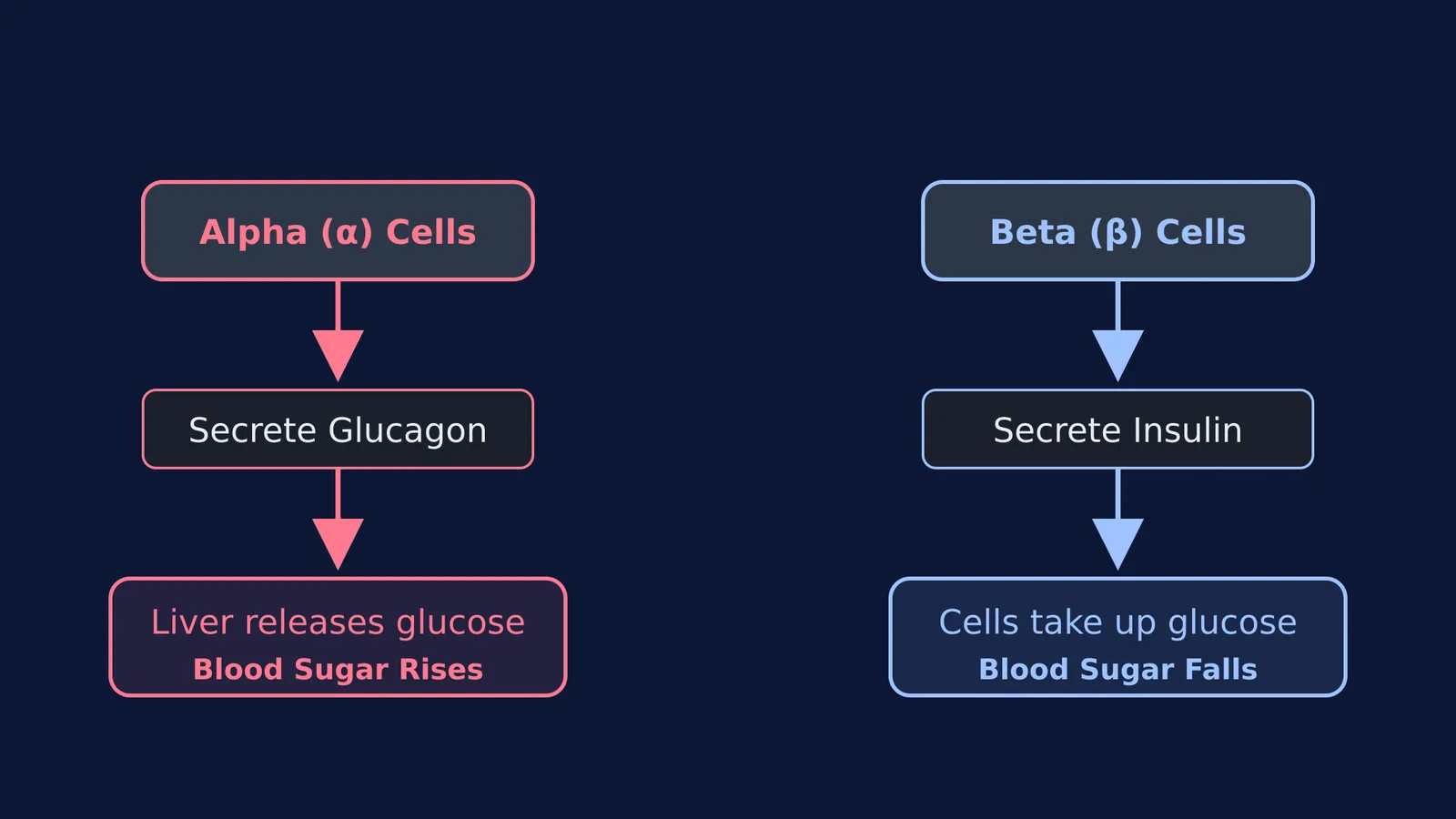
Beta cells make insulin. Insulin is an anabolic hormone that lowers blood glucose. When you eat a meal and your blood sugar rises, the beta cells sense this increase and secrete insulin. The insulin travels through the blood and binds to receptors on muscle and fat cells, signalling them to take up glucose from the blood. In making human insulin by rDNA, scientists insert the genetic instructions for these same beta-cell secretions into bacteria to produce medicine for diabetics.
Alpha cells make glucagon. Glucagon is a catabolic hormone that raises blood glucose. During a fast, or between meals, your blood sugar falls. The alpha cells detect this drop and release glucagon, which signals the liver to break down its stored glycogen and release fresh glucose into the bloodstream.
How do alpha and beta cells balance blood sugar?
The opposing actions of insulin and glucagon create a see-saw mechanism that maintains a steady blood sugar level, a state known as homeostasis.
When blood glucose is high, insulin acts as a brake on the alpha cells. The insulin released by beta cells acts locally within the islet to suppress glucagon secretion. When blood glucose drops, this brake is removed; insulin secretion falls, allowing the alpha cells to release glucagon and restore the sugar supply.
In conditions like Type 1 diabetes, an autoimmune response destroys the beta cells, leaving the body without insulin. Without the insulin brake, alpha cells may continue to secrete glucagon even when blood sugar is dangerously high.
If you struggle to recall how the endocrine and exocrine parts of the pancreas work, the Fermi Concept Library holds lessons on human physiology where you can map out every gland, hormone, and its target tissue. Fermi's AI tutor works alongside you, drawing diagrams on the board and checking your understanding of the mechanisms before you move on.
How can you learn biological mechanisms?
Biology requires you to memorise facts, but the facts make more sense when you see the whole system. When you study parturition and lactation hormones or the islets of Langerhans, use this three-step framework:
Draw the loop: Sketch the stimulus (high blood sugar), the sensor (beta cells), the messenger (insulin), and the target (muscle cells).
Break it: Ask yourself what happens if one part fails. What happens to glucagon levels if beta cells are destroyed?
Link it: Connect the micro to the macro. The hormones are the micro; the result (you having energy to run) is the macro.
By mapping the system, you turn a list of cell names into a logical mechanism you can derive on exam day.