

On this page
A dog-sized beetle is a horror-film staple, and part of the reason you never meet one is plumbing. How an insect breathes seems to set a ceiling on its size, and that ceiling may have moved as Earth's oxygen changed.
Why are insects so small?
Insects have no lungs. Air enters through holes called spiracles and travels down branching tubes, the tracheae, to the tissues. You can trace the route in our post on how insects breathe through spiracles, tracheae and tracheoles.
Unlike vertebrates, which pass oxygen from lungs to blood, insects rely almost entirely on the tracheal system for gas exchange, according to a 2007 PNAS study by Alexander Kaiser and colleagues. Oxygen has to move along those tubes, much of the way by diffusion, and diffusion gets weaker over longer distances. That is Fick's law at work. A review by Jon Harrison, Alexander Kaiser and John VandenBrooks describes this system as "blind-ended": the tubes stop at the tissues, so air is not pumped round in a loop the way blood is.
The Kaiser team used synchrotron X-rays to image the tubes inside four species of darkling beetle whose body masses differed by a factor of about 1,000. Tracheal volume scaled with body mass to the power 1.29, so bigger beetles gave a larger share of their bodies to breathing tubes, in striking contrast to the pattern seen in vertebrates.
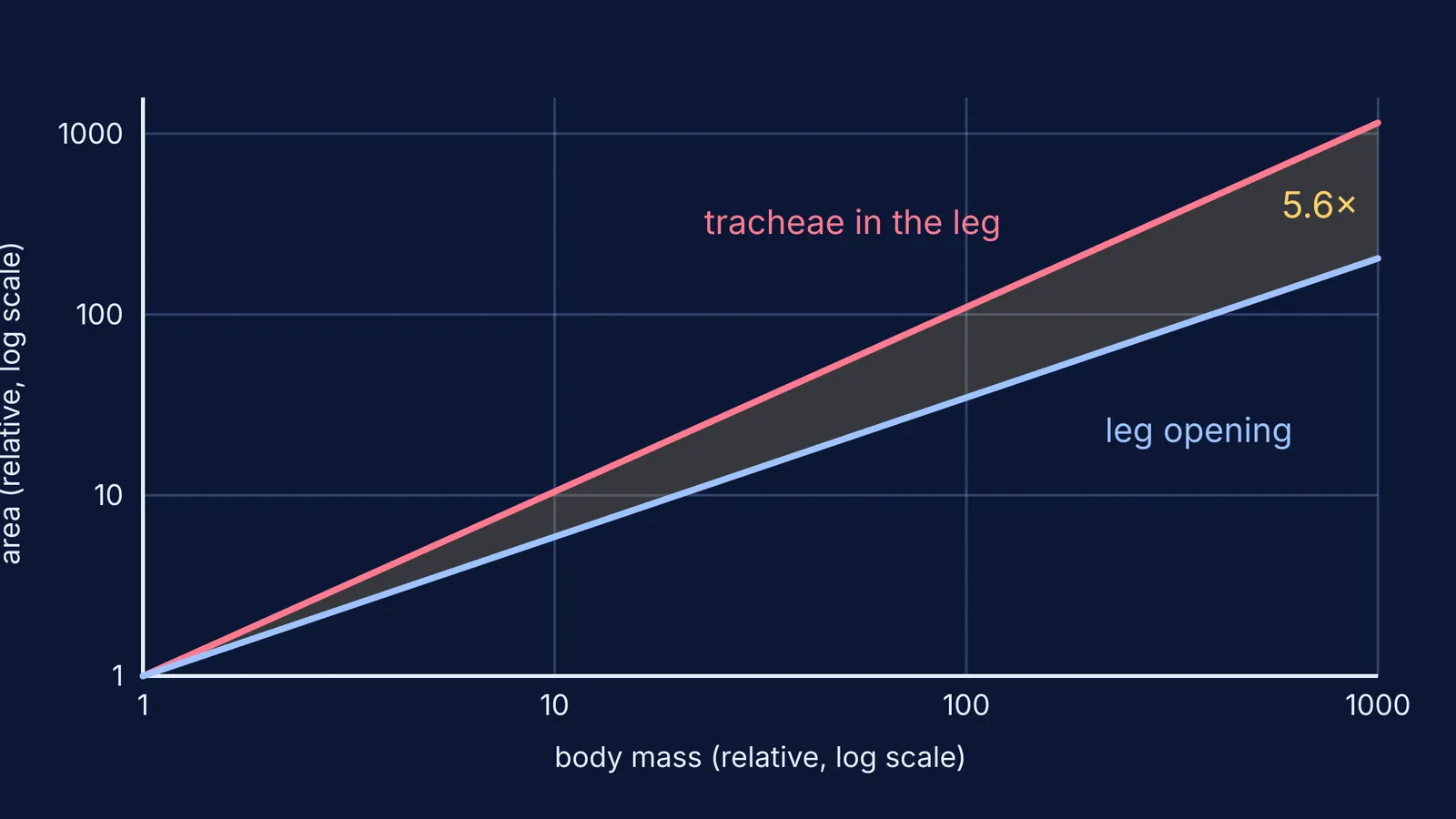
The trend was strongest in the legs. The cross-section of the tubes entering a leg scaled with mass to the power 1.02, but the leg opening they pass through scaled only with mass to the power 0.77. The authors suggest that the room for tubes inside the legs may limit the maximum size of beetles alive today.
You can run the same rough check on a monster beetle in a film:
Write the scale-up in mass, not length. Ten times longer means about 1,000 times heavier, because of the square-cube rule Galileo used to show why giants cannot exist.
Raise that mass factor to each of the beetle exponents: 1.02 for the tubes, 0.77 for the opening.
Divide the first answer by the second. The bigger the result, the more the tubes outgrow their space.
If exponents feel slippery, the Fermi Concept Library gives each concept in mathematics its own lesson.
Does the exoskeleton get too heavy?
It is a common answer, but the evidence is weak. Hilary Lease and Blair Wolf weighed the exoskeletal chitin of 551 adult terrestrial insects from 245 species. Chitin mass scaled with dry body mass to the power 1.03, almost exactly in proportion (Lease and Wolf, 2010).
So across insects as a whole, large and small species give a similar fraction of their mass to chitin, although beetles were the one order where the study did not find this pattern. The authors conclude that exoskeleton investment may not be the main limit on insect size.
How did ancient dragonfly relatives reach 70 cm wingspans?
The giants were griffinflies, extinct relatives of dragonflies. *Meganeura*, found at Commentry, a former mining town in France, had a wingspan of about 70 cm and lived 300 million years ago, according to palaeontologists Romain Garrouste and André Nel of France's National Museum of Natural History. Its Permian relative *Meganeuropsis permiana* had a wingspan of about 710 mm (Cannell, 2018).
The air was different then. Today's atmosphere is about 21% oxygen. A charcoal-based reconstruction suggests oxygen stayed above today's level, and usually above 23%, until at least the end of the Permian, peaking at about 28% in the early Permian (Glasspool et al., 2015). When oxygen supply rises, insects can make do with a smaller tracheal system, so richer air may have let limbs grow larger before the tubes ran out of room (Kaiser et al., 2007). Lab work supports the link: most insects develop smaller bodies in low oxygen, and some grow larger in high oxygen (Harrison et al., 2010).
Is oxygen the whole story?
No. Matthew Clapham and Jered Karr studied more than 10,500 fossil insect wing lengths. Maximum size tracked oxygen for roughly the first 150 million years of insect evolution, until the end of the Jurassic (Clapham and Karr, 2012). Then the largest insects shrank even as oxygen rose in the Early Cretaceous, as birds evolved more agile flight. The authors suggest predation and competition took over from oxygen as the main limit.
So the answer has two parts. Breathing tubes appear to set a physical ceiling, and oxygen sets how high it sits. Since the end of the Jurassic, birds, and possibly bats, seem to have kept the largest insects below it.
Scaling clicks faster when you watch it change. The Fermi Simulation Lab has interactive simulations for ideas that are easier to see than to read.


