

On this page
Sunlight carries ultraviolet light, yet you see none of it. Two things stop you: the front of your eye soaks up UV before it reaches the retina, and your colour receptors are tuned to longer wavelengths. Bees and many birds have neither problem, so flowers and feathers that look plain to you carry patterns they can see.
What counts as ultraviolet light?
The World Health Organization) splits ultraviolet into three bands: UVA (315 to 400 nm), UVB (280 to 315 nm) and UVC (100 to 280 nm). According to the same WHO page, all UVC and most UVB is absorbed by ozone, water vapour, oxygen and carbon dioxide in the atmosphere. So the UV that reaches your eyes outdoors is mostly UVA, with a little UVB.
Why can't humans see ultraviolet light?
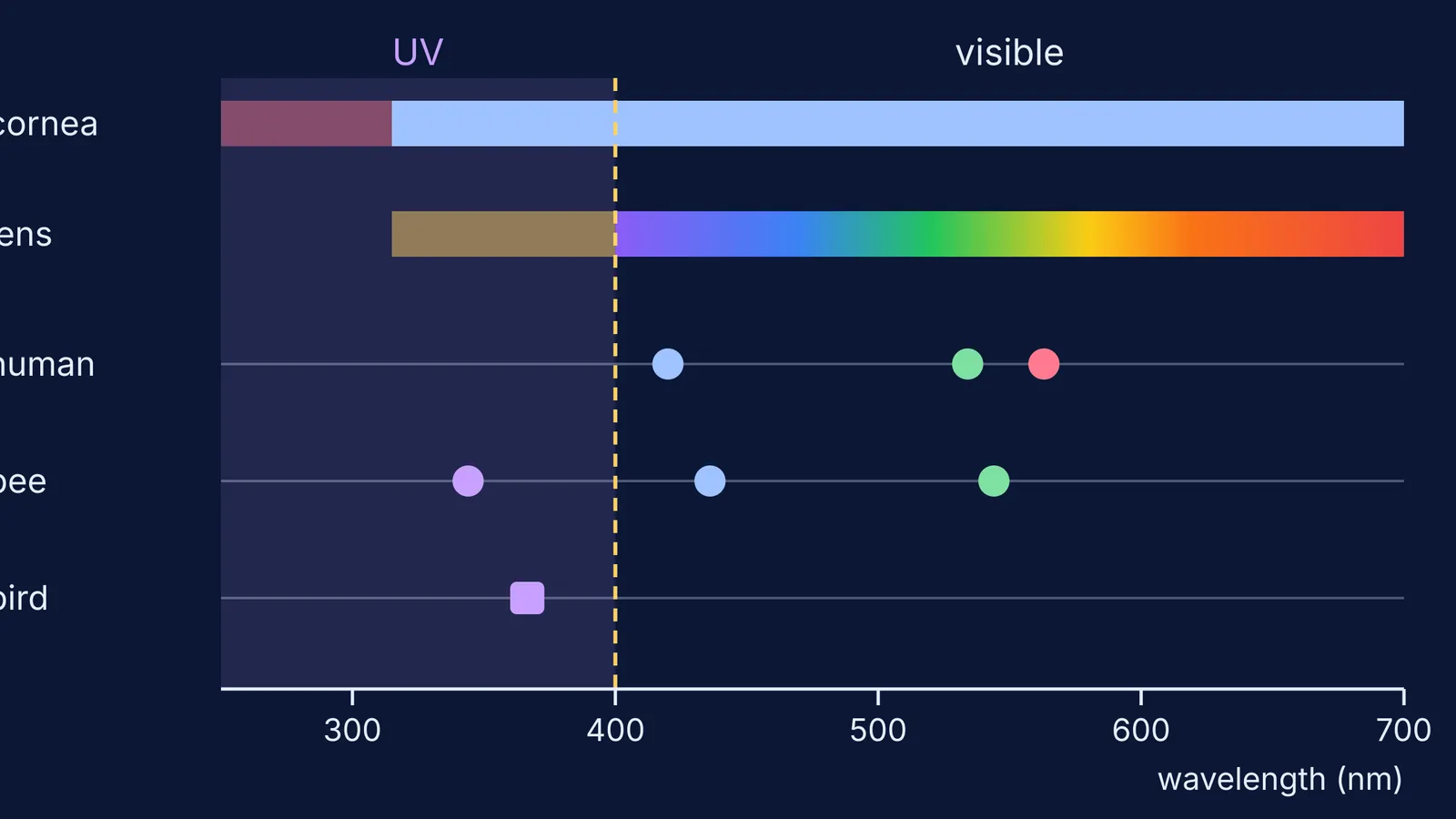
The first filter is the cornea, the clear dome at the front of the eye. A 2021 study of 74 donor corneas found that the cornea blocks UVC and practically all UVB, but lets most UVA pass through to the lens. An earlier study of corneal layers in IOVS found UVB absorption is 1.8 times higher in the front 100 micrometres of the cornea than in the layers behind it.
The second filter is the lens. In a 2014 survey of lenses from 38 mammal species, Ron Douglas and Glen Jeffery note that adult humans are insensitive to UV because it is absorbed by the lens. Evidence comes from people whose lens has been removed after cataract surgery or injury and not replaced with a UV-absorbing implant. The same paper reports that they describe vivid, detailed vision in the UV, which looks like a whitish blue-violet. A 1992 Vision Research study by Griswold and Stark90166-G) found that in dark-adapted eyes the human lens lowers sensitivity at 350 nm by about 4 log units, roughly 10,000 times.
Why throw light away? Douglas and Jeffery explain that scatter and chromatic aberration (colours focusing at different depths) are worse at short wavelengths, so removing UV sharpens the image, and retinal light damage is greater at shorter wavelengths. For how the cornea and lens share focusing, see which part of the eye bends light more.
How do cone cells limit the colours you see?
Even light that gets through has to be caught by a receptor. Human colour vision uses three cone pigments that absorb most strongly at 420, 534 and 563 nm, as listed in the same 2014 paper. The 420 nm cone is the one closest to UV. Fewer cone types means fewer colours, as our post on what two cone types mean for dogs shows.
Why do bees and birds see UV patterns?
Honeybees have three receptor types, which respond most to 344 nm (ultraviolet), 436 nm (blue) and 544 nm (green), as Reser and colleagues summarise in PLOS ONE.
Many flowers use this. Silverweed (Argentina anserina) looks plain yellow to us, but in UV its petals show a bullseye: UV-absorbing bases and UV-reflecting tips. In field experiments by Koski and Ashman, flowers with a UV pattern attracted bees and hoverflies at higher rates than flowers that were fully UV-reflecting or fully UV-absorbing. A bee's eye is also limited by its tiny facets, which you can read about in why a bee sees in 1 degree blocks.
Birds go further. A study of 38 bird species by Lind and colleagues reports that some birds have UV-sensitive cones peaking around 360 to 373 nm, while others have violet-sensitive cones peaking at 402 to 426 nm. Birds with UV-sensitive cones also have clearer eyes: the wavelength at which half the light gets through averages 323 nm in these birds, compared with 358 nm in violet-sensitive birds. The authors note that many birds prefer mates with strongly UV-reflecting plumage.
Worked example: follow three wavelengths into the eye
Ask two questions of each ray, using the WHO's UV bands) and the cone peaks above: does it reach the retina, and is there a receptor tuned to it?
300 nm (UVB): most is absorbed by the atmosphere, and what reaches you is stopped by the cornea. Nothing reaches the retina, so you see nothing.
365 nm (UVA): passes the cornea, then is absorbed by the lens. You see nothing. It sits close to the 344 nm peak of a bee's UV receptor. A UV-sensitive bird has a cone peaking right here and eye media that let it through.
450 nm (blue): passes the cornea and lens and lands within range of your 420 nm cone. You see blue.
If the link between wavelength and colour still feels loose, the Fermi Concept Library gives each concept in physics and biology its own lesson and shows its place in the map, so you can connect the eye to the spectrum.
Next time you see a yellow flower, remember that a bee is looking at a target you cannot see.


