On this page
Your dog does not live in a black-and-white world. It does live in a world with fewer colours than yours, and the reason comes down to the cells at the back of the eye. Once you see how two cone types work, you can predict which toys your dog will spot in the park.
Can dogs see red and green?
Not as two separate colours. In a 1989 study in Visual Neuroscience, Jay Neitz, Timothy Geist and Gerald Jacobs ran colour-matching and discrimination tests on three dogs. They concluded that the dog retina contains two classes of cone pigment.
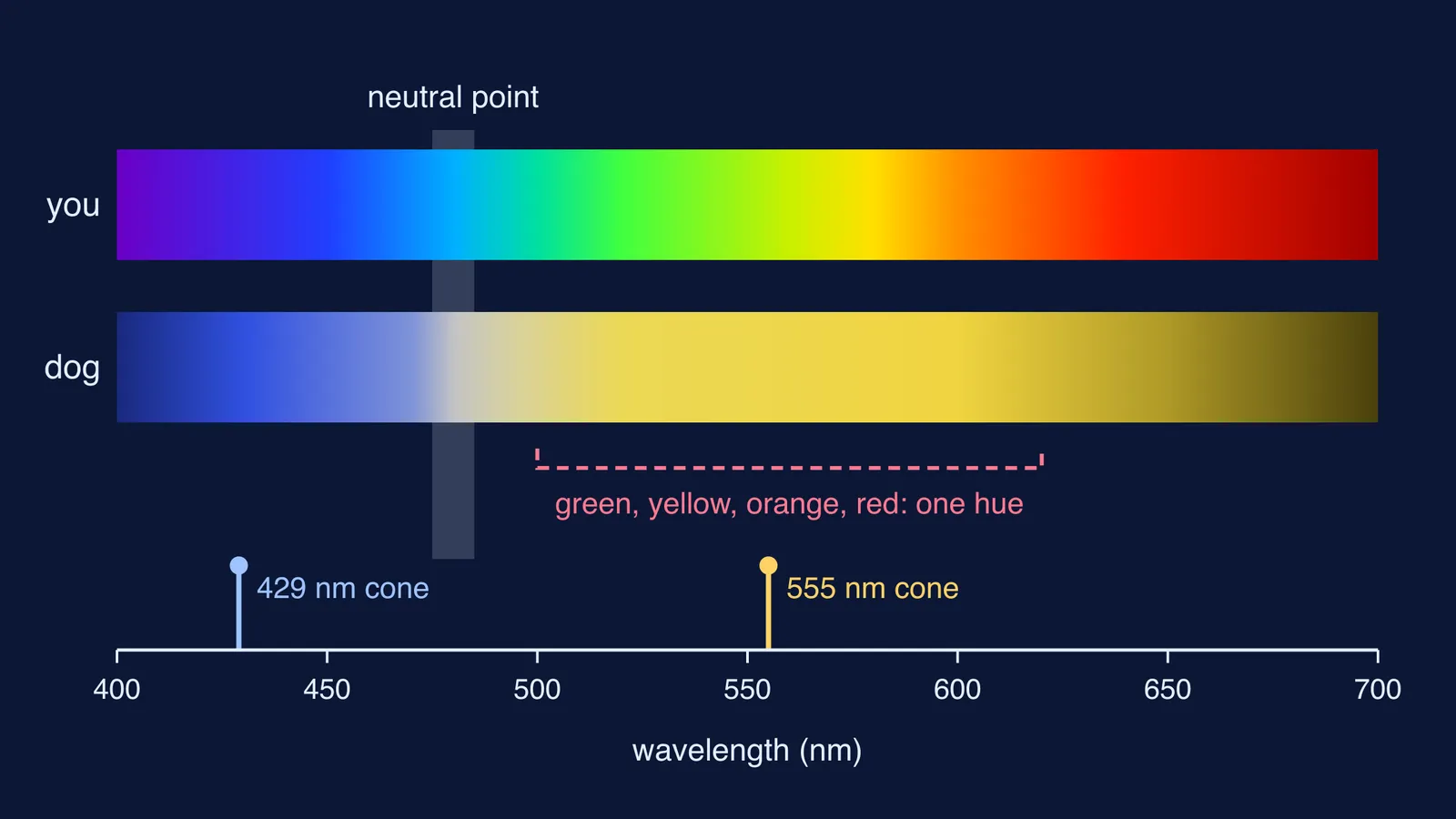
The two dog cone pigments have peak sensitivities of about 429 nm and 555 nm, according to Neitz, Geist and Jacobs (1989).
An eye with two cone types has dichromatic colour vision. People with normal colour vision are trichromatic, with three cone types. A 1995 review of dog vision by Miller and Murphy in the Journal of the American Veterinary Medical Association sums up the biggest difference: dogs cannot tell apart the middle-to-long wavelengths that people see as green, yellow-green, yellow, orange or red.
Why do two cones make red and green look the same?
A single cone only reports how strongly it is stimulated, so a dim light at its best wavelength can give the same signal as a bright light at a poorer one. Colour comes from the brain comparing the signals from different cone types.
With three cone types, your brain can compare a long-wave cone against a medium-wave cone, and that comparison separates red from green. A dog has no such pair at the long end of the spectrum. The Miller and Murphy review suggests that dogs probably split the visible spectrum into two hues:
violet and blue-violet light (about 430 to 475 nm), probably seen as blue
greenish-yellow, yellow and red light (about 500 to 620 nm), probably seen as yellow
In between sits the neutral point. The same review says light from about 475 to 485 nm, which looks blue-green to you, probably looks white or grey to a dog.
This is the same pattern as deuteranopia, a type of red-green colour blindness in people who lack the green-sensitive cone. The review notes one difference: the dog's neutral point is near 480 nm, while a deuteranope's is near 505 nm. If you want the human side of the story, read how our eyes see so many different colours, then who made the Ishihara colour blindness test.
Do dogs actually use colour, or just brightness?
Early studies concluded that colour did not matter to dogs. A 2013 study in Proceedings of the Royal Society B by Anna Kasparson, Jason Badridze and Vadim Maximov tested eight previously untrained dogs on choices that differed in both brightness and colour. For these dogs, colour proved more informative than brightness.
Dog colour is probably less vivid than yours, though. The Miller and Murphy review estimates that cones make up probably less than 10% of the photoreceptors in the central area of the dog retina, whereas cones fill almost 100% of the human fovea. The same review describes a practical result: a guide dog would be unable to tell traffic-light signals apart by colour alone, so it has to rely on other cues such as position and brightness.
Will your dog spot a red or blue toy?
This three-step check uses the two-hue picture above. It is a reasoning tool, not a lab measurement.
Name the colour of the object and the colour of the background.
Put each one in a dog bin: the blue bin (violet, blue), the yellow bin (green, yellow, orange, red) or the grey zone (blue-green, teal).
Different bins means strong colour contrast. Same bin means the dog has to rely on brightness, so a light object on a dark background still works, but similar shades blend in.
Here is how that plays out on a green lawn in a city park:
A red ball on grass falls in the same bin as the grass, so a red ball can be harder for your dog to find than it is for you.
A blue ball on grass falls in a different bin, so it should stand out by colour.
A yellow ball falls in the same bin as the grass, but it may still stand out if it is much lighter than the grass.
A teal frisbee sits near the neutral point, so it may look greyish.
Try it with two toys of similar brightness and note which one your dog finds first.
How can you picture what a two-cone eye sees?
Cone curves and colour mixing are easier to see than to read. The Fermi Simulation Lab has interactive simulations for ideas like these. If you want to see why colour blindness runs in families, try this post on running an X-linked inheritance simulation for colour blindness. If the eye and light are a weak spot before an exam, the Fermi Concept Library gives each concept in physics and biology its own lesson.
Next time you throw a ball, pick a blue one and watch what changes.