

On this page
A queen honeybee can lay an egg that hatches into a male without any sperm. An aphid on a rose stem can give birth to daughters all summer without a mate. A human egg can't do either. The reason is genomic imprinting: some of the egg's genes are switched off on purpose, and for those genes only the father's copy works.
What is parthenogenesis?
Parthenogenesis is producing offspring from the mother's germ cells alone, with no father, as a 2004 *Nature* paper from Tomohiro Kono's team defines it. Its abstract opens bluntly: "Only mammals have relinquished parthenogenesis." It also notes that parthenogenetic mouse embryos die by day 10 of gestation.
Plenty of insects use it. In honeybees, males develop from unfertilized eggs while females come from fertilized eggs, and Beye and colleagues (*Cell*, 2003) note that haplodiploid organisms like this make up about 20% of animals. Our explainer on how haplodiploidy decides sex in honey bees walks through the queen, worker and drone genetics.
Aphids work differently. A 2014 review by Ogawa and Miura describes aphids switching between live-birth parthenogenesis and sexual reproduction depending on day length. When autumn days get short, mothers produce males and egg-laying females, and those are themselves made parthenogenetically. For the history, see how Charles Bonnet proved aphid parthenogenesis in 1740 by raising a single aphid in isolation.
What is genomic imprinting?
Genomic imprinting is a mark that makes some genes work only from the copy inherited from one particular parent. Ferguson-Smith's 2011 review in *Nature Reviews Genetics* calls it essential for normal mammalian growth and development, and points to DNA methylation as one of the mechanisms involved.
Here's a concrete example. In mice, the growth gene *Igf2* is expressed only from the father's copy in embryos; the mother's copy is silent, according to DeChiara, Robertson and Efstratiadis (*Cell*, 1991). Pups that inherited a broken copy from their father were undersized. Pups that inherited it from their mother looked normal.
So an egg with two maternal genomes has all the right chromosomes but would carry *Igf2* switched off on both copies in most tissues.
Which experiments proved both parents are needed?
Two labs answered this in 1984 by swapping pronuclei, the separate sperm and egg nuclei found in a fertilised egg before they merge.
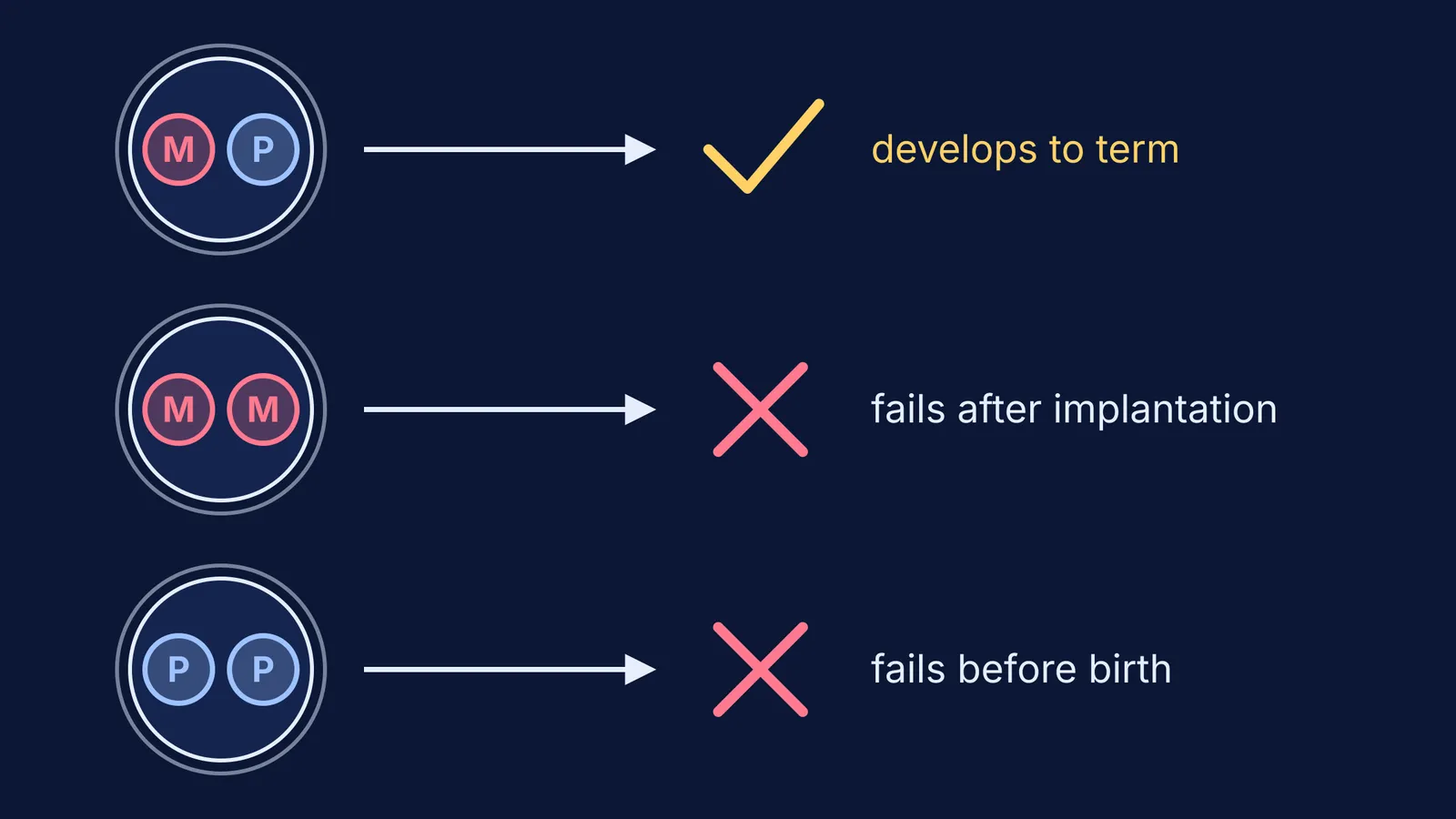
**McGrath and Solter (*Cell*, 1984).** They built mouse embryos carrying two female pronuclei or two male pronuclei. Neither kind completed normal embryogenesis, while control embryos that had a pronucleus swapped for another of the same sex developed normally. They concluded that the maternal and paternal contributions "are not equivalent."
**Surani, Barton and Norris (*Nature*, 1984).** Azim Surani's team started from activated eggs with only a mother's genome and added a second pronucleus. Eggs given a male pronucleus developed to term, while eggs given a second female pronucleus developed only poorly after implantation. So the egg's cytoplasm was fine; they proposed that the genome is imprinted while eggs and sperm are made. They added that the father's imprint seemed necessary for the extraembryonic membranes and the trophoblast, the tissue that goes on to form much of the placenta.
The controls are what make this convincing. Every embryo had a full diploid set of chromosomes (see our guide to haploid vs diploid cells), and only the parent of origin changed.
Can scientists get around imprinting?
In mice, yes, but only with deliberate genetic edits. In 2004 Kono's team made a fatherless mouse that grew to adulthood and had offspring of its own. One of its two maternal genomes came from an immature egg of a mutant mouse missing 13 kilobases of the *H19* gene. That let *Igf2*, *H19* and other imprinted genes be expressed appropriately. The authors concluded that paternal imprinting prevents parthenogenesis.
In 2022, a Shanghai team got live mouse pups from single unfertilised eggs by rewriting DNA methylation at seven imprinting control regions. Needing that many edits suggests the barrier is spread across several imprinted regions rather than one faulty gene.
Human cases fit the same pattern. Benign ovarian teratomas, which are tumours rather than embryos, arise parthenogenetically from a single germ cell, according to a 1975 chromosome study. A complete hydatidiform mole, an abnormal pregnancy, is completely androgenetic, meaning all its DNA comes from the father; its imprinted genes are expressed abnormally and its placental tissue overgrows.
How to write this answer in an exam
When a board or NEET-UG question asks why mammals need two parents, use this four-step chain:
Define: parthenogenesis means development from an unfertilised egg.
Contrast: bees (males from unfertilised eggs) and aphids (females in summer) do it naturally.
Mechanism: genomic imprinting silences some genes by parent of origin, so both parents' copies are needed.
Evidence: in 1984 mouse pronuclear transplants, two-mother and two-father embryos failed while normal controls developed.
If you get stuck on imprinting or haploid and diploid cells, the Fermi Concept Library gives each biology concept its own lesson and shows where it fits in the map. When you want to practise multi-step answers, the Fermi Problem Library has worked problems with a step-by-step solver that explains the reasoning.


