

On this page
In biology, we often learn terms by memorising their definitions from a textbook. Parthenogenesis, for example, is defined as a form of asexual reproduction where an embryo develops without fertilisation. But how do we actually *know* that some animals reproduce without mating? Before modern genetics and microscopes, proving that a female animal could produce offspring entirely on her own was a monumental challenge.
The answer goes back to a careful, groundbreaking experiment by a young Swiss naturalist. His work shifted the study of life from theoretical guesswork to meticulous, controlled observation, and it remains a masterclass in how to rigorously test a scientific idea.
What did Charles Bonnet discover about aphids?
In the early 1700s, naturalists and farmers alike noticed that aphids (small sap-sucking insects) seemed to multiply on plants at an astonishing, almost impossible rate. Entire colonies would appear seemingly overnight. The leading French scientist of the day, René-Antoine Ferchault de Réaumur, suspected that aphids might be able to reproduce without mating, but he needed someone with enough patience to prove it conclusively.
Charles Bonnet, an ambitious student, took up the challenge. He knew that to prove a female aphid could reproduce alone, he had to be absolutely certain she had never encountered a male in her entire life. This required creating an environment where no other insect could enter, yet the aphid could still survive and thrive.
How did Charles Bonnet prove parthenogenesis?
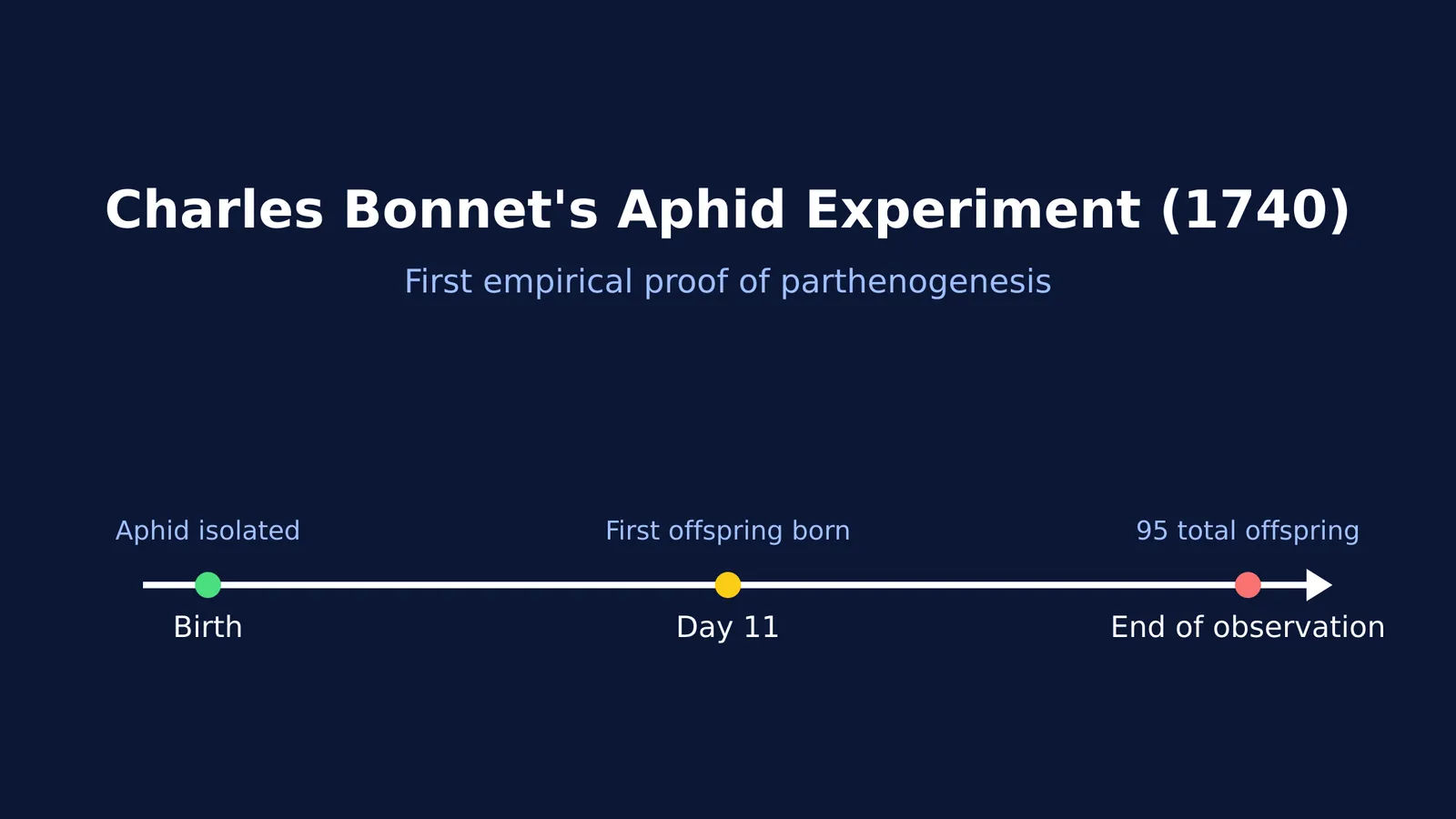
In May 1740, Bonnet found a newly born spindle tree aphid (*Aphis euonymi*) and isolated it immediately upon its birth (Embryo Project Encyclopedia). He carefully placed the tiny insect on a twig inside a completely sealed glass vessel. This strict isolation ensured the aphid had a constant supply of food and air but zero contact with any other insect.
He watched the solitary aphid closely, recording its every move and molt. Eleven days after her own birth, the virgin aphid gave birth to her very first offspring, and eventually produced exactly 95 live young aphids (Embryo Project Encyclopedia).
By tracking the aphid through its life cycle in a strictly controlled environment, Bonnet proved without a doubt that the female possessed everything needed to generate life internally. The French Academy of Sciences immediately recognised his work, and it became the first widely accepted empirical proof of clonal asexual generation by a female animal.
What is parthenogenesis in biology today?
Today, parthenogenesis is a standard, essential topic in biology curricula across the world. It is seen not just in aphids, but in a variety of organisms including microscopic rotifers, honeybees (where unfertilised eggs become male drones), some species of lizards, and even occasionally in turkeys. In aphids, this reproductive strategy can take the form of permanent parthenogenesis (known as anholocycly) or it can alternate between sexual and asexual generations depending on the season and environmental stress (holocycly).
Plants have similar fascinating mechanisms for bypassing the usual rules of reproduction. If you are studying for exams, you might have already encountered Apomixis and polyembryony (the production of seeds without fertilisation) or False fruits and parthenocarpy (the development of fruit without fertilisation).
How can you learn biology by tracing evidence?
When you read a dense biology textbook, it is incredibly easy to gloss over the experiments that built the foundational facts. But active learning means asking *how* we know what we know. Bonnet's aphid experiment is a perfect historical example of controlling variables: by sealing the aphid in a glass jar from birth, he completely eliminated the variable of mating, leaving only one possible conclusion.
Here is a checklist for applying Bonnet's observation method to your own biology studies:
Identify the core claim: What is the specific biological fact you are trying to understand (e.g., aphids can reproduce without mating)?
Find the key variable: What specific factor must be isolated to prove this claim (e.g., access to a male)?
Trace the original experiment: Look up who proved the concept and how they designed their test.
Draw the mechanism: Sketch the life cycle or pathway involved instead of just writing out text notes.
If you find yourself memorising facts without fully understanding where they come from, Fermi's AI tutor can work out what you already know and build a plan for the session, helping you trace the reasoning behind biological laws. When you need to connect these historical ideas across topics—from insect reproduction to human genetics—the Fermi Concept Library contains a lesson on every concept in physics, chemistry, biology, mathematics and computing, each with its place in the map.


