

On this page
Shut a freezer door, change your mind and pull it again a few seconds later. It often feels stuck, as if something inside is holding it. A minute later it opens normally. The reason is a small gas-law problem straight out of the Class 11 syllabus: warm kitchen air got in, the door sealed it, and the air cooled at constant volume.
Why is a freezer door hard to open right after you close it?
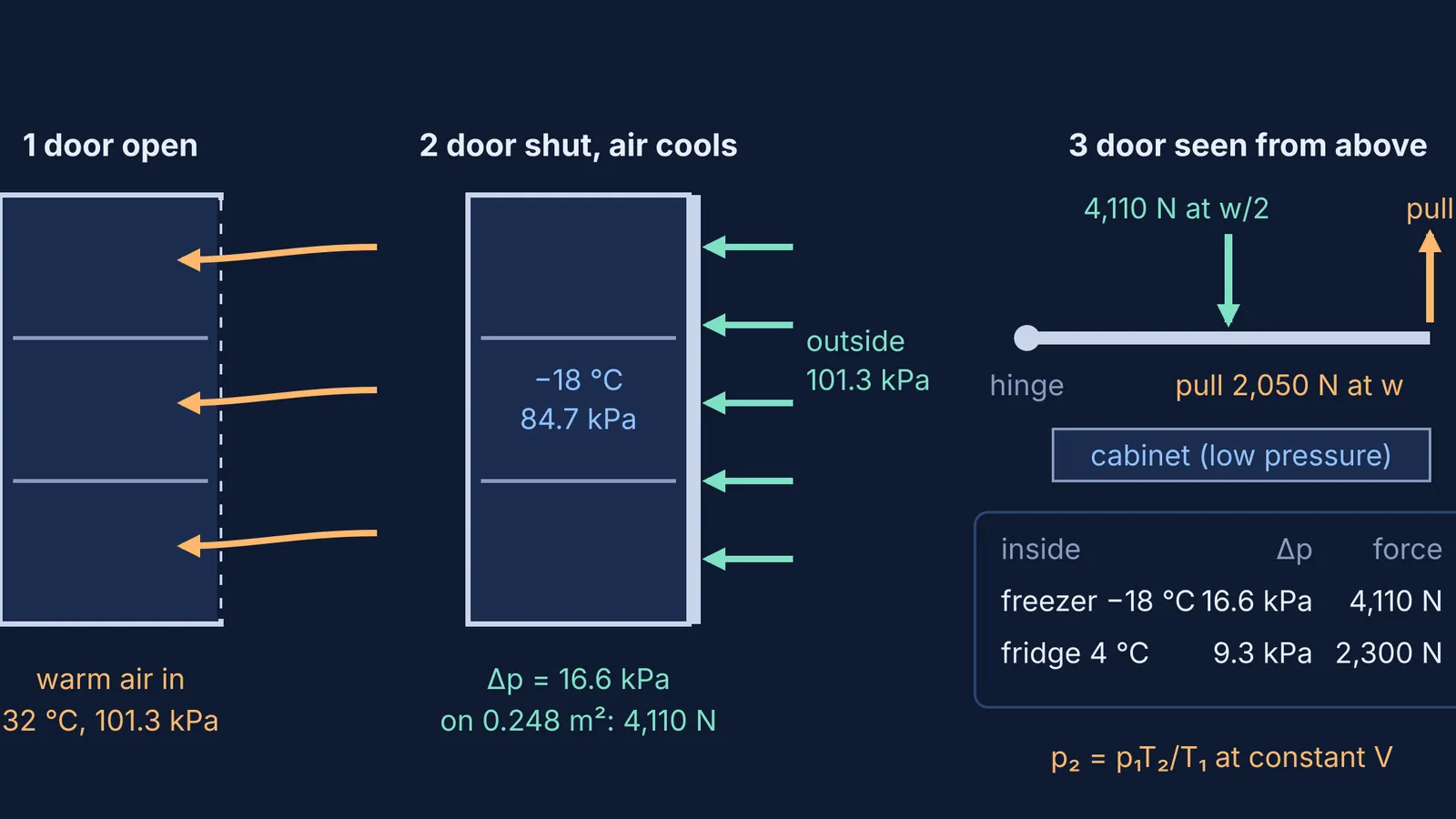
While the door is open, cold dense air spills out of the bottom and warm kitchen air takes its place. When you shut the door, the gasket seals that warm air inside. The freezer walls, shelves and food are at about −18 °C, so the trapped air cools quickly.
The volume cannot change, because the cabinet is rigid. So, by the pressure law, the pressure falls in proportion to the absolute temperature. The air outside is still at atmospheric pressure. The difference pushes the door against the cabinet.
Manufacturers describe exactly this. Whirlpool's help page on a freezer door that is hard to open says warm air mixing with cold air can create a vacuum, that it should take less than a minute to clear, and that it is more likely in warm, humid weather. Sub-Zero's door difficult to open page advises waiting 30 to 60 seconds and notes that the greater the temperature difference, the longer the vacuum may last.
One point of language: nothing inside "sucks" the door. The atmosphere outside pushes on it, and there is less pressure inside to push back.
How much does the pressure drop at constant volume?
For a fixed amount of gas at fixed volume, p/T is constant, so p₂ = p₁ T₂/T₁ with temperatures in kelvin. No work is done, because the volume does not change, which is the case covered in why work is zero in an isochoric process.
Take a hot Indian kitchen at 32 °C (305.15 K) and a freezer at −18 °C (255.15 K):
p₂ = 101.3 kPa × 255.15/305.15 = 84.7 kPa.
The drop is 101.3 − 84.7 = 16.6 kPa, about 16% of an atmosphere.
A refrigerator compartment at 4 °C (277.15 K) gives p₂ = 92.0 kPa, a drop of 9.3 kPa. The freezer's drop is almost twice as large because the temperature gap is 50 K instead of 28 K. That matches Sub-Zero's note that a bigger temperature difference makes the effect last longer.
Worked example: the force on a freezer door
An upright freezer door is 0.45 m wide and 0.55 m tall. The kitchen is at 32 °C and 101.3 kPa, and the freezer runs at −18 °C. Assume all the air inside was replaced while the door was open. Find the pressure force on the door and the pull needed at the handle.
Convert temperatures to kelvin. T₁ = 32 + 273.15 = 305.15 K; T₂ = −18 + 273.15 = 255.15 K.
Apply the pressure law. p₂ = 101.3 × 255.15/305.15 = 84.7 kPa.
Find the pressure difference. Δp = 101.3 − 84.7 = 16.6 kPa = 1.66 × 10⁴ Pa.
Find the door area. A = 0.45 × 0.55 = 0.2475 m², about 0.248 m².
Find the force. F = Δp × A = 1.66 × 10⁴ × 0.2475 ≈ 4,110 N, the weight of about 420 kg.
Take moments about the hinge. A uniform pressure acts as if the whole force sits at the middle of the door, at w/2 from the hinge. The handle is at the free edge, distance w. So F_handle × w = F × w/2, and F_handle = 4,110/2 ≈ 2,050 N.
Check units. Pa × m² = (N/m²) × m² = N. Both sides of the moment equation are in N m.
A pull of 2,050 N is the weight of about 210 kg, which nobody applies to a freezer handle. So why do doors open at all? The next section explains.
Why is the real force much smaller than 4,110 N?
The calculation is an upper limit. Three things cut it down.
Only part of the air is replaced. If a fraction f of the cabinet's air was swapped for kitchen air, the drop is f × 101.3 × (1 − 255.15/305.15). Half the air gives 8.3 kPa and about 2,050 N on the door; a quarter gives 4.2 kPa and about 1,030 N.
The gasket leaks. A door seal is a soft magnetic strip, not a welded joint. Air seeps in, and the pressure climbs back towards atmospheric within a minute or so, as the manufacturers' pages say.
The door peels rather than lifts. As you pull the handle, the seal near the handle edge flexes and lets air in before the whole door has to move. Electrolux's page on a freezer door that is difficult to open calls the suction normal and suggests pressing a finger into a corner of the seal to let air in.
The air also cools fast because there is so little of it. 100 L of air at 32 °C has a mass of about 0.116 kg (from pV = mRT/M). Cooling it by 50 K at constant volume removes only about 0.116 × 718 × 50 ≈ 4.2 kJ, using cᵥ ≈ 718 J/(kg K) for air. The cold walls and frozen food absorb that in seconds. For the bigger energy picture of a fridge door left open, see whether an open fridge door can cool a room.
Why is it worse in humid weather?
Humid kitchen air carries water vapour. At 32 °C and 60% relative humidity, the vapour's partial pressure is about 2.8 kPa. Inside the freezer most of it deposits as frost on the cold walls, leaving only about 0.12 kPa, the approximate vapour pressure over ice at −18 °C. The dry air drops by the usual factor of 255.15/305.15. Together the pressure falls to about 82.5 kPa, a drop of about 18.9 kPa instead of 16.6 kPa. That fits Whirlpool's note about warm, humid months. The frost itself is the subject of why frost builds up inside your freezer.
If you want to see how pressure, volume and temperature trade off as you change one at a time, the Simulation Lab has interactive simulations for ideas that are easier to see than read.
Quick checklist
At constant volume, p₂ = p₁T₂/T₁, with T in kelvin.
Kitchen air at 32 °C cooled to −18 °C: 101.3 kPa falls to 84.7 kPa, a 16.6 kPa drop.
On a 0.45 m × 0.55 m door that is up to about 4,110 N; the handle needs half of it by moments.
Real forces are smaller: partial air exchange, a leaky gasket and a door that peels open.
Humid air makes it worse, because vapour turns to frost.
The atmosphere pushes the door shut; nothing inside pulls it.


