On this page
Picture a gas sealed in a steel cylinder with no piston. You heat it, the temperature climbs, the pressure climbs, and yet the gas does no work at all. The reason is one line of maths, and once you see it, a whole class of JEE and board numericals gets shorter.
Why is work done zero in an isochoric process?
An isochoric process is "a process where the volume of the system does not change", in the words of OpenStax University Physics, Volume 2.
Work done by a gas is W = ∫p dV, taken from the starting volume to the final volume, as set out in OpenStax section 3.2.
If the volume never changes, every dV in that integral is zero, so the integral is zero. Pressure can be huge; it does not matter. Work needs the gas to push its boundary through a distance, and a rigid wall does not move. Describing a constant-volume step, OpenStax puts it simply: "there is no change in volume and therefore no work is done."
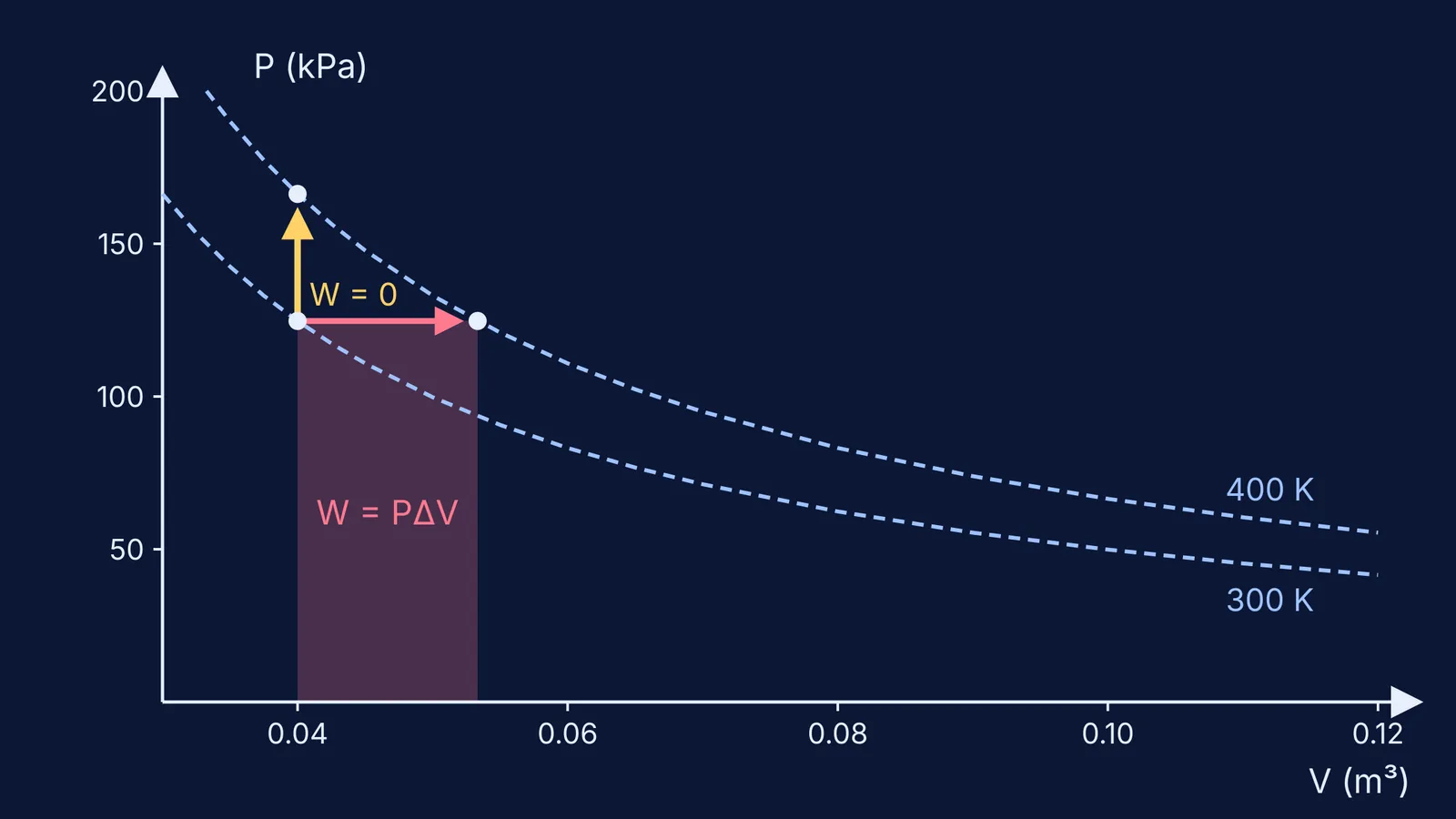
On a P-V graph the same idea is visual. Work is the area under the path. An isochoric path is a vertical line, and a vertical line encloses no area. Compare that with a constant-pressure process, where the area is a rectangle; we walk through that case in why isobaric work is P times delta V.
Where does the heat go if no work is done?
The first law says the change in internal energy equals Q − W, where W is positive when the system does work (OpenStax section 3.3). Put W = 0 and you get ΔU = Q. Every joule of heat you add goes into internal energy, and none leaves as work.
For n moles of ideal gas, heat at constant volume is dQ = nCv dT, where Cv is the molar heat capacity at constant volume (OpenStax section 3.5). The same section gives Cv = (3/2)R for a monatomic gas and lists (5/2)R, about 20.79 J/mol K, for a diatomic gas, along with Cp = Cv + R.
There is a bonus hidden here. OpenStax notes that because the internal energy of an ideal gas depends only on temperature, ΔU = nCvΔT holds for any process with a temperature change, not just isochoric ones. We explain why in internal energy depends only on temperature.
Worked example: heating a gas in a rigid cylinder
Two moles of a diatomic ideal gas sit in a rigid cylinder at 300 K. You heat it to 400 K. Find W, Q and ΔU. Then compare with the same heating at constant pressure. Take Cv = 20.79 J/mol K from the OpenStax table and R = 8.314 J/mol K from NIST.
Volume is fixed, so W = 0.
Q = nCvΔT = 2 × 20.79 × 100 ≈ 4158 J, or about 4.16 kJ.
ΔU = Q − W = 4.16 kJ.
Since pV = nRT with V and n fixed, pressure rises in proportion to temperature, by a factor of 400/300, about 1.33.
Now heat the same gas through the same 100 K at constant pressure. Cp = Cv + R ≈ 29.10 J/mol K, so Q ≈ 2 × 29.10 × 100 ≈ 5.82 kJ. The gas expands and does W = nRΔT ≈ 2 × 8.314 × 100 ≈ 1.66 kJ of work. And ΔU is still about 4.16 kJ, because the temperature change is the same. The extra 1.66 kJ of heat simply pays for the work. That is the whole reason Cp is bigger than Cv, which we unpack in heat at constant pressure and constant volume.
What mistakes do students make with isochoric processes?
Run through this checklist before you write an answer:
"Pressure changed, so work was done." No. Work needs a change in volume. Pressure can double with W still zero.
"Closed container" read as fixed volume. Closed means no gas gets in or out. Look for "rigid", "fixed volume" or "constant volume" before you set W = 0.
Using Cp by habit. At constant volume, heat is nCvΔT. Check whether the gas is monatomic (3R/2) or diatomic (5R/2 near room temperature).
Mixing up two kinds of zero. In free expansion into a vacuum, W is also zero, but the volume does change; there is simply nothing to push against. Know which reason applies.
Forgetting cooling. If the gas cools at constant volume, Q is negative and U falls by the same amount.
If this felt shaky, the Fermi Concept Library gives every concept in physics its own lesson and its place in the map, so you can see how isochoric, isobaric and isothermal processes connect. For practice, the Fermi Problem Library has worked problems with a step-by-step solver that explains the reasoning rather than printing an answer.
Next time a question mentions a rigid container, write W = 0 first, then Q = nCvΔT.