

On this page
In short
The formula for work done in an isobaric process is W = PΔV, where P is the constant pressure and ΔV is the change in volume. For an ideal gas, this work can also be calculated as W = nRΔT, using the exact molar gas constant R = 8.314 J/(mol K) established by NIST. The matching heat transfer for the process is Q = nCpΔT.
An isobaric process is a thermodynamic process in which pressure remains constant while volume and temperature change. When a gas expands or compresses at a steady pressure, it does work.
Here is how you calculate the work, the heat, and the internal energy for an ideal gas in an isobaric state change.
What is the work done in isobaric process formula?
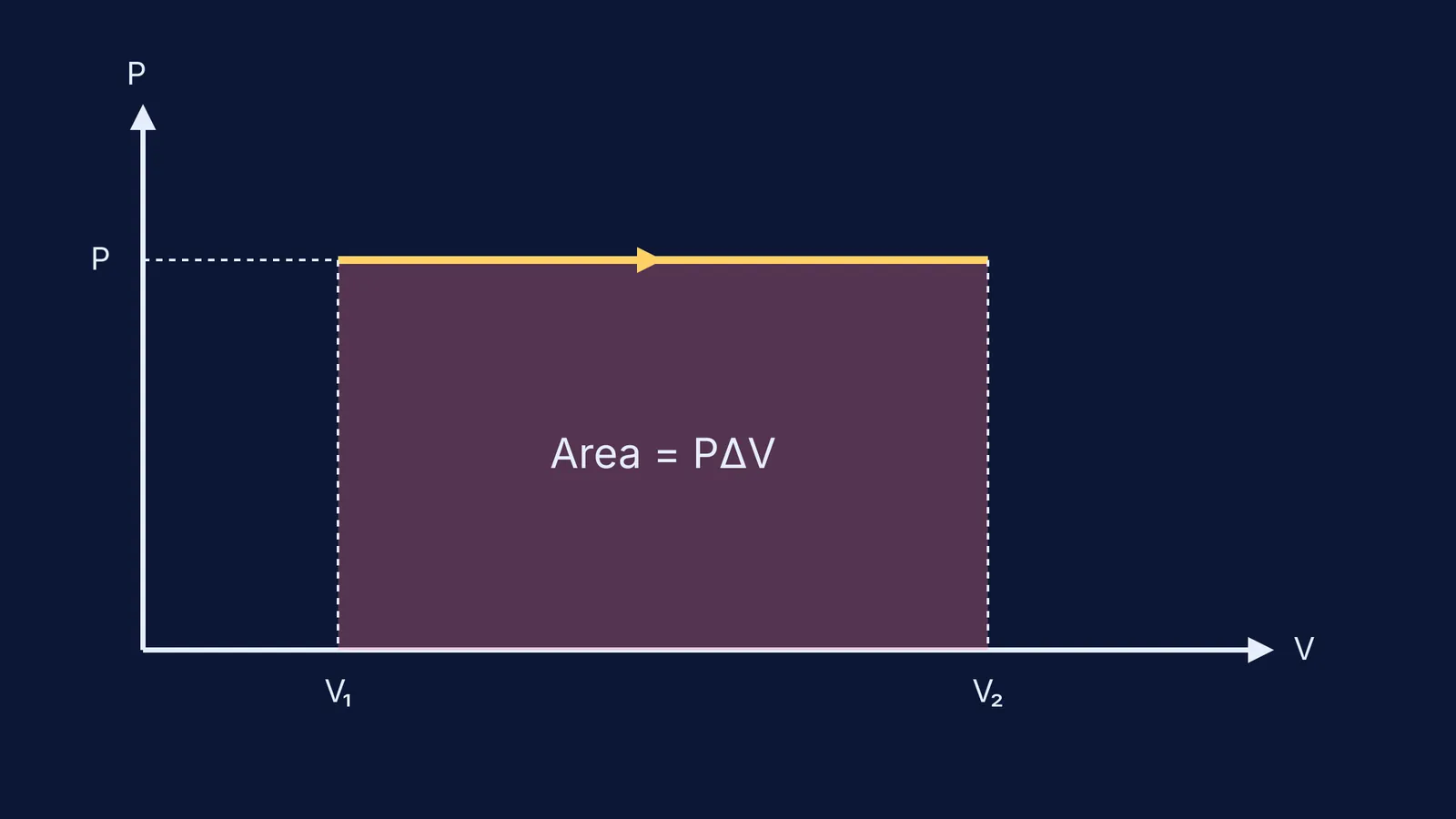
Work (W) in thermodynamics is calculated as the area under a pressure-volume (PV) graph. Because the pressure (P) does not change in an isobaric process, the PV graph is simply a horizontal line. The area under this line forms a rectangle, making the calculation straightforward:
W = PΔV = P(V₂ − V₁)
Here, V₁ is the initial volume and V₂ is the final volume.
For an ideal gas, we can rewrite this formula using the ideal gas equation, PV = nRT. Since the pressure is constant and the amount of gas (n) does not change, any change in volume is proportional to a change in temperature (ΔT):
PΔV = nRΔT
This gives us a second formula for the work done in an isobaric process:
W = nRΔT
In this equation, the molar gas constant is exactly R = 8.314462618 J/(mol K), according to NIST's CODATA recommended values. If you are finding the total work for a process that returns to its starting point, you can learn how to read the net work in a cycle from a closed loop.
How do you calculate heat in an isobaric process?
When you add heat to a gas at constant pressure, it expands and does work. The First Law of Thermodynamics states that the heat (Q) added goes into changing the internal energy (ΔU) and doing work (W).
To find the heat directly, we use the molar heat capacity at constant pressure (Cp):
Q = nCpΔT
Because the heat must cover both the internal energy rise and the expansion work, Cp is greater than the molar heat capacity at constant volume (Cv). For an ideal gas, the difference is exactly the gas constant: Cp − Cv = R. You can see how these capacities are used in problems about heat in isobaric and isochoric processes.
What does an isobaric process look like in real life?
A classic example is a gas trapped in a cylinder with a freely moving, frictionless piston. As long as the external pressure and the piston's weight do not change, the pressure inside the cylinder remains constant.
When you heat the cylinder, the gas particles gain energy and push the piston upwards. The gas volume increases (positive ΔV), doing mechanical work.
If you cool the cylinder, the external pressure pushes the piston down, compressing the gas (negative ΔV), and work is done on the gas.
This model shows why heating at constant pressure requires more energy than at constant volume (an isochoric process). With a locked piston, all heat raises the gas temperature. In an isobaric process, the heat must raise the temperature and lift the piston.
Connecting work, heat and internal energy
The internal energy of an ideal gas depends solely on its temperature. Whether you heat the gas at constant pressure, compress it adiabatically, or let it expand freely, the change in internal energy is always:
ΔU = nCvΔT
If you substitute our formulas into the First Law (Q = ΔU + W), you get a unified equation:
nCpΔT = nCvΔT + nRΔT
Dividing every term by nΔT brings you right back to Mayer's relation:
Cp = Cv + R
This relationship shows why heating a gas at a constant pressure always requires more energy per degree of temperature rise: the extra energy is the work done by the gas.
A quick worked example
Imagine 2 moles of an ideal gas expand at a constant pressure of 100,000 Pa, increasing the container's volume by 0.05 m³. What is the work done, and the temperature change?
Find the work done: Using W = PΔV, multiply the external pressure by the volume change.
100,000 Pa × 0.05 m³ = 5,000 J.
Find the temperature change: Using W = nRΔT, rearrange to solve for the temperature difference: ΔT = W / (nR).
5,000 J / (2 mol × 8.314 J/(mol K)) ≈ 300.7 K.
If you have gaps in your understanding of the First Law or these gas expansions, the Concept Library has every concept in physics, chemistry, biology, mathematics and computing, each with its own lesson and its place in the map. Visualising how these variables shift is often half the battle, which is why converting PV, PT and VT graphs is a common test of whether you understand the underlying rules.


