

On this page
Chlorine forms four oxoacids: HOCl, HClO₂, HClO₃ and HClO₄, with chlorine at +1, +3, +5 and +7. Bromine and iodine form similar families. Fluorine forms exactly one, hypofluorous acid, HOF, and even that is an unstable compound that has to be made and kept cold. The reason comes down to two facts about fluorine, and once you see them you can also answer the favourite exam twist about this molecule: the oxidation state of oxygen in HOF.
What does a halogen need to form a series of oxoacids?
Look at any chlorine oxoacid. The chlorine is bonded to oxygen, and oxygen is the more electronegative partner. Oxygen pulls the bonding electrons towards itself, so chlorine ends up with a positive oxidation state. Each extra oxygen raises chlorine by two: +1, +3, +5, +7.
To build that ladder, a halogen needs two things:
It must be less electronegative than oxygen, so it can take a positive oxidation state.
It must be able to bond to more than one atom, so several oxygens can surround it.
Fluorine fails both tests. The acidity side of chlorine's family is covered in why HClO₄ is more acidic than HOCl. Here the question is why fluorine never gets a family at all.
Why can't fluorine take a positive oxidation state?
Fluorine is the most electronegative element (Pauling value 4.0, against 3.5 for oxygen). In oxidation-number bookkeeping, the shared electrons in a bond are given to the more electronegative atom. Fluorine always wins that contest, so it is −1 in every compound, and 0 only in F₂ itself. The full argument is in why fluorine shows only a −1 oxidation state.
The consequence for oxygen compounds is that the roles flip. When oxygen bonds to fluorine, oxygen is the one that loses out. In OF₂, oxygen is +2, which is why the compound is called oxygen difluoride and not fluorine oxide.
Why can't fluorine bond to more than one atom?
Fluorine's valence shell is n = 2. That shell has only 2s and 2p orbitals: four orbitals holding at most eight electrons. Fluorine has seven valence electrons, so it needs one more and forms one covalent bond. There is no 2d subshell at all. It is wrong to say fluorine "has d orbitals it cannot use"; there are none in its valence shell.
Chlorine in HClO₄ is bonded to four oxygens. Textbooks often credit chlorine's empty 3d orbitals for this. Modern bonding calculations show the d orbitals contribute little, and the Cl–O bonds are better pictured as polar bonds with formal charges: in the all-single-bond structure of ClO₄⁻, chlorine carries a formal charge of +3 and each oxygen −1. Either way, the key facts are that chlorine is a larger atom with room for four oxygens around it, and it is less electronegative than oxygen, so its electrons can be drawn away. Fluorine is small and holds its electrons too tightly for either picture to work.
Worked example: oxidation states in HOF, HOCl and HClO₄
Rules you need: H is +1 when bonded to non-metals, F is always −1, the sum of oxidation states in a neutral molecule is 0, and O is usually −2, but not when it is bonded to fluorine.
HOCl. H = +1. O is more electronegative than Cl, so O = −2. Then +1 + (−2) + x = 0, so Cl = +1.
HClO₄. H = +1, four O = −8. Then +1 − 8 + x = 0, so Cl = +7.
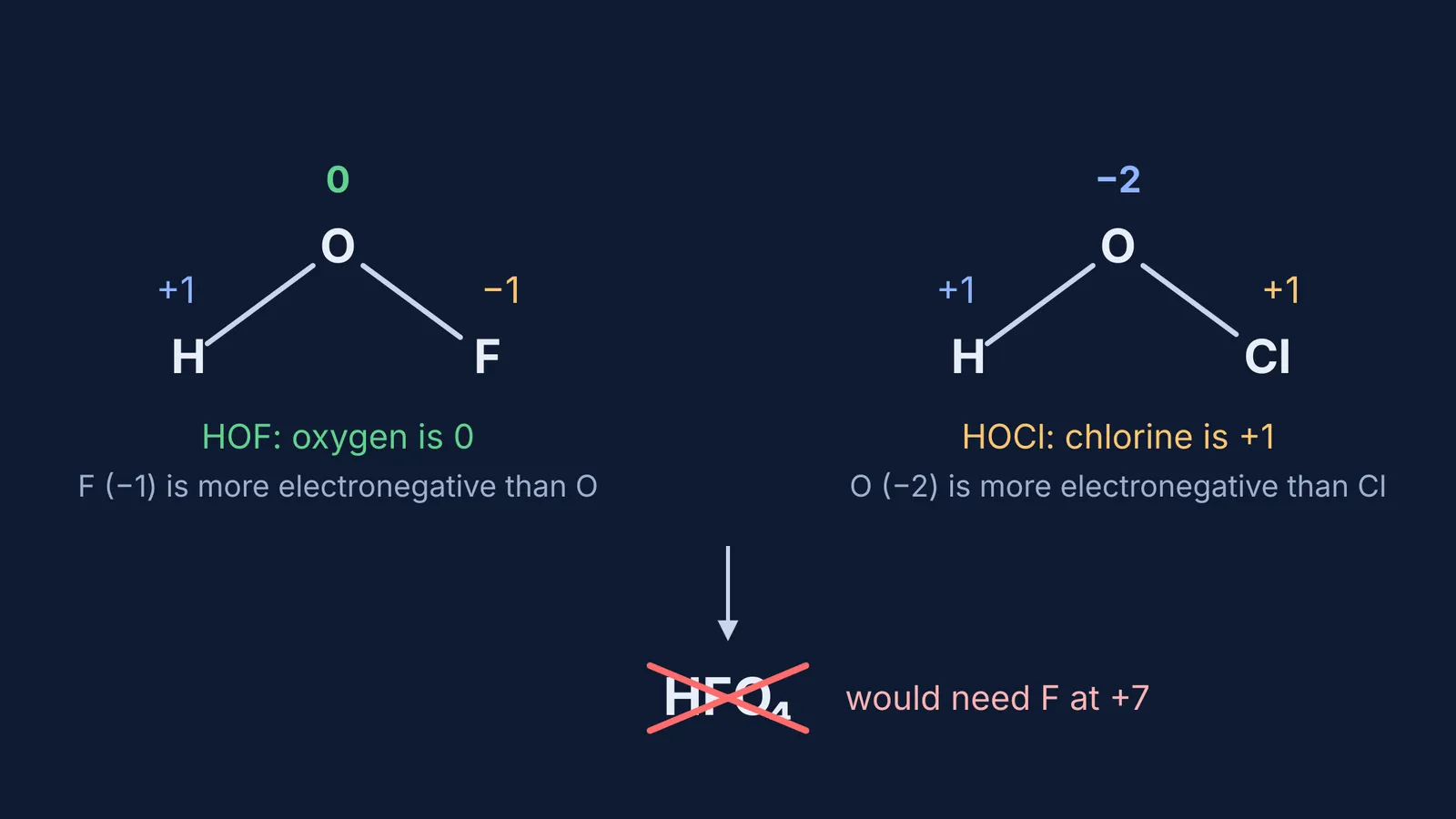
HOF. H = +1 and F = −1 (fixed). Then +1 + y + (−1) = 0, so O = 0.
Check HOF bond by bond. In the O–H bond, oxygen takes both electrons and gains one charge unit (−1). In the O–F bond, fluorine takes both and oxygen loses one (+1). Net for oxygen: 0. Oxygen is in the zero state even though it is in a compound.
Try "HFO₄". H = +1, four O = −8, so fluorine would have to be +7. Fluorine cannot be positive and cannot bond to four oxygens, so HFO₄ cannot exist. The same argument rules out HFO₂ and HFO₃.
So HOF reverses the HOCl pattern. In HOCl the halogen is +1 and oxygen is −2. In HOF the halogen is −1 and oxygen is 0.
How is HOF made, and why is it so unstable?
HOF is made by passing fluorine gas over ice at about −40 °C:
F₂ + H₂O → HOF + HF
The low temperature matters. At room temperature fluorine oxidises water all the way to oxygen, 2F₂ + 2H₂O → 4HF + O₂, as explained in why fluorine and chlorine give different products with water. Chlorine, by contrast, gives HOCl and HCl with water at room temperature without any trouble.
Once made, HOF decomposes readily at room temperature:
2HOF → 2HF + O₂
With water it reacts to give hydrogen peroxide:
HOF + H₂O → HF + H₂O₂
Both equations balance in atoms and charge. The instability makes sense from the oxidation states. Oxygen at 0 is in an unusual state and is strongly oxidising; it is pulled down to −2 in H₂O or −1 in H₂O₂, while the H–F bond that forms is very strong. The O–F bond itself is weak.
Do not treat HOF as a typical acid. It is a very weak acid that barely ionises, and its chemistry is that of a powerful oxidising agent, not of a proton donor. It is called an oxoacid because of its formula, not because it behaves like HClO₄.
Do bromine and iodine behave like chlorine?
Yes. Both are less electronegative than oxygen and both are large, so both take positive oxidation states and form several oxoacids. Iodine is big enough to hold six oxygens in periodic acid, H₅IO₆, where iodine is +7 (5 − 12 + 7 = 0). Fluorine is the exception at the top of the group, as it is for so many group 17 properties.
If you want to revise oxidation-state rules or halogen chemistry from the start, the Concept Library covers every concept in chemistry, and the Fermi Problem Library has a step-by-step solver for oxidation-number problems like the worked example above.
Quick checklist
Chlorine: four oxoacids, Cl from +1 to +7. Fluorine: one oxoacid, HOF.
An oxoacid series needs a halogen less electronegative than oxygen and able to bond to several atoms. Fluorine is neither.
Fluorine has no 2d subshell; do not say it has d orbitals it cannot use.
In HOF: H +1, O 0, F −1. In HOCl: H +1, O −2, Cl +1.
HFO₄ would need F at +7, so it cannot exist.
HOF: made from F₂ and ice at about −40 °C; decomposes to HF and O₂; gives H₂O₂ with water.
HOF is a very weak acid and a strong oxidant, not a typical acid.


