

On this page
Have you ever noticed that while chlorine can form compounds like perchloric acid (HClO₄) with an oxidation state of +7, fluorine refuses to do anything of the sort? Fluorine stands out as the strict rule-follower among the halogens. While its heavier chemical siblings can form compounds with various positive and negative oxidation states, fluorine stubbornly sticks to just two: 0 in its elemental form, and -1 in every other compound.
When you encounter fluorine in oxidation numbers from structure problems, you can confidently write down -1 and move on. But why does this single element behave so rigidly compared to the rest of its group? The answer lies in its extreme electron-pulling power and the strict architectural limits of its quantum electron shells.
Why does fluorine only have a negative oxidation state?
To exhibit a positive oxidation state in a molecule, an atom must be bonded to another atom that is more electronegative than itself. Electronegativity is simply a measure of how strongly an atom attracts shared electrons in a chemical bond.
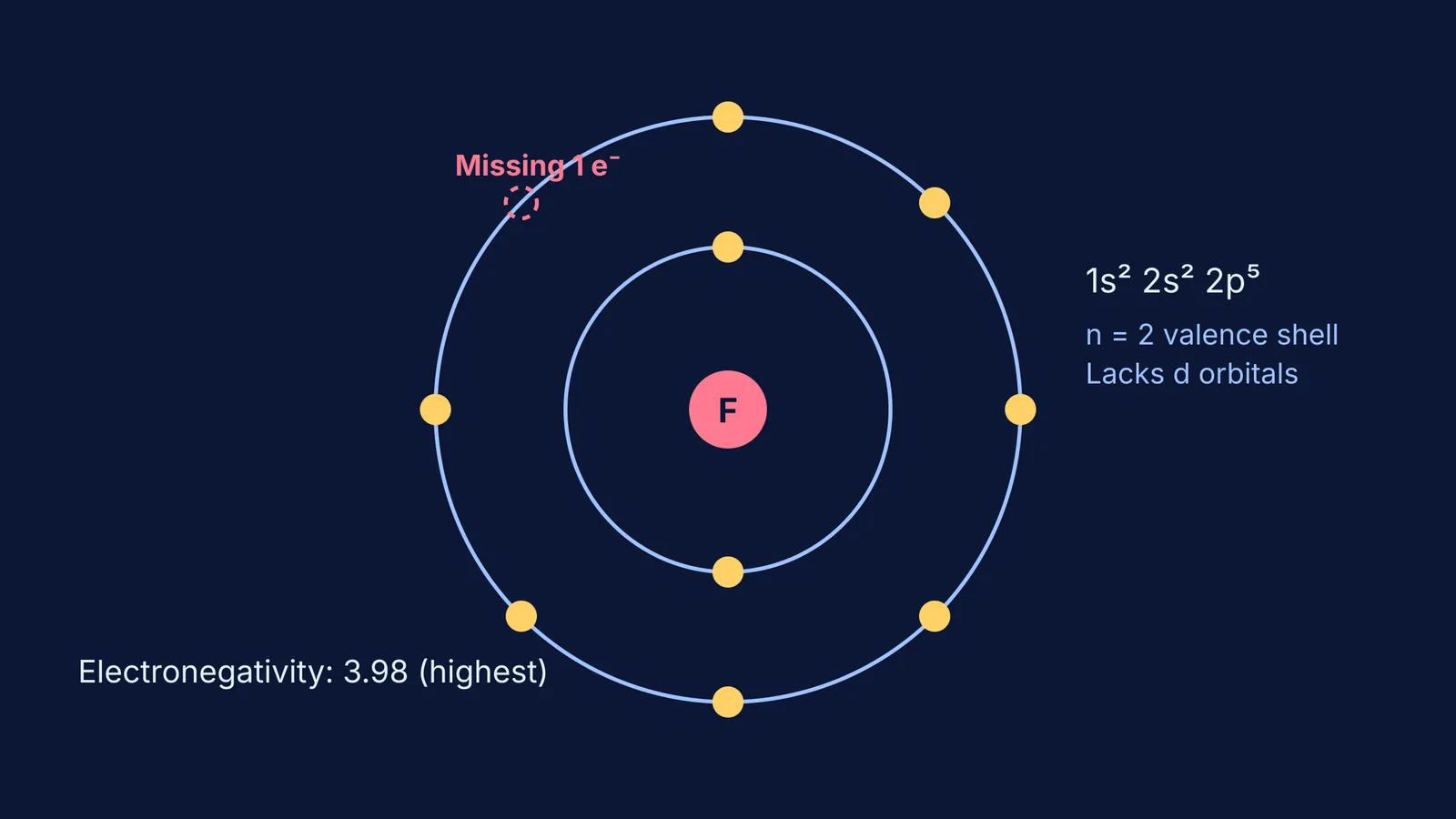
According to Wikipedia's data on Fluorine, this element is the most electronegative in the periodic table, scoring a maximum 3.98 on the Pauling scale. Because no other element pulls electrons harder than fluorine—not even oxygen—it will always draw the shared electron density toward itself.
In the bookkeeping system of oxidation states, the more electronegative atom is assigned the shared electrons. Since fluorine never loses this atomic "tug-of-war," it can never have its electrons pulled away to create a partial positive charge. Therefore, a positive oxidation state is fundamentally impossible for fluorine in any stable compound.
Why can't fluorine expand its octet?
Electronegativity explains why fluorine is always negative, but why is it *only* -1? Why can't it pull in more electrons to become -2 or -3?
As explained in the Wikipedia article on Halogens, fluorine has an electron configuration of 1s² 2s² 2p⁵. It holds exactly seven valence electrons in its outermost shell (the n = 2 level). To achieve a stable, full-octet configuration matching the noble gas neon, it requires exactly one more electron. By gaining one electron to form a fluoride ion (F⁻) or by sharing one in a covalent bond, it satisfies the octet rule perfectly and reaches the -1 oxidation state.
It stops at one bond because it has nowhere else to put extra electrons. Fluorine belongs to the second period of the periodic table, meaning its valence shell is strictly limited to s and p subshells. It completely lacks available d orbitals.
Elements in the third period and below, such as chlorine or iodine, possess vacant d orbitals (like the 3d subshell) right next to their valence electrons. When these heavier halogens bond with highly electronegative atoms, they can promote electrons into these empty d orbitals to "expand their octet." This mechanism allows them to form multiple bonds and exhibit positive oxidation states up to +7, as frequently seen in interhalogen compounds. Fluorine simply does not have the physical orbital space to do this.
How do you assign halogen oxidation states?
When you are solving textbook chemistry questions or sitting for an exam, you can rely on a consistent, practical framework for assigning oxidation numbers to group 17 elements.
Use this simple checklist to avoid calculation mistakes:
Locate the fluorine: If the molecule contains fluorine, assign it a -1 state immediately. There are no exceptions in standard stable compounds.
Check the heavier halogens: For chlorine, bromine, or iodine, look at what they are bonded to. Are they attached to a more electronegative element, such as oxygen or fluorine?
Assign the positive state: If they are bonded to oxygen or fluorine, the heavier halogen will take a positive oxidation state. You must calculate it algebraically based on the rest of the molecule (it will typically be +1, +3, +5, or +7).
Assign the negative state: If the heavier halogen is bonded to a less electronegative element—like hydrogen in HCl or sodium in NaCl—it will take its standard -1 state.
If you find yourself struggling to remember which elements can expand their octets, the Concept Library has a lesson for every concept in chemistry and shows its place in the map. Tracing how atomic radius and orbital availability change across the periodic table makes it much easier to recall these rules.
By understanding the "why" behind the chemistry, you save time and reduce errors. The combination of its unmatched electronegativity and its tiny, d-orbital-free valence shell makes fluorine the most predictable element on the board.


