

On this page
A bowl of fried namkeen and a bowl of plain rice can weigh the same and still carry very different energy. The reason is chemistry you meet in Class 11: how oxidised the carbon atoms in each molecule already are.
Why does fat give more energy than carbohydrate per gram?
Food labels use the Atwater general factors: 17 kJ (4.0 kcal) per gram for protein, 37 kJ (9.0 kcal) per gram for fat and 17 kJ (4.0 kcal) per gram for carbohydrate, according to the FAO report on food energy. The same report says these factors start from the heats of combustion of each nutrient, corrected for losses in digestion, absorption and urine, and gives the conversion 1 kcal = 4.184 kJ.
You can see the raw gap in a bomb calorimeter. Burning solid glucose releases 2805 kJ per mole, according to the NIST Chemistry WebBook entry for glucose. Burning solid palmitic acid, a saturated fatty acid, releases 9977.6 kJ per mole, according to the NIST entry for palmitic acid.
Divide by molar mass and the per-gram picture appears:
Glucose, C₆H₁₂O₆ (180.16 g/mol): 2805 ÷ 180.16 = 15.6 kJ/g, about 3.7 kcal/g.
Palmitic acid, C₁₆H₃₂O₂ (256.43 g/mol): 9977.6 ÷ 256.43 = 38.9 kJ/g, about 9.3 kcal/g.
Gram for gram, the fatty acid releases about 2.5 times as much heat. The label factors are rounded averages. Fat's 9 sits a little below palmitic acid's 9.3 because it allows for fat your gut does not absorb. Carbohydrate's 4 sits a little above glucose's 3.7: the FAO report gives 15.7 kJ/g for carbohydrate counted as monosaccharide but 16.7 kJ/g by weight, because starch carries less water per glucose unit.
How does the oxidation state of carbon explain it?
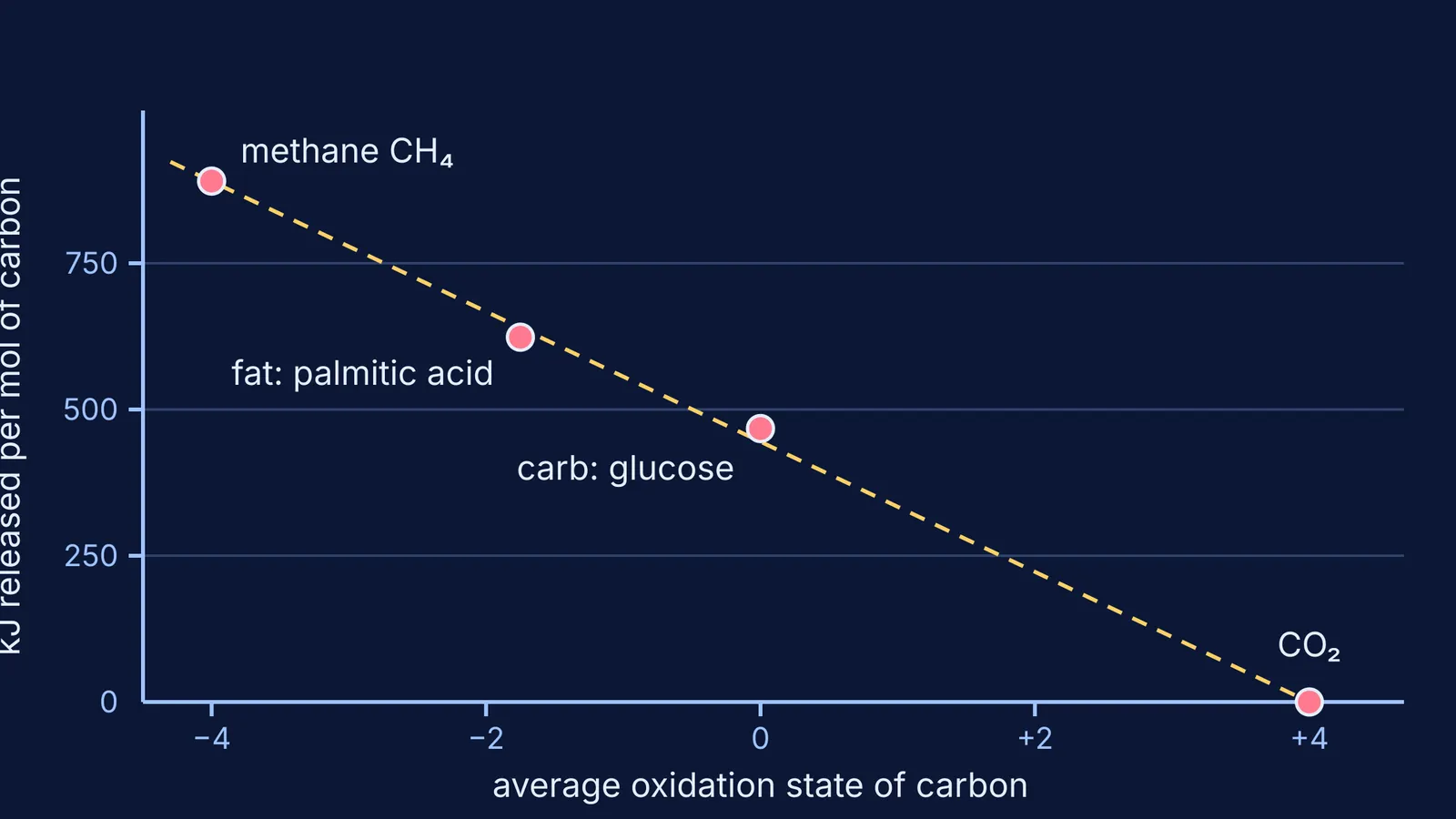
Burning food moves electrons from carbon to oxygen until carbon reaches +4 in CO₂. The more reduced a carbon starts, the more electrons it has to give, and the more energy comes out. Take the formulas from the NIST entries for glucose and palmitic acid and use H = +1, O = −2 (the full method is in our guide to finding the oxidation state of carbon in organic compounds):
Glucose: 6x + 12 − 12 = 0, so x = 0. Each carbon gives 4 electrons on its way to +4.
Palmitic acid: 16x + 32 − 4 = 0, so x = −1.75. Each carbon gives 5.75 electrons.
Two effects stack up. Each fat carbon carries more electrons, and fat carries little dead weight. Oxygen is 53% of glucose's mass but only 12.5% of palmitic acid's mass, by formula. Per gram, glucose has 0.133 mol of electrons to hand over and palmitic acid has 0.359 mol, a ratio of about 2.7.
The heat per electron moved is roughly the same for both. From the NIST values, glucose releases 468 kJ per mole of O₂ it uses and palmitic acid releases 434 kJ. So energy tracks electrons, and fat simply has more of them per gram.
If oxidation numbers in organic molecules still feel shaky, the Fermi Concept Library gives each concept in chemistry and biology its own lesson, so you can fix the gap before redox and respiration questions pile up.
Why is protein only 4 kcal per gram?
Protein releases more heat in a calorimeter than in your body, because your body does not burn protein all the way. Its nitrogen leaves as urea, which still holds energy. Atwater-era estimates of protein's heat of combustion subtract about 1.25 kcal per gram lost as urea, as Novotny, Gebauer and Baer note in the American Journal of Clinical Nutrition. How those values were first measured is the story in our post on Wilbur Atwater and the 4-9-4 food calorie values.
How do you work out the calories on a snack label?
Use the FAO's 4-9-4 factors. Here is an example label for a 30 g serving of namkeen (illustrative numbers):
Fat: 10 g
Carbohydrate: 15 g
Protein: 3 g
Fat: 10 × 9 = 90 kcal
Carbohydrate: 15 × 4 = 60 kcal
Protein: 3 × 4 = 12 kcal
Total: 90 + 60 + 12 = 162 kcal
Fat is 10 of the 28 g of these nutrients, about 36% by mass, yet it supplies 90 of the 162 kcal, about 56% of the energy. Swap that 10 g of fat for 10 g of carbohydrate and the serving drops to 112 kcal: every gram moved saves 5 kcal.
Now check your total against the energy line on a real pack. Our line-by-line guide to reading a nutrition label in India explains what each row means.
The factors are averages, not exact readings. When the same AJCN team measured the energy people actually got from almonds in their diet, they found 129 kcal per 28 g serving; the Atwater factors overestimated it by 32%, according to their 2012 paper.
For more practice turning formulas into numbers, the Fermi Problem Library has worked problems with a step-by-step solver that explains the reasoning rather than printing an answer.


