

On this page
In organic chemistry, oxidation rarely looks like an electron leaving an atom. An alcohol becomes an aldehyde, an alkene picks up water, and the paper asks which step is redox. The quickest tool is the oxidation state of each carbon, found by counting bonds.
What is the oxidation state of carbon, really?
An oxidation state is a bookkeeping number, not a real charge. The IUPAC recommendation defines oxidation state using the ionic approximation of bonds: you pretend every bond is ionic and give its electrons to the more electronegative partner (Karen, McArdle and Takats, Pure and Applied Chemistry, 2016). A LibreTexts organic chemistry module puts it plainly: the charge on carbon is not really +4 or −4, but the formalism helps you keep track of where the electrons are going (Chemistry LibreTexts/Fundamentals/Oxidation_States_of_Organic_Molecules)).
If the difference between oxidation number and the number of bonds an atom makes still feels blurry, read our explainer on oxidation number versus valency first.
How do you find the oxidation state of carbon by counting bonds?
Look at one carbon at a time and score each of its four bonds, using the rules in this LibreTexts chapter on carbon's oxidation state/19:_Oxidation_and_Reduction/19.01:_Definition_of_oxidation_state_for_carbon):
Each bond to hydrogen counts −1, because hydrogen is treated as +1.
Each bond to a more electronegative atom (O, N, S, a halogen) counts +1.
Each bond to another carbon counts 0.
Count a double bond as two bonds and a triple bond as three, so a C=O scores +2. Add the scores and you have that carbon's oxidation state.
Why does methane sit at −4 and CO₂ at +4?
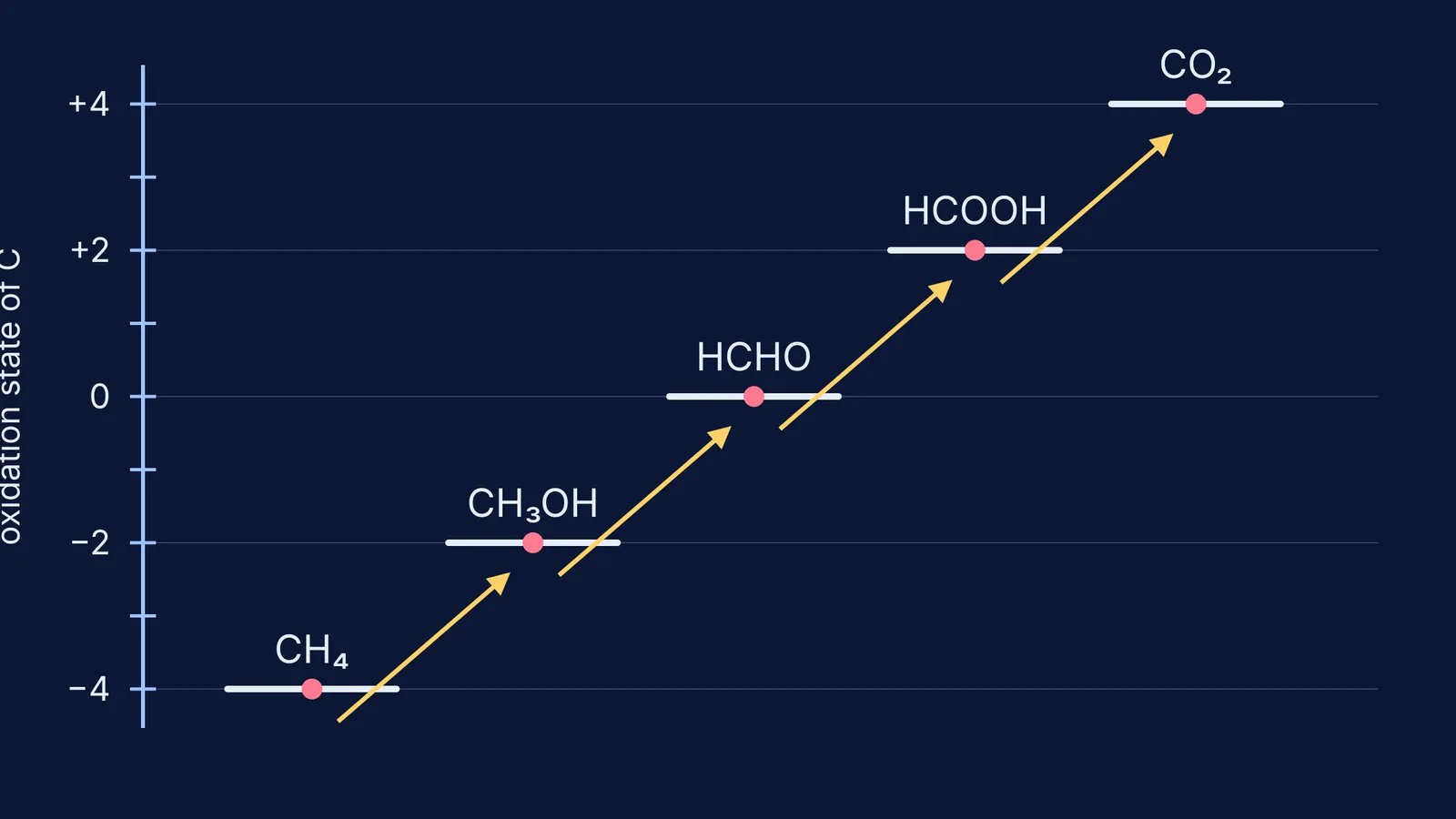
Apply the count to the one-carbon family and you get a ladder. The values are methane −4, methanol −2, formaldehyde 0, formic acid +2 and carbon dioxide +4, as listed in LibreTexts' overview of oxidation and reduction in organic chemistry/10:_Organohalides/10.09:_Oxidation_and_Reduction_in_Organic_Chemistry).
Each rung swaps C–H bonds for bonds to oxygen. Methane has four C–H bonds. Methanol trades one for a C–O bond. Formaldehyde has a C=O worth +2 and two C–H bonds. Formic acid has C=O plus C–OH and one C–H. In CO₂ all four bonds go to oxygen. The same ladder in functional-group language is alkane, alcohol, aldehyde, carboxylic acid, carbon dioxide.
Worked example: ethanol to acetic acid
Write ethanol as CH₃–CH₂–OH and score each carbon separately.
CH₃ carbon: three C–H bonds (−3) and one C–C bond (0), so −3.
CH₂OH carbon: two C–H bonds (−2), one C–O bond (+1), one C–C bond (0), so −1.
Oxidise to acetaldehyde, CH₃–CHO. The carbonyl carbon now has one C–H (−1) and a C=O (+2), so +1.
Oxidise again to acetic acid, CH₃–COOH. That carbon has C=O (+2) and C–OH (+1), so +3.
The functional carbon climbs −1, +1, +3 while the CH₃ carbon stays at −3, which is why you score carbons one by one. Choosing the reagent that stops at the aldehyde is a separate skill, covered in our post on PCC versus KMnO₄ for alcohol oxidation.
The formula method gives only the average: for C₂H₆O, 2x + 6 − 2 = 0 gives x = −2, the mean of −3 and −1.
How do you tell if an organic reaction is redox?
Add up the oxidation states of the carbons that change, before and after.
Ethene to ethane with H₂: each carbon goes from −2 to −3. The total falls, so it is a reduction.
Ethene to ethanol with water: the carbons go from −2 and −2 to −3 and −1. The total stays at −4, so hydration is not a redox step, even though oxygen was added.
Methane to chloromethane: carbon goes from −4 to −2 (three C–H, one C–Cl). That is an oxidation.
LibreTexts makes the same point about two common traps: adding HBr to an alkene is not redox because the overall oxidation state of the carbons does not change, and an acyl transfer that swaps a bond to oxygen for a bond to nitrogen is not redox either (Chemistry LibreTexts/10:_Organohalides/10.09:_Oxidation_and_Reduction_in_Organic_Chemistry)).
The reverse direction works the same way: aldehydes and ketones going down to alcohols drop one rung, which is where our guide to LiAlH₄ versus NaBH₄ reductions picks up.
A five-minute practice plan
Draw the five rungs of the methane-to-CO₂ ladder from memory and score each carbon.
Take any three conversions from your textbook's alcohols and carbonyls chapter and mark each carbon's number before and after.
Label each step oxidation, reduction or neither, then check the reagent fits.
If a particular conversion keeps catching you out, the Fermi Problem Library has worked problems with a step-by-step solver that explains the reasoning rather than printing an answer, so you can check your own working step by step.


