

On this page
When you look at the nutrition label on a packet of biscuits or a sports drink, you see a total calorie count. But how do we know how much energy is actually in our food? The answer goes back to the late 19th century and a scientist who decided to measure exactly what goes into and comes out of the human body.
Who was Wilbur Atwater?
Wilbur Olin Atwater (1844–1907) was an American chemist and the director of the first United States Agricultural Experiment Station at Wesleyan University. He is considered the father of modern nutrition research. Atwater wanted to understand human metabolism and how the body uses energy from different macronutrients. Before his work, dietary advice was largely guesswork, and the exact energy values of everyday foods were unknown.
How did Wilbur Atwater measure calories with a respiration calorimeter?
To find out how much energy food contains, Atwater first used a device called a bomb calorimeter. He burned small, dried samples of food inside a sealed metal container surrounded by water. By measuring how much the water's temperature rose, he could calculate the gross energy of the food.
However, the human body is not a perfect furnace. We do not absorb every bit of food, and we do not burn it completely. To find the "available" or metabolisable energy, Atwater needed to measure living people.
He teamed up with physicist Edward Bennett Rosa to build a respiration calorimeter. This device was designed to measure living human subjects and successfully confirmed the conservation of energy in humans. The device monitored the heat the subject gave off, alongside the incoming and outgoing oxygen and carbon dioxide levels. Atwater meticulously tracked all food going in and all bodily waste coming out. By comparing the gross energy of the food eaten with the energy the body actually extracted, Atwater could calculate the true energy value of different diets.
When you study energy transfer in chemistry or physics, calorimetry calculations can sometimes get confusing. The Fermi Problem Library has worked problems with a step-by-step solver that explains the reasoning rather than printing an answer, helping you trace the heat flow just as Atwater did.
What is the 4-9-4 rule for food calorie values?
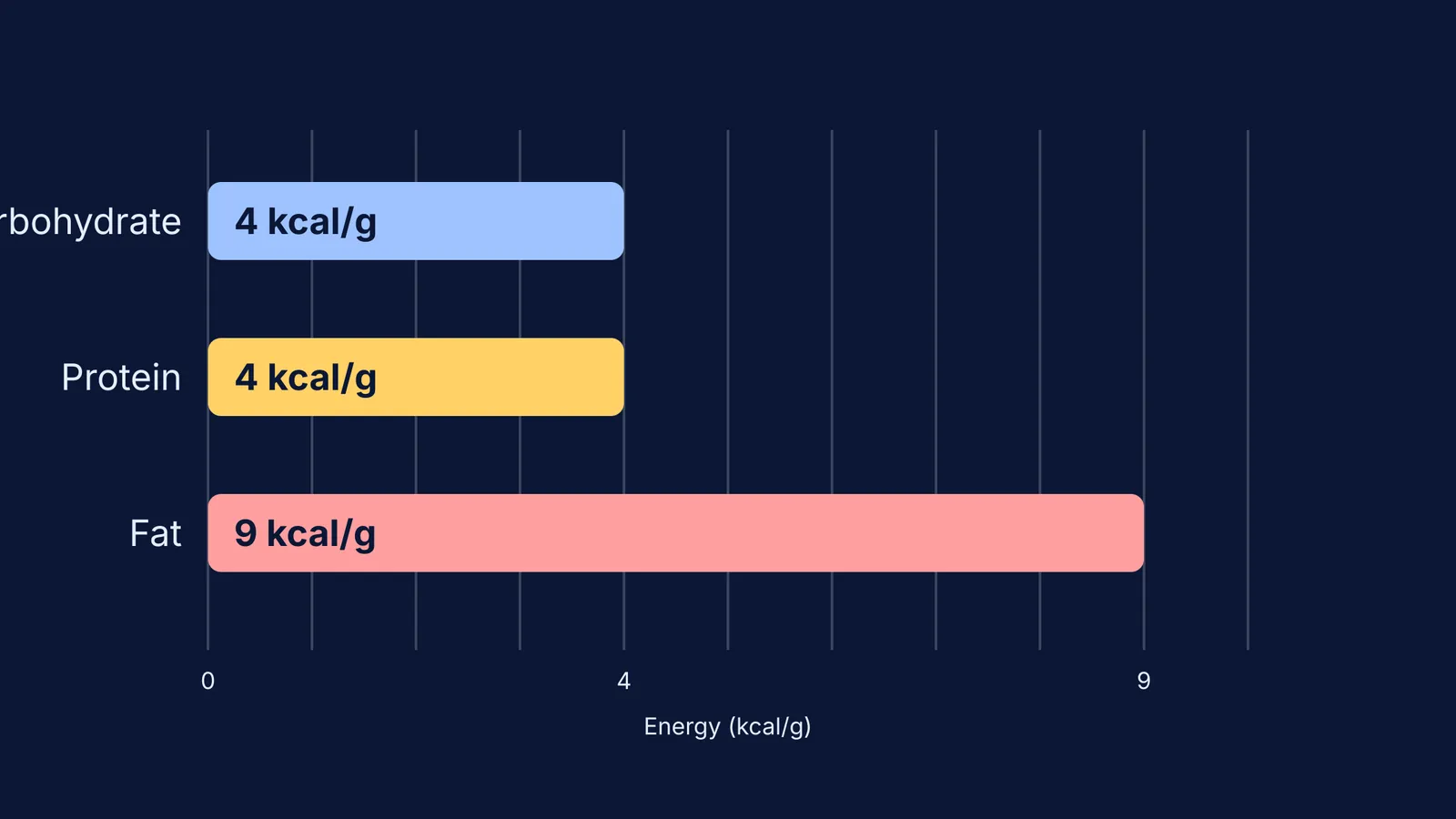
Through his rigorous experiments, Atwater determined average values for the metabolisable energy of the three main macronutrients. This became known as the Atwater system, and it established the famous 4-9-4 rule used worldwide today.
The Atwater system assigns a value of 4 kilocalories per gram (kcal/g) to carbohydrates. It assigns a value of 4 kcal/g to proteins. It assigns a value of 9 kcal/g to fats (lipids).
Because fat has a higher proportion of carbon and hydrogen atoms and less oxygen than carbohydrates and proteins, it releases more energy when oxidised. Note that in nutritional contexts, the word "Calorie" with a capital C (or kilocalorie) is used, which is equivalent to 4.184 kilojoules (kJ).
The original Atwater values are averages. Later, scientists Annabel Merrill and Bernice Watt at the USDA refined his work to create the Modified Atwater system. They recognised that proteins, fats, and carbohydrates from different sources are digested differently. For instance, the fibre in carbohydrates is largely indigestible by human enzymes and contributes very little energy, which is why dietary fibre is often handled differently when calculating net calories. Despite these modern refinements, Atwater's foundational 4-9-4 rule is remarkably accurate for general purposes.
How to calculate the energy in a meal?
You can use Atwater's 4-9-4 values (derived from the Atwater system) to estimate the calories in any meal if you know its macronutrient breakdown.
Imagine a hypothetical snack that contains 15 grams of carbohydrates, 5 grams of protein, and 10 grams of fat.
Carbohydrates: 15 g × 4 kcal/g = 60 kcal
Protein: 5 g × 4 kcal/g = 20 kcal
Fat: 10 g × 9 kcal/g = 90 kcal
Total energy = 60 + 20 + 90 = 170 kcal
This simple addition is exactly how modern nutrition labels are calculated. The 4-9-4 rule remains the most practical way to understand where your food energy comes from.
Read more about the history and chemistry of metabolism:


