On this page
If you eat a 500 g meal, do you gain 500 g? Not for long. Some mass leaves you in ways you cannot see. Santorio Santorio, a physician in Padua around 1600, set out to measure that hidden loss by weighing himself on a giant scale. This post covers what he built, what he found, and the physics and arithmetic behind his method.
Who was Santorio Santorio?
An article in the American Journal of Nephrology by Garabed Eknoyan calls Santorio, also known as Sanctorius (1561–1636), a founding father of metabolic balance studies. Eknoyan notes that he published Ars de statica medicina in 1614, three years after becoming Professor of Theoretical Medicine at Padua, and that he designed instruments to measure pulse, temperature and humidity at the bedside.
One of those, the pulsilogium, is described by Bigotti and Taylor as the first precision instrument in the history of medicine. It was first mentioned in 1602 by a colleague in Padua, and may have influenced Galileo. Santorio promised a book on his instruments but never wrote it.
What was the weighing chair?
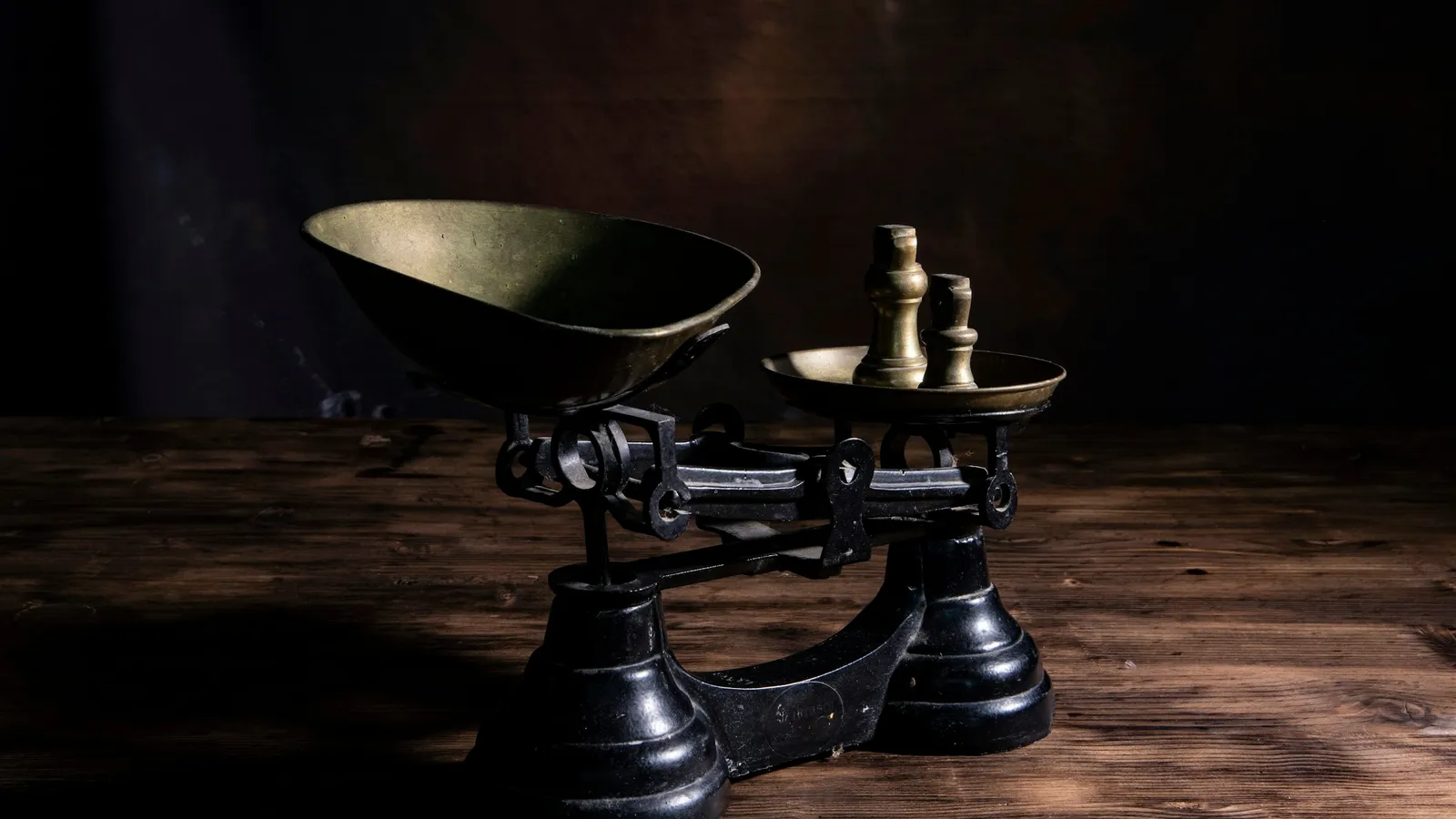
A 2018 study by Teresa Hollerbach, part of a project at the Max Planck Institute for the History of Science, rebuilt the chair and tested it. Santorio described it in a 1625 commentary on Avicenna. It was a chair hanging from one arm of a large Roman steelyard, a beam balance with a counterweight, fixed to the ceiling beams above a dining room. He hid the steelyard in the beams, he wrote, partly because unusual things look ridiculous to the ignorant.
The chair hung about a finger's height off the floor. While eating, the sitter watched it sink; when it reached a set mark, he knew he had taken the right amount of food. Weighing food, drink and wastes over time let Santorio estimate the perspiratio insensibilis, the insensible perspiration: mass lost without being seen.
In a 1615 letter to Galileo, Hollerbach notes, he said he had run the experiments for 25 years. His detailed records are lost, as Eknoyan points out; only his conclusions survive, as short aphorisms in the 1614 book.
Worked example 1: the mass balance
Sample numbers for practice. Over one day, a person takes in 3.0 kg of food and drink. Urine and faeces together weigh 1.8 kg. Next morning their body mass is 0.1 kg higher.
Unseen loss = intake − visible losses − gain = 3.0 − 1.8 − 0.1 = 1.1 kg.
In modern terms, much of that is water evaporating from the skin and lungs, plus carbon dioxide breathed out after food is broken down in respiration. Santorio had no chemistry for this, but his balance sheet showed that the loss was real and large.
Worked example 2: why small changes were hard to read
A steelyard balances by moments: load × its distance from the pivot = counterweight × its distance from the pivot. Hollerbach's team used a 20 kg counterweight. Take sample values: person and chair together are 80 kg, hanging 10 cm from the pivot.
Balance: 80 × 10 = 20 × x, so x = 40 cm.
After a loss of 0.5 kg: 79.5 × 10 = 20 × x, so x = 39.75 cm.
A half-kilogram change moves the balance point only 2.5 mm.
That matches the team's report that, with their 20 kg counterweight, minor weight differences were very hard to read along the beam.
Common mistakes to avoid:
Forgetting the body-weight change in the balance sheet.
Assuming old units are fixed. Hollerbach notes that Santorio's pound, the libra, varied between Italian states; the Roman libra was 327.45 g.
Using mass on one side and weight on the other. Use the same quantity on both sides; g cancels.
For more on moments, see our guide to torque and equilibrium problems.
What can a student take from Santorio's way of working?
Santorio took something everyone ignored, the daily rise and fall of body weight, and measured it again and again for decades. He also built his own instruments when none existed, as Daniel Fahrenheit later did for temperature; read our post on Fahrenheit and the thermometer.
In a lab practical, the same idea applies: a single reading proves little, but a long, careful series shows a pattern. If moments and balance problems still trip you up, the Fermi Problem Library has worked problems with a step-by-step solver that explains the reasoning.
Next step: redo worked example 2 with a 10 kg counterweight and see how far the balance point moves for the same 0.5 kg loss.